
✦ AI Summary
Table of Content
▲
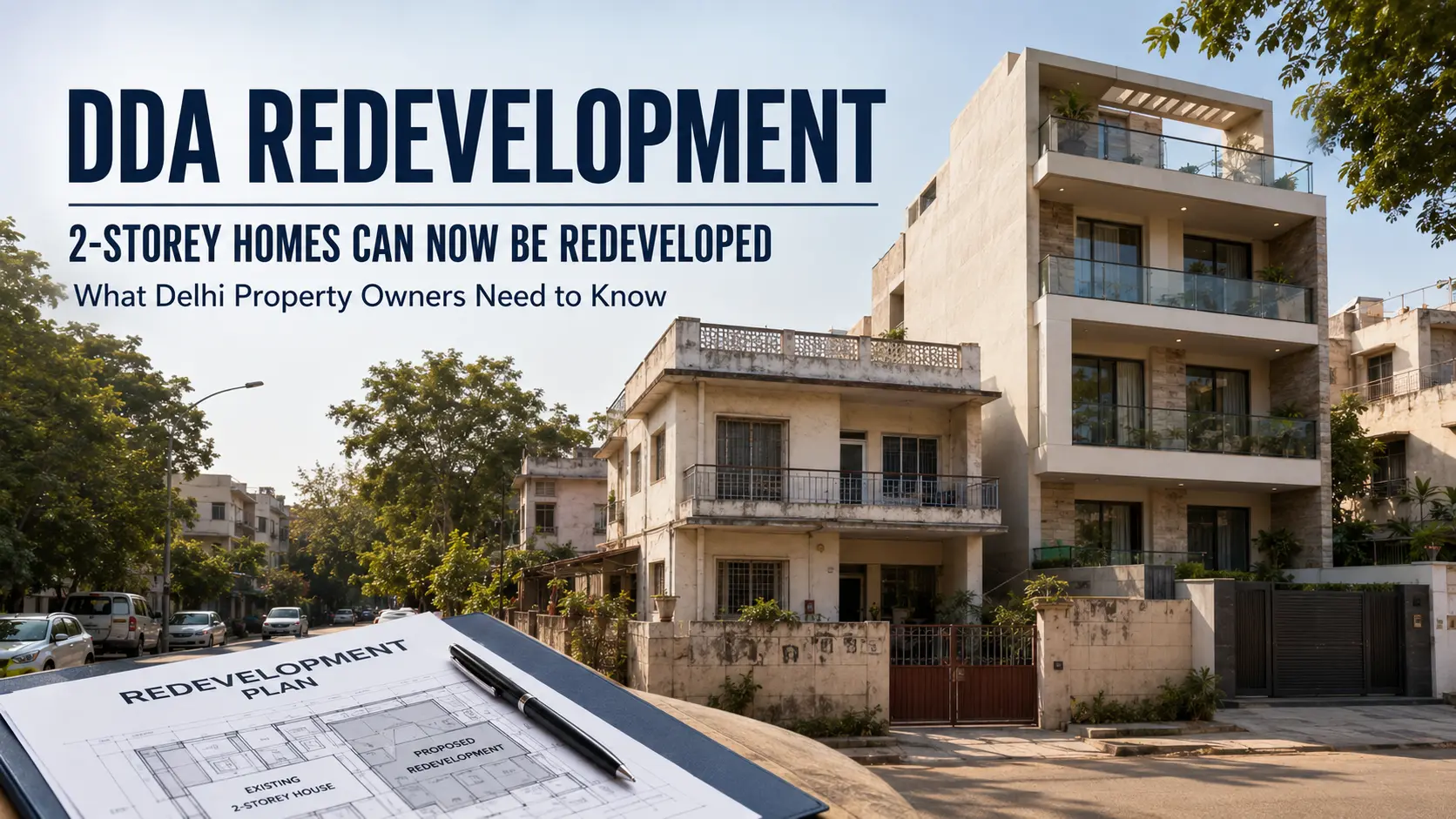
The Delhi Development Authority has approved a policy allowing the reconstruction and redevelopment of old two-storey dwelling units built on individual plots in older housing schemes.
The decision is significant for owners of ageing DDA homes, many of which were developed decades ago under the Master Plan for Delhi 1962. Several such properties are now more than 50 years old and, according to the DDA, some have become structurally deficient.
Until now, there was a gap in the redevelopment framework. Vacant residential plots had defined redevelopment provisions, while built-up two-storey DDA units on individual plots did not have a uniform policy. The new decision seeks to put these older homes on a similar footing to vacant residential plots for redevelopment purposes.
For homeowners, that could change how these properties are viewed. An ageing two-storey house will no longer have to be considered only as an existing structure that needs repair or alteration. Subject to the applicable rules, it can now be considered for reconstruction.
Which DDA homes are covered?
The policy is aimed at old two-storey dwelling units constructed by the DDA on individual plots in older housing schemes.
Many of these homes were developed under planning norms that date back several decades, forming part of Delhi’s older DDA housing schemes. Their layouts and construction standards reflect the needs of the time, while the requirements of today's households are very different.
The DDA's decision extends the redevelopment policy to similarly placed schemes across Delhi. Reports have specifically mentioned older schemes such as Naraina Vihar as examples of the type of housing covered by the move.
It is worth stressing that the policy does not mean every two-storey DDA property can immediately be rebuilt without restrictions. The property will still have to comply with the relevant development controls and building regulations.
What the new policy changes
- Old eligible two-storey DDA units can be considered for reconstruction and redevelopment.
- Built-up two-storey units receive redevelopment rights comparable to vacant residential plots under the applicable framework.
- The policy covers older housing schemes with similarly placed properties.
- Redevelopment will remain subject to applicable planning and building regulations.
- Owners will still need the necessary approvals before starting construction.
Why this matters to Delhi property owners
For many owners, the biggest change is the additional choice.
An old house can require repeated repairs, electrical upgrades, plumbing work and structural maintenance. In some cases, spending money on the existing building may not make much sense if the structure itself has reached the end of its useful life.
Property redevelopment in Delhi offers a different route: replace the old structure with a new one, while making use of the development potential available under current rules.
That could also allow homes to be designed around present-day requirements such as better parking, improved layouts, modern kitchens and bathrooms, and more efficient use of floor space.
The exact construction potential, however, will vary from property to property.
What role does FAR play?
For anyone considering redevelopment, Floor Area Ratio (FAR) will be one of the most important terms to understand.
FAR broadly determines how much floor area can be constructed in relation to the size of a plot. A property owner therefore cannot simply assume that replacing an old two-storey house will allow unrestricted additional construction.
Other factors also come into play, including setbacks, ground coverage, road width, parking, height and the applicable development controls.
DDA's redevelopment framework has provisions for incentives on individual plots. Under the applicable redevelopment provisions in MPD 2021, a maximum overall FAR incentive of 50% above the existing permissible FAR was provided for qualifying individual plots, subject to the prescribed ceiling and other conditions.
That provision should not be interpreted as a guarantee that every newly eligible two-storey dwelling unit will receive the same construction potential. The rules applicable to the specific property will determine what can actually be built.
|
Factor |
Why it matters in redevelopment |
|
Plot size |
Determines the base development potential |
|
Permissible FAR |
Determines the allowable floor area |
|
Road width |
Can affect applicable development controls |
|
Setbacks |
Restrict the area available for construction |
|
Parking |
Must meet the applicable requirements |
|
Building height |
Remains subject to planning and safety rules |
|
Existing title |
Establishes the owner's legal rights over the property |
|
Approvals |
Required before redevelopment begins |
Will owners be able to simply demolish and rebuild?
Not automatically.
The DDA's decision creates a redevelopment framework; it does not remove the approval process.
An owner considering reconstruction will need to establish that the property falls within the policy and then determine the applicable building and planning requirements.
This makes professional planning advice particularly useful before demolition.
A property owner should first examine the title documents, sanctioned plan, plot dimensions and existing construction. The road width and applicable zoning or development controls should also be checked because these can affect the design and permissible built-up area.
In other words, the redevelopment right is an opportunity, not a free pass to construct without restrictions.
What should owners check before redevelopment?
The decision could encourage more owners to look at redevelopment as a financial and practical option. But the numbers need to work.
Construction costs, architect and consultant fees, approval-related expenses and the cost of living elsewhere during construction can all add to the budget.
Owners should therefore assess the project before committing to demolition.
A basic due-diligence checklist would include:
- Verify the ownership and title documents.
- Check the original sanctioned plan.
- Confirm the plot dimensions.
- Establish the existing and permissible FAR.
- Check road width and setback requirements.
- Understand parking requirements.
- Confirm applicable DDA building regulations.
- Obtain a redevelopment plan from a qualified architect.
- Calculate the total construction and temporary accommodation cost.
The DDA publishes planning policies and guidelines covering redevelopment and development controls, which can be used alongside the applicable building regulations when assessing a property.
Could the move affect Delhi's older housing stock?
The policy fits into a broader effort to make better use of land that is already part of Delhi's urban fabric.
Many older DDA housing schemes occupy established neighbourhoods with roads, markets, schools and other infrastructure already in place. Rebuilding ageing structures in these areas can improve the housing stock without creating an entirely new residential settlement.
The timing is also significant. The DDA has approved the Master Plan for Delhi 2047, which is intended to guide the city's development over the coming decades. The redevelopment policy for old two-storey units forms part of this wider shift towards changes in land use and development norms.
For the property market, the effect is likely to be more visible over time than immediately.
An older DDA house with a clear redevelopment pathway could become more attractive to an owner or prospective buyer than a similar property where redevelopment rights are uncertain. But actual value will still depend on location, plot size, road access, development potential and the cost of reconstruction.
What does the DDA decision mean for homeowners?
The practical significance is straightforward: eligible old two-storey DDA dwelling units now have a clearer route towards redevelopment.
For owners of ageing properties, that can mean an alternative to continuing with repairs and alterations.
For Delhi's urban landscape, it could gradually lead to newer housing structures replacing some of the city's oldest residential stock.
The next step for individual owners is not necessarily to start construction. It is to establish exactly what their property is entitled to under the new policy and current development regulations.
That distinction will matter. The redevelopment opportunity is wider, but the final size, design and cost of a new home will still depend on the rules governing each property.
More About Real Estate

_1792140859.webp)


_1792151285.webp)
Ans 1. The policy covers eligible old two storey DDA dwelling units built on individual plots in older housing schemes. Owners should confirm that their particular property falls within the applicable DDA redevelopment provisions before beginning the process.
Ans 2. No. The DDA redevelopment decision provides a framework for eligible properties, but owners still need to comply with planning, building and approval requirements. Before demolition, they should verify the property's title, sanctioned plan, development controls and permissible construction.
Ans 3. Not automatically. Redevelopment does not guarantee additional floors. The permissible construction will depend on FAR, plot size, road width, setbacks, parking, building height and other applicable DDA regulations.
Ans 4. FAR, or Floor Area Ratio, determines the amount of floor space that can generally be constructed in relation to the plot area. A higher permissible FAR can provide greater construction potential, but other restrictions such as setbacks, parking and building height can also affect the final design.
Ans 5. It could increase the appeal of some eligible DDA properties because redevelopment potential can make an ageing property more useful and attractive to buyers. However, the effect will vary by location, plot size, permissible construction, road access and redevelopment costs. The policy does not guarantee a rise in property prices.
Ans 6. Owners should check their title documents, sanctioned building plan, plot size, permissible FAR, road width, setbacks, parking requirements and applicable DDA building regulations. They should also calculate construction and temporary accommodation costs before deciding whether redevelopment is financially viable.