
✦ AI Summary
Table of Content
▲
Most home gym articles tell you to "use rubber flooring" and move straight to equipment lists. That advice is incomplete in a way that matters specifically in Indian apartments: the wrong flooring thickness doesn't just risk your own tiles; it can transmit impact noise straight through to the flat below. Getting the fundamentals right flooring, space, and ventilation matters more than any equipment choice, and it's where most home gym planning in India actually goes wrong.
The Flooring Rule Every Apartment Owner Should Know
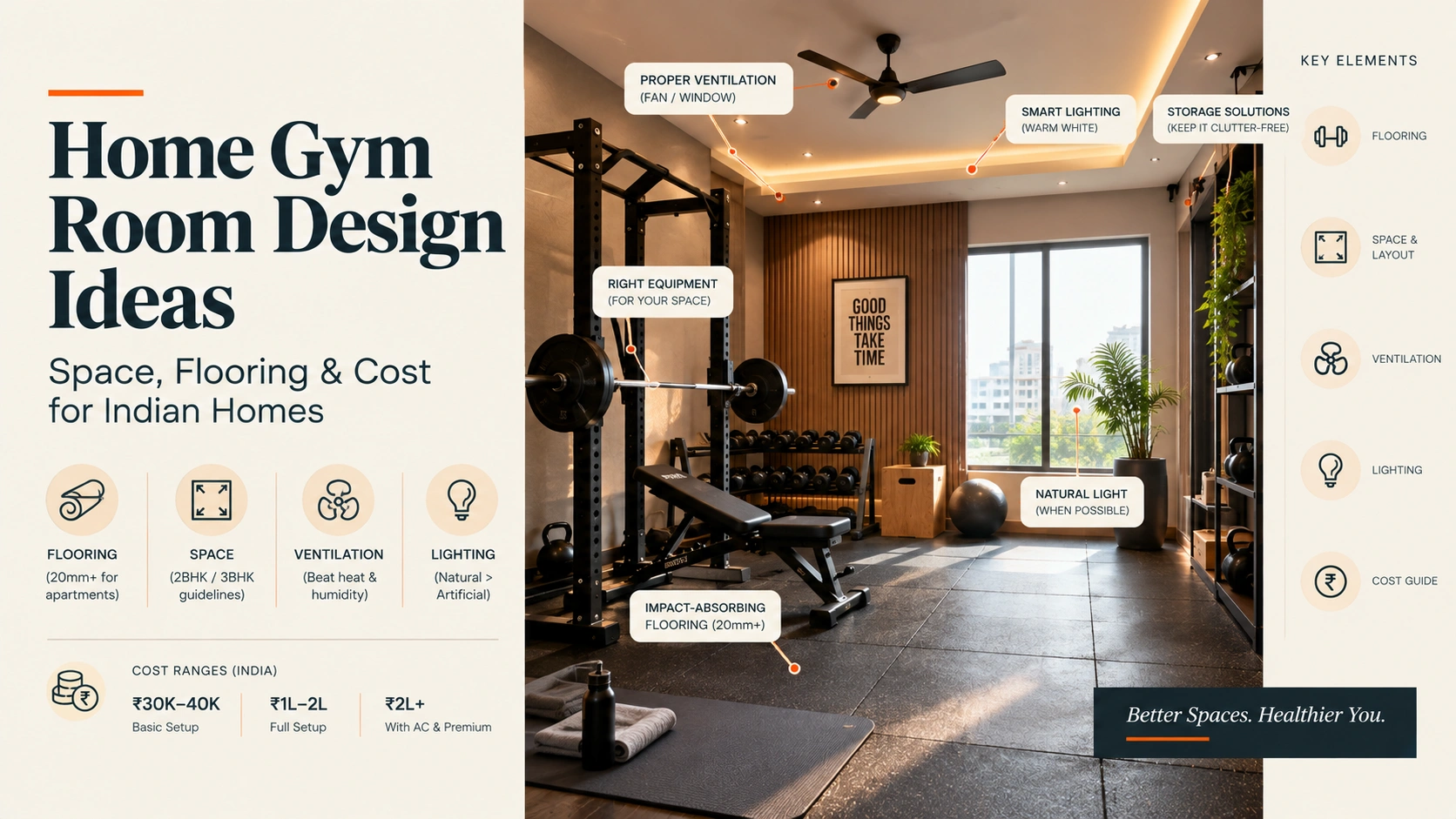
For any barbell or dumbbell floor work in a high-rise flat, 20mm rubber flooring is the non-negotiable minimum. This isn't just about protecting your own tiles; it protects the building slab and absorbs impact that would otherwise transmit directly to the unit below you, a genuinely common source of neighbour disputes in Indian apartment buildings that most gym-design content doesn't mention at all. Thinner mats, the kind commonly sold as basic "yoga and exercise mats," are fine for bodyweight work and stretching but don't provide adequate impact absorption for dropped weights or heavier compound lifts. For a broader look at flooring choices for Indian homes, see our guide to floor carpet designs for home.
This concern applies specifically to high-rise apartment living. In independent houses and older buildings, common in cities like Hyderabad, Jaipur, Ahmedabad, Nagpur, and Coimbatore, a covered terrace is genuinely one of the best home gym environments available good ventilation, natural light, and no floor below to worry about worth considering seriously if you have one, rather than defaulting to an indoor room.
How Much Space Do You Actually Need?
Real numbers, tied to actual Indian home types, are more useful here than a generic "clear some floor space" suggestion:
- A 2BHK spare room at 100–150 sq ft comfortably supports adjustable dumbbells, an FID (flat-incline-decline) bench, a mat, and resistance bands, a genuinely complete strength setup without needing a rack.
- A 3BHK spare room at 150–200 sq ft opens up space for a compact power rack and barbell setup, though this needs careful layout planning rather than simply fitting the rack wherever it happens to leave the most floor space.
- Ceiling height of 9–10 feet works for most rack units, but this needs verifying before buying anything with an integrated pull-up bar, since a rack that looks compact in a showroom photo can be too tall for a standard Indian apartment ceiling.
- A 7.2 ft Olympic barbell needs roughly 8 ft of lateral clearance, wall to wall, to actually be usable without hitting furniture or a doorframe mid-lift.
Even smaller than this works for a genuinely functional setup a 6×6 ft area is enough for a focused bodyweight and light-equipment routine. The goal isn't maximum space; it's matching your equipment ambitions honestly to the space you actually have before you buy anything. If you're creating the gym within a shared living area, you can also explore our simple Indian middle class living room ideas for ways to keep the space functional without making it feel overcrowded.
Ventilation and Lighting for India's Climate
Airflow planning matters more in most of India than it would in a drier Western climate, since poor ventilation becomes a genuinely bigger problem during summer months and in humid coastal cities specifically. A dedicated exhaust fan or a window that actually opens, not just a sealed AC unit, makes a real difference to how usable the space feels during an intense workout in peak summer heat. Where climate control is added, the budget for it as its own line item air conditioning and proper ventilation together commonly runs ₹1–2 lakh, a meaningful addition on top of the room and equipment cost.
Natural light, where available, is worth prioritising over relying purely on artificial lighting. If your gym depends on windows for airflow, choosing the right openings can make a significant difference. Our guide to UPVC windows with in-built mosquito mesh covers ventilation-focused window options for Indian homes. A room with a window genuinely feels more usable day-to-day than an enclosed, artificially lit space, which matters more for whether you'll actually keep using the gym than most equipment choices do.
Double-Duty and Small-Space Setups
Most Indian homes don't have a genuinely spare room to convert, which makes the double-duty setup the realistic path for most readers, not a compromise. Gym-and-home-office combinations are common, as are guest-bedroom and balcony hybrids. For more ideas on making limited rooms work harder, explore our guide to best interior upgrades for apartments. Before committing equipment to a shared space, check lighting, ventilation, temperature, and electric supply for that specific corner, since a balcony that feels fine for a chair and plants may not have adequate airflow or space once a bench and rack are added.
If you're planning to use the space for yoga, aerobics, or other movement-based activities alongside strength equipment, think through this before finalising your equipment plan: a cluttered room with too much fixed equipment defeats the purpose for activities that need open floor space to move.
What Does a Home Gym Actually Cost?
Costs scale with ambition, and it's worth knowing where the real jumps happen. A basic strength setup, adjustable dumbbells, resistance bands, a mat, and a pull-up bar typically runs ₹30,000–40,000, and is genuinely enough for a serious beginner-to-intermediate routine. A fully equipped gym, including flooring, ventilation, and lighting, typically runs ₹1–2 lakh, and adding proper climate control (air conditioning) on top can add another ₹1–2 lakh. Beyond this, cost is driven mainly by machine quality (premium cardio equipment, full power racks, cable machines) rather than the room itself.






Ans 1. 20mm rubber flooring is the recommended minimum for any barbell or dumbbell floor work in a high-rise, since it protects the building slab and absorbs impact that would otherwise be transmitted to the flat below.
Ans 2. A 2BHK spare room of 100–150 sq ft comfortably fits dumbbells, a bench, a mat, and bands. A 3BHK spare room of 150–200 sq ft can fit a compact rack and barbell setup with careful layout planning. Even a 6×6 ft corner works for a focused bodyweight routine.
Ans 3. It can, if the flooring is inadequate. Thin exercise mats don't absorb enough impact for dropped weights; 20mm rubber flooring specifically is designed to prevent noise and vibration transmitting to the unit below.
Ans 4. 9–10 feet works for most rack units, but always verify against the specific rack's height before buying, especially if it includes an integrated pull-up bar.
Ans 5. Yes, double-duty spaces (a home office, guest bedroom, or covered balcony) are the realistic setup for most Indian homes. Check lighting, ventilation, and electric supply for that specific corner before committing equipment to it.
Ans 6. A basic strength setup with adjustable dumbbells, bands, and a mat runs roughly ₹30,000–40,000. A fully equipped gym with flooring, ventilation, and lighting typically costs ₹1–2 lakh.
Ans 7. Yes, particularly for independent houses in cities like Hyderabad, Jaipur, Ahmedabad, Nagpur, and Coimbatore, a covered terrace offers good ventilation and natural light and avoids the impact-noise concern that applies to high-rise flats.