
✦ AI Summary
Table of Content
▲
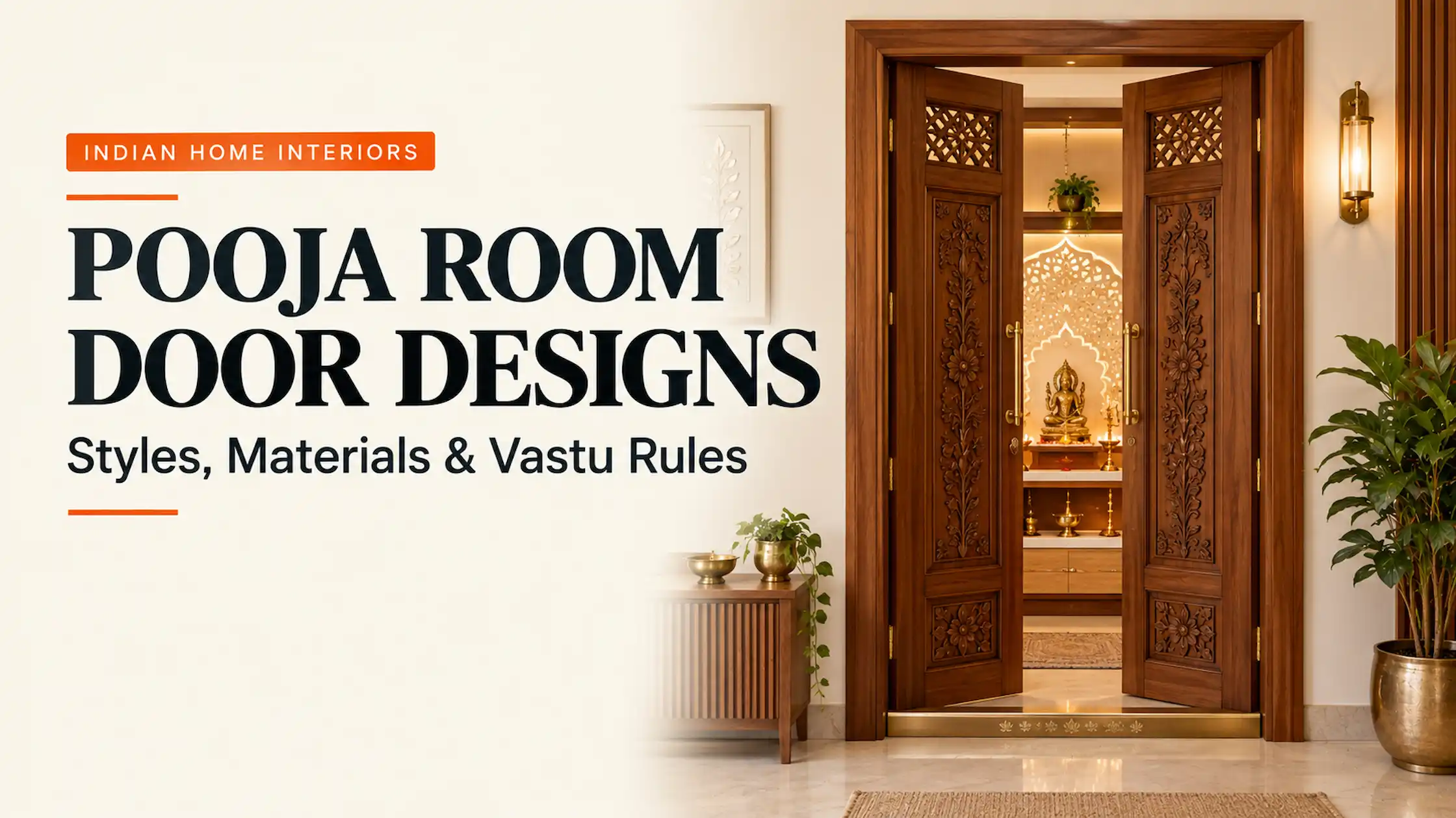
A pooja room door does two jobs. It marks the edge of a sacred space, and it has to look right beside the mandir. Most designs start from the same tradition and then vary in carving, material and finish.
Pooja room door Vastu advises two-shutter doors in good-quality wood, with a threshold. Everything below builds on that, with styles for traditional homes, compact flats and modern layouts. If you are still planning the wider prayer space, explore our ideas for 11 modern pooja room designs to beautify your sacred space.
What a pooja room door usually includes
The double-leaf door has two equal leaves opening outward, and an even number of leaves is preferred in Vastu. A raised threshold, or dehleez, marks the boundary of the sacred space. It is also said to keep insects out.
Wood is the default. A wooden door is considered a Vastu-compliant material and comes in teakwood, rosewood and other varieties. The most preferred pooja room doors are wooden with two shutters opening outwards.
Pooja room door designs to consider
|
Design |
What it looks like |
Works best for |
|
Carved solid wood |
Floral or temple motifs on teak or rosewood |
Independent houses, traditional interiors |
|
Brass-accented wood |
Brass cladding, inlay or studs on a wooden leaf |
Homes that want a temple-gate feel |
|
Jaali or lattice |
Pierced wood or metal panels |
Rooms that need airflow and light |
|
Framed glass |
Etched or tinted glass inside a wooden frame |
Modern homes wanting visibility |
|
Painted door |
Hand-painted motifs on panels |
Colourful or heritage-style interiors |
|
Sliding or foldable |
Shutters that slide or fold away |
Small flats with no swing space |
|
Plain panel door |
Plywood or laminate panels, minimal detail |
Budget or minimalist homes |
Styles available include lattice, painted, jaali, foldable and doors with hanging bells. Carved teak, jaali, glass with mantra etching and brass-clad styles are all in common use. A wooden door with a metal jali panel is another option, blending wood’s warmth with metal detailing.
Choosing for your space
In a compact flat, the door’s swing can eat into the room. A sliding or pocket door saves the swing arc where floor space is tight. A foldable door does something similar.
For more inspiration on space-saving prayer corners, see our 10 simple mandir designs for middle-class Indian homes. These ideas can help you coordinate the door with the mandir unit, storage and available wall space.
Consider the room’s size and layout, the material and finish for your budget, and how much privacy and ventilation you want. A jaali panel gives airflow while still screening the mandir. A solid carved door gives full privacy but keeps the room closed.
Lighting also affects how the door and its carvings appear. For ideas on coordinating the upper part of the prayer space with the door and mandir, see our pooja room ceiling design ideas.
For a first-time buyer on a budget, a simple plywood panel door with a threshold meets the tradition. Spend the money on the mandir and the lighting rather than the door.
Vastu rules that affect the door
These are traditional guidelines, not building regulations.
- Location: Vastu recommends north-east, north or east for the pooja room. Doors and windows of the room should ideally open towards the east or north.
- Ceiling: A pooja room should have a lower ceiling than the rest of the house.
- Idol and worshipper: Idols should face west or east, so the person praying faces east or north.
- Avoid: Sharing a wall with a bathroom, being under a staircase, being inside the master bedroom, and the south-west corner. Some Vastu guidance also advises against locating it next to the kitchen.
- Size: One builder’s guide gives a minimum pooja room size of 5 ft by 7 ft, though a corner mandir works in small homes.
For related traditional décor ideas around thresholds and auspicious symbols, read our article on Vastu decor ideas for your home entrance.
Where sources disagree
Glass doors. Some Vastu guides advise reserving full glass and metal-faced doors for other rooms and choosing a solid wooden two-shutter door. Design brands also promote glass doors. A framed glass panel inside a wooden door is a possible compromise.
Idol facing. Many sources say west or east. Some also allow south-facing idols with the worshipper facing north, while others say different deities have different preferred placements. If this matters to your family, ask your own pandit or Vastu consultant before fixing the layout.

_1792140859.webp)

_1792151285.webp)


Ans 1. A two-shutter wooden door with a threshold is the traditional choice.
Ans 2. Doors with two shutters opening outwards are commonly preferred in traditional Vastu guidance.
Ans 3. Yes, many designers use glass, although traditional guidance often prefers solid wood. Framed glass inside a wooden door is a middle path.
Ans 4. Vastu recommendations commonly favour the north-east, east or north, depending on the layout.
Ans 5. A sliding or pocket door saves the swing arc. A foldable door can also work.
Ans 6. Traditional Vastu advice commonly discourages placing it under a staircase, against a bathroom wall, inside the master bedroom or in the south-west corner.