
Table of Content
▲- Why Was Freehold Conversion Put on Hold?
- Why the Restart Is a Turning Point for Lutyens’ Delhi
- What Has Changed Under the New Conversion Policy?
- High-Value Transactions Likely to Be Unlocked
- Impact on Prices Across L&DO Colonies
- What Industry Experts Are Saying
- Government Revenue and Policy Implications
- Will This Change Make Lutyen's Delhi More Affordable?
- What Lies Ahead for Buyers and Sellers?
- Conclusion
The restart of leasehold-to-freehold conversion is expected to revive Lutyens Delhi property deals, unlocking more than 100 stalled high-value transactions that were put on hold due to regulatory uncertainty. With the Land and Development Office (L&DO) set to allow conversions based on Delhi government circle rates from January 1, 2026, clarity has returned to one of India’s most exclusive and tightly held residential markets.
Industry stakeholders believe this move will restore transaction momentum, improve liquidity, and support long-term price stability across Lutyens’ Delhi and select South Delhi micro-markets.
Why Was Freehold Conversion Put on Hold?
For over a year, Lutyens Delhi property deals faced significant disruption after the L&DO paused the issuance of no-objection certificates (NOCs) required for converting leasehold properties into freehold.
In July 2022, the L&DO instructed the Delhi government’s revenue department not to register properties under its jurisdiction without an NOC. Since most homes in Lutyens’ Delhi are leasehold, this effectively froze transactions in areas where individual deal values often exceed ₹50 crore.
As a result:
- Multiple marquee transactions were stalled
- Buyers deferred payments
- Government revenue from stamp duty and conversion charges declined
Also Read: DDA Towering Heights Phase 2 Launched: Flat Count, Price, Location, Dates
Why the Restart Is a Turning Point for Lutyens’ Delhi
The decision to restart conversions using Delhi government circle rates marks a critical inflection point for Lutyens Delhi property deals.
Previously, the lack of a clear calculation mechanism for conversion charges created uncertainty for both buyers and sellers. By linking charges to officially notified circle rates, the L&DO has introduced predictability into a market that thrives on transparency and compliance.
This change is expected to:
- Enable pending registrations to move forward
- Restore buyer confidence
- Improve deal execution timelines
What Has Changed Under the New Conversion Policy?
From January 1, 2026, conversion charges will be calculated using Delhi government circle rates rather than discretionary or unclear benchmarks.
Key changes include:
- Standardised conversion cost calculation
- Faster NOC approvals
- Reduced ambiguity in deal structuring
- Improved compliance across L&DO colonies
According to real estate consultants, this clarity was the single biggest missing piece affecting Lutyens Delhi property deals over the past year.
High-Value Transactions Likely to Be Unlocked
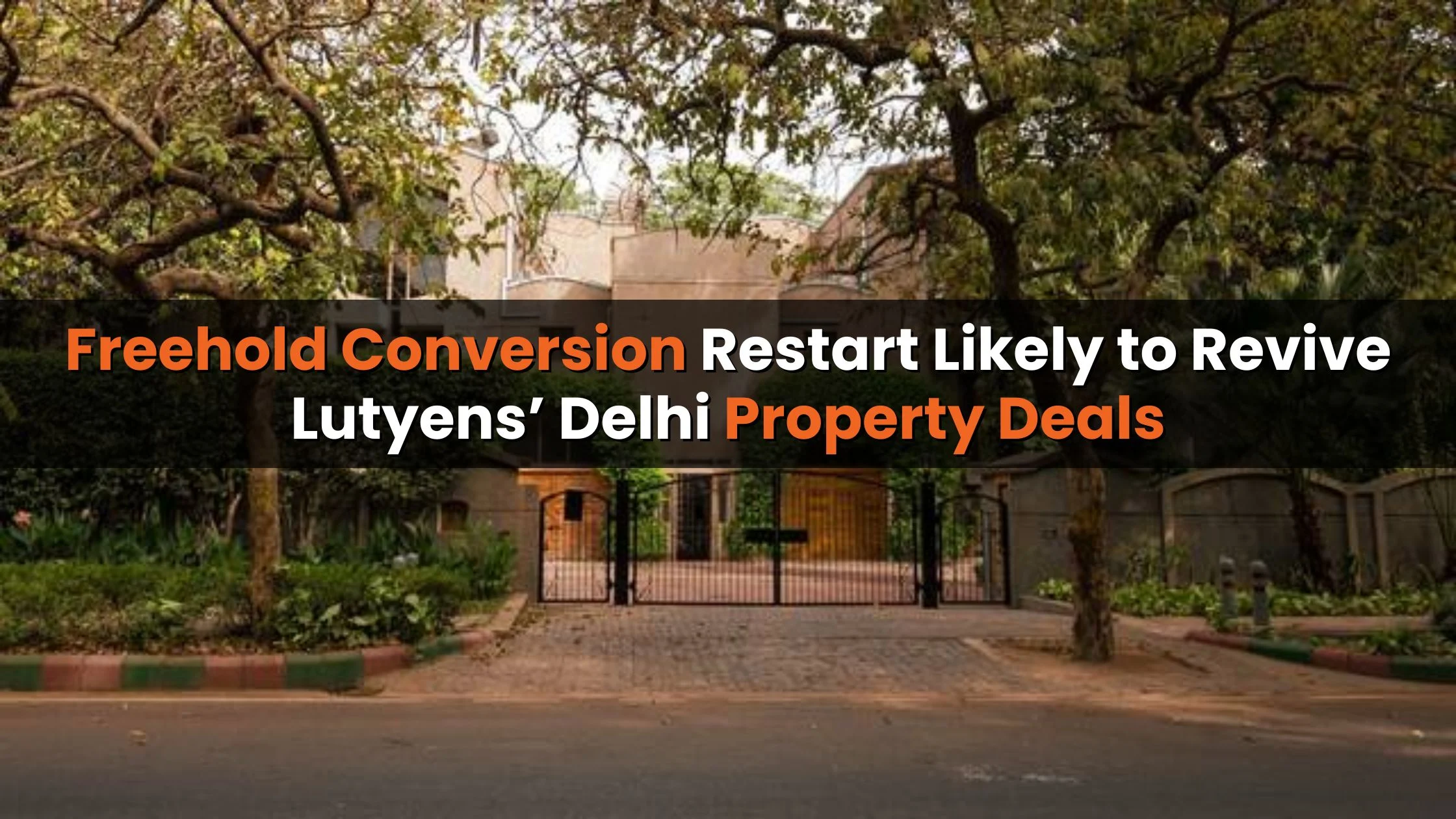
Among the most notable stalled transactions is the ₹1,100 crore-plus deal involving 17 York Road (now Motilal Nehru Road), once the official residence of India’s first Prime Minister, Jawaharlal Nehru.
Industry estimates suggest:
- Over 100 pending transactions could be registered in 2026
- Most deal sizes will range between ₹50 crore and ₹300 crore
- Ultra-high-value bungalow sales will dominate
These transactions were ready for closure but remained stuck solely due to the absence of L&DO approvals.
Impact on Prices Across L&DO Colonies
While the move is expected to boost liquidity, experts say it will not trigger sharp price appreciation in the short term.
Area-wise impact outlook:
|
Area |
Expected Impact |
|
Lutyens’ Bungalow Zone |
Price firmness due to scarcity |
|
Defence Colony |
Improved liquidity, price stability |
|
Jangpura |
Faster registrations |
|
South Delhi apartments |
Selective support, not a surge |
Pricing in Lutyens Delhi property deals continues to be driven primarily by land scarcity, ownership profile, and long-term capital preservation rather than short-term market cycles.
What Industry Experts Are Saying
Real estate leaders have welcomed the move as long overdue.
According to Amit Goyal, Managing Director (India), Sotheby’s International Realty, linking conversion charges to circle rates introduces much-needed predictability. He noted that several high-profile deals were stalled purely due to the absence of L&DO NOCs.
Boutique consultants echo similar views. Rohit Chopra, founder of SouthDelhiPrime.com, believes the move will first improve transaction liquidity, followed by gradual price stabilisation rather than sharp corrections.
Government Revenue and Policy Implications
The freeze on registrations resulted in significant revenue loss for both the Centre and the Delhi government due to:
- Uncollected freehold conversion charges
- Missed stamp duty income
With registrations resuming, authorities are expected to recover:
- Stamp duty collections
- Conversion fee arrears
- Property tax compliance
This also strengthens governance across nearly:
- 57,000 residential units
- 1,597 commercial units
- 1,430 institutional properties
- 110 industrial plots under L&DO jurisdiction
Will This Change Make Lutyen's Delhi More Affordable?
Despite improved clarity, experts caution that Lutyens Delhi property deals will remain firmly in the ultra-luxury category.
Key reasons:
- Extremely limited supply
- High entry barriers
- Prestige-driven demand
- Legacy ownership patterns
The policy improves execution and compliance not affordability.
Also Read: India’s Real Estate Sector Raises Rs 17,867 Crore via Capital Markets in FY26 YTD
What Lies Ahead for Buyers and Sellers?
While the decision is final, detailed standard operating procedures (SOPs) are still awaited. Once issued, market participants expect:
- Faster transaction closures
- Increased institutional interest
- Renewed global buyer attention
The restart also reinforces Delhi’s position as a preferred destination for ultra-high-net-worth residential investment in India.
Conclusion
The restart of freehold conversion marks a crucial reset for Lutyens Delhi property deals, clearing regulatory bottlenecks that stalled some of the country’s most valuable real estate transactions. By aligning conversion charges with Delhi government circle rates, the L&DO has restored confidence, improved transparency, and unlocked long-pending deals without distorting market prices.
As registrations resume in 2026, the move is expected to benefit buyers, sellers, and the exchequer alike while preserving the exclusivity and long-term value of Lutyens’ Delhi.






Ans 1. Freehold conversion allows leasehold properties in Lutyens’ Delhi to be converted into freehold, giving owners full ownership rights. This process requires approval from the Land and Development Office (L&DO) and typically involves paying conversion charges based on government guidelines.
Ans 2. Conversions were paused for over a year after the L&DO instructed the Delhi government’s revenue department not to register properties without a no-objection certificate (NOC). The lack of a clear mechanism for calculating conversion charges created regulatory uncertainty and stalled high-value transactions.
Ans 3. From January 1, 2026, conversion charges will be calculated using Delhi government circle rates, replacing discretionary benchmarks. This standardisation is expected to speed up NOC approvals, reduce ambiguity, and improve compliance across L&DO-administered properties.
Ans 4. The policy primarily benefits ultra-luxury bungalow transactions in the Lutyens’ Bungalow Zone, along with high-value residential properties in Defence Colony, Jangpura, and select South Delhi micro-markets. Pending deals that were frozen due to the absence of NOCs are likely to be unlocked.
Ans 5. The restart is expected to improve transaction liquidity, enable pending registrations to move forward, and restore buyer confidence. While it may not sharply increase prices, it ensures smoother deal execution and strengthens long-term price stability in Lutyens’ Delhi.
Ans 6. No. Despite improved regulatory clarity, properties in Lutyens’ Delhi remain ultra-luxury with extremely limited supply and high entry barriers. The policy improves transparency and execution but does not reduce the high cost of ownership.
Ans 7. Resuming freehold conversions will help the Centre and Delhi government recover uncollected conversion charges, stamp duty, and improve property tax compliance across thousands of residential, commercial, institutional, and industrial units under L&DO jurisdiction.
Ans 8. Once detailed standard operating procedures (SOPs) are issued, market participants can expect faster transaction closures, renewed institutional and global buyer interest, and a more predictable legal and financial framework for ultra-high-value property deals in Lutyens’ Delhi.