
✦ AI Summary
Table of Content
▲
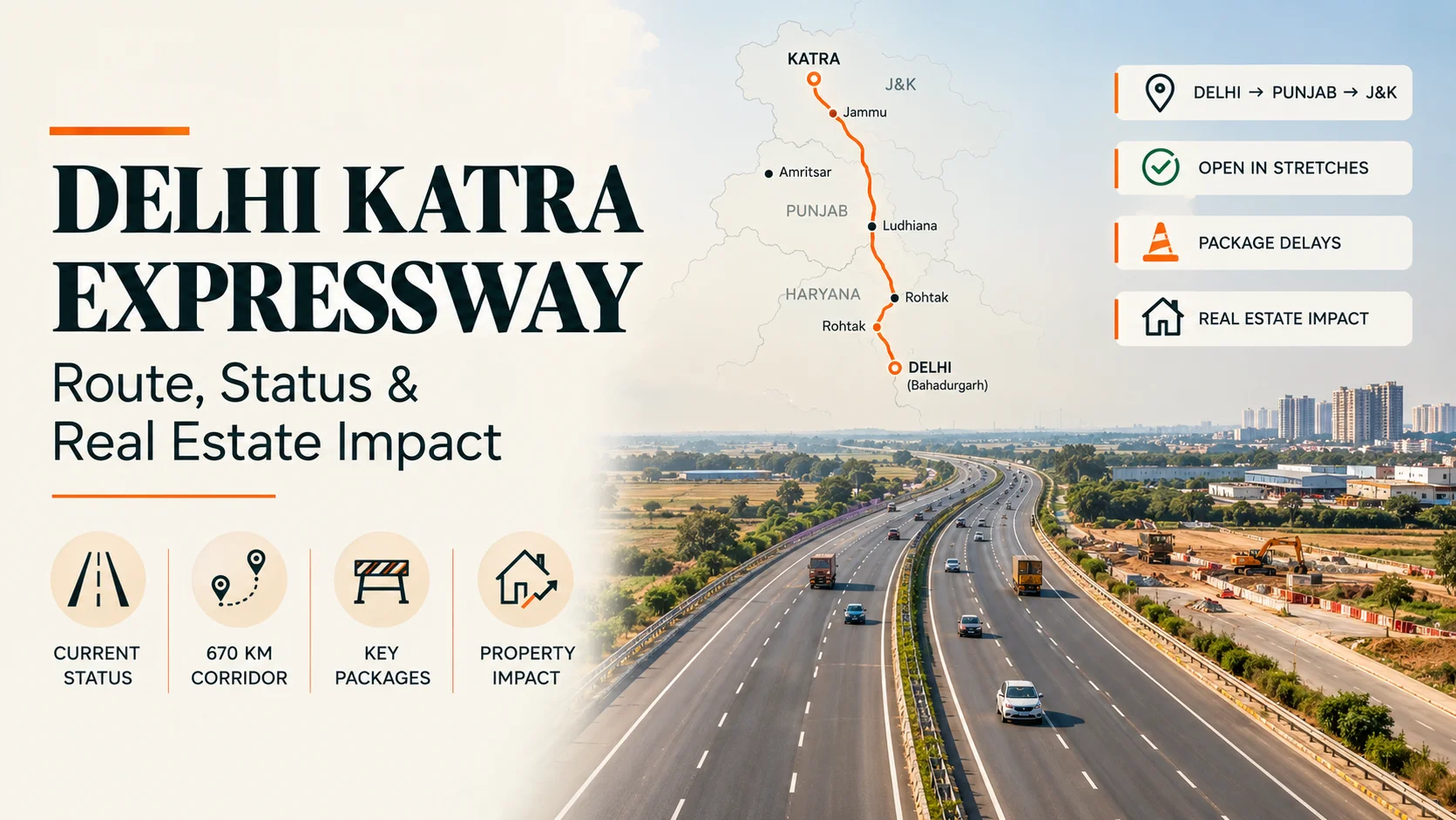
A meaningful stretch of the Delhi-Amritsar-Katra Expressway is genuinely open but the fuller picture is less tidy than a lot of real estate marketing content suggests. Three Punjab construction packages were formally terminated by the National Highways Authority of India in 2026 over contractor non-performance and are now being re-tendered, and the project's original completion target has already slipped more than once. Here's the honest, current status, the route, and a properly sourced read on what it actually means for property along the corridor.
What's Actually Open, and What's Genuinely Delayed
On 10 July 2026, the government formally inaugurated a roughly 158 km stretch (Packages 1-5) of the expressway. Separately, a section between Balsua and Raya, covering over 100 km across three packages in Punjab and Jammu & Kashmir, has been reported with physical progress between 85% and 95%, and the Devak bridge near AIIMS Vijaypur is already carrying traffic.
That's genuine progress. The delays are just as real. The project's completion target has moved repeatedly from an earlier goal, to December 2026, and current estimates from mid-2026 reporting mostly point to 2027 or 2028 for full completion. The clearest, most current explanation for this: Punjab has been the genuine bottleneck. Three packages numbered 8, 10, and 11 were formally terminated by NHAI in 2026 due to contractor non-performance, with settlement payouts made, and are now being re-tendered. That's a materially different, more accurate picture than a simple "Punjab is 90% complete" summary, which several sites still repeat.
Toll collection has begun on the operational Haryana stretch using a boothless, FASTag-based RFID entry-slip system, similar to the existing KMP Expressway.
The Route, State by State
The expressway is roughly 670 km long (a small number of sources give a marginally different 669 km figure, close enough to treat as the same). It begins near the Kundli-Manesar-Palwal (KMP) Expressway at Bahadurgarh, on Delhi's border, and runs through:
- Haryana: Jhajjar, Rohtak, Sonipat, Jind, and Kaithal
- Punjab: Patiala, Sangrur, Ludhiana, Jalandhar, Kapurthala, and Gurdaspur, with a spur connecting to Amritsar's Sri Guru Ram Das Ji International Airport
- Jammu & Kashmir: entering via Kathua, then Samba and Jammu, before terminating at Katra, the gateway to the Vaishno Devi shrine
It's worth flagging that sources genuinely disagree on the lane count: some describe it as a 4-lane expressway expandable to 8, while others describe it as 6-lane, expandable to 8. Rather than state one figure with false confidence, both descriptions appear across otherwise credible sources, and it's worth confirming the exact specification for your specific stretch directly with NHAI if it matters to your decision.
Once complete, travel time from Delhi to Amritsar is expected to fall from roughly 8 hours to 4, and Delhi to Katra from roughly 12-14 hours (sources vary slightly on the current baseline) to around 6.
Real Estate Impact What's Real vs What's Marketing
This is where it's worth applying real scepticism to specific numbers you'll see quoted. One source claims land values near expressway interchanges will see 15-20% annual appreciation over the next five years, a large, specific, confident figure presented without a clear citation. Compare that against JLL India research, cited by a different source, which puts infrastructure-led appreciation along major highway corridors generally at 20-40% over a decade a considerably more modest and more credibly sourced figure, given JLL's standing as a recognised real estate research firm rather than a real estate marketing blog.
The honest takeaway: infrastructure corridors genuinely do drive real estate demand, through better connectivity, new logistics and industrial activity, and improved liveability near interchanges that part is well established, with the Yamuna Expressway between Delhi and Agra cited as a comparable precedent. But treat any specific, large annual percentage figure for this expressway specifically with real caution unless it's tied to a named, credible research source, and remember that appreciation from infrastructure projects is typically concentrated near interchanges and existing economic activity, not spread evenly across the entire 670 km corridor. Buyers and investors evaluating a corridor property should also compare entry cost, liquidity, rental potential, infrastructure delivery risk and legal due diligence using a broader real estate investment framework for 2026.
Towns Already Seeing Early Movement
Given the genuine timeline uncertainty for full completion, the more useful signal right now is which specific locations are already showing real activity rather than speculative corridor-wide claims:
Kundli and nearby Sonipat, already an established emerging real estate destination close to Delhi, is seeing rising demand for residential and industrial plots, aided by proximity to both Delhi and the KMP Expressway interchange.
Jind and Kaithal in Haryana are emerging specifically as logistics and warehousing hubs, driven by proximity to interchange points along the corridor, a genuinely different growth story from residential demand.
The Zirakpur and Chandigarh tricity corridor is being influenced by the 6-lane Zirakpur Bypass, designed to integrate directly with the expressway, with early effects already visible on tricity property prices.
For anyone evaluating a specific location along this corridor, checking the actual construction status of the nearest package, rather than a generic "Delhi Katra Expressway" completion date, is the more reliable way to judge how near-term the connectivity benefit genuinely is. Before buying land or property near an interchange, buyers should also complete a property title verification checklist, including ownership history, encumbrances, land records and applicable regulatory approvals.

_1792140859.webp)



_1792151285.webp)

Ans 1. Partially. A roughly 158 km stretch (Packages 1-5) was formally inaugurated on 10 July 2026, and a further section between Balsua and Raya has reported 85-95% physical progress, but the full 670 km corridor is not yet complete.
Ans 2. Most current estimates from mid-2026 reporting point to 2027 or 2028, after the original target slipped more than once. Three Punjab packages were formally terminated by NHAI in 2026 over contractor non-performance and are being re-tendered, a genuine cause of the delay.
Ans 3. It runs roughly 670 km from Bahadurgarh near Delhi, through Jhajjar, Rohtak, Sonipat, Jind, and Kaithal in Haryana, through Patiala, Sangrur, Ludhiana, Jalandhar, Kapurthala, and Gurdaspur in Punjab (with a spur to Amritsar), and through Kathua, Samba, and Jammu in Jammu & Kashmir, ending at Katra.
Ans 4. Treat that specific figure with caution as it comes from a source without a clear citation. A more credibly sourced estimate, citing JLL India research, puts infrastructure-led corridor appreciation generally at 20-40% over a decade, considerably more modest than an annual 15-20% claim.
Ans 5. Sources genuinely disagree, some describe it as 4-lane, expandable to 8, others as 6-lane, expandable to 8. Confirm the specific configuration for your stretch directly with NHAI if this matters to your decision.
Ans 6. Kundli and Sonipat near Delhi, Jind and Kaithal as emerging logistics and warehousing hubs, and the Zirakpur/Chandigarh tricity corridor, aided by the connecting Zirakpur Bypass, are the locations showing the clearest current movement.
Ans 7. The National Highways Authority of India (NHAI), under the Bharatmala Pariyojana infrastructure programme, is developing the project through a series of civil construction packages awarded to different contractors.