
✦ AI Summary
Table of Content
▲- The Corporate Engine: What's Actually Driving Gurgaon's Office Demand in 2026
- Case Study: How Return-to-Office Mandates Reshaped Gurgaon's Rental Market
- The Premium, Mature Corridors: Cyber City, Golf Course Road, DLF Phases
- The Emerging Value Corridors: Golf Course Extension Road, Sohna Road, New Gurgaon
- Rent by Corridor: A Comparative Snapshot
- How Tenant Profiles Differ by Corridor
- What to Watch: Infrastructure-Dependent Growth Corridors
- What This Means for Investors and Tenants
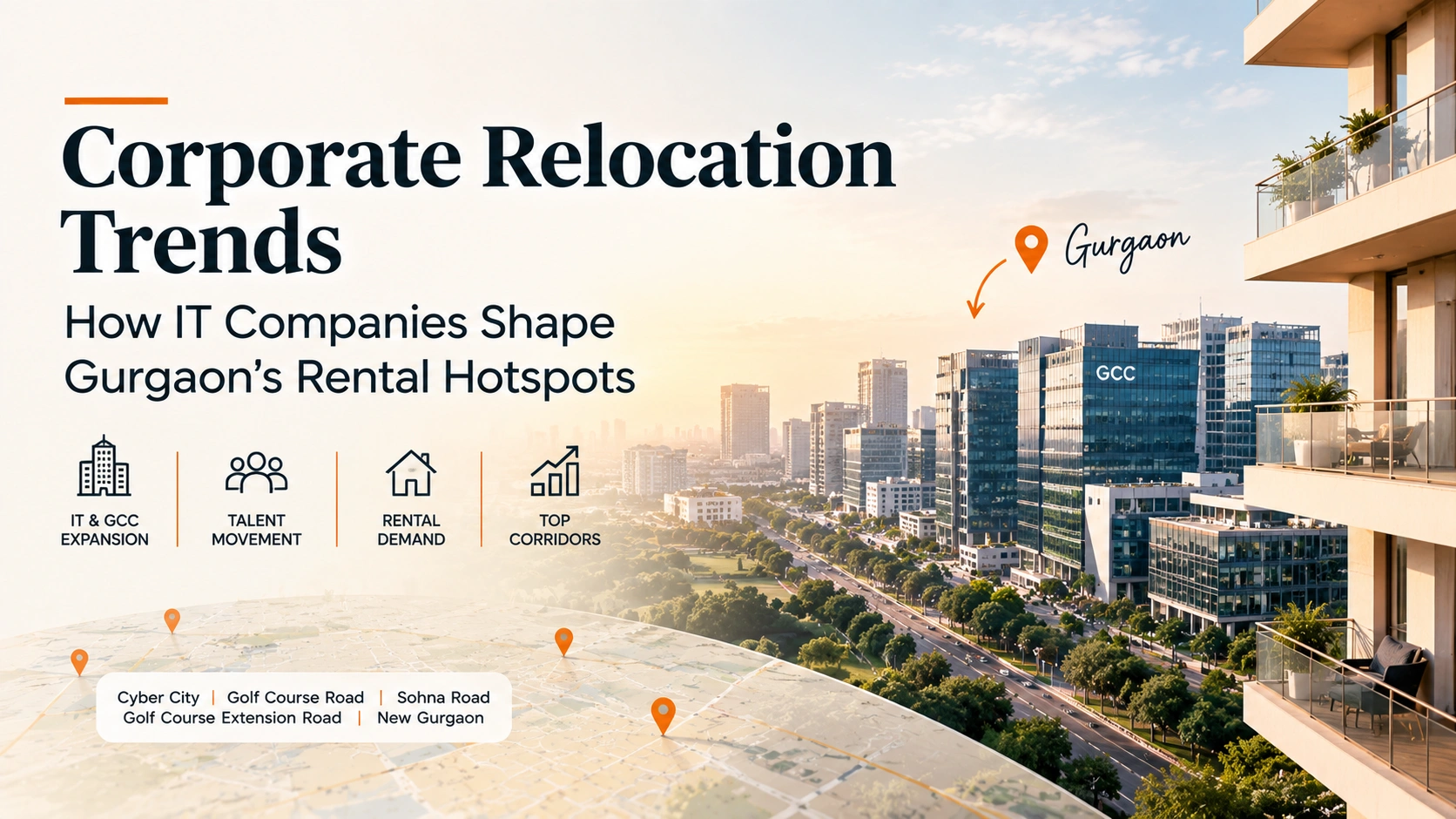
Gurgaon's rental market doesn't move uniformly. It moves in direct response to where corporate office demand concentrates, and the clearest proof of this came in 2022-2023, when corporations across Cyber City and Udyog Vihar ended their remote-work policies and called employees back within a roughly six-month window. Thousands of professionals needed housing near those specific corridors almost simultaneously, and rents in the immediate vicinity surged 20-35% as a direct result, a sharp, well-documented illustration of exactly the mechanism this topic is asking about. For a broader look at the city's rental investment pockets, see our guide to the best areas for PG and rental income in Gurugram.
This piece traces that mechanism in full: what's currently driving Gurgaon's office demand (Global Capability Centres, flex space growth, specific new developments), which residential corridors that demand actually spills into, how tenant profiles differ by corridor, and where the smarter forward-looking opportunities and risks currently sit.
The Corporate Engine: What's Actually Driving Gurgaon's Office Demand in 2026
Gurgaon hosts a genuinely dense concentration of corporate activity: major IT and technology firms (Infosys, TCS, Wipro, HCL Technologies, Accenture, IBM, Cognizant, Capgemini, Tech Mahindra), alongside a large and growing base of startups, SaaS companies, and, increasingly, the single biggest current driver of new office demand: Global Capability Centres (GCCs).
GCCs, offshore operational and innovation hubs set up by global corporations, now account for an estimated 40-45% of enterprise office seat uptake in Gurgaon, with that share projected to reach 50% within two years, and Gurgaon reportedly capturing roughly 40% of all new GCC setups nationally. These aren't companies looking for basic office space; GCCs specifically demand large, contiguous floor plates (50,000+ sq ft on a single level, which many older Cyber City buildings can't provide), IGBC or LEED-certified sustainability compliance, and increasingly, real-time indoor air quality monitoring as a standard leasing requirement, connecting directly to the air-quality-driven property trends covered in our companion piece on Gurgaon's air quality and property pricing.
Layered on top of GCC growth is the rapid rise of flexible and coworking office space, projected to account for 20-25% of all office leasing in India in 2026 (roughly 15-18 million sq ft annually), with Gurgaon leading this shift nationally. Companies increasingly structure their footprint as "core plus flex," a smaller permanent headquarters base combined with flexible coworking seats for project-based or scaling teams, a structural change that affects not just how much office space gets leased but how quickly companies can scale headcount, and therefore how quickly nearby residential demand can shift.
The concentration of technology companies and GCCs is therefore important not only for office absorption but also for the surrounding residential rental market, as employees typically prefer homes within manageable commuting distance of their workplace.
This relationship between employment hubs and residential demand is also visible across other major Gurgaon localities and market trends.
Case Study: How Return-to-Office Mandates Reshaped Gurgaon's Rental Market
This is worth examining in detail, because it's the clearest, most concrete illustration available of how directly corporate decisions translate into residential rental outcomes. When corporations in Cyber City and Udyog Vihar ended pandemic-era remote work policies, thousands of employees needed to relocate back to the city within a compressed roughly six-month window. This created what one detailed market account describes as a genuine "bottleneck" for flats near Cyber City specifically, sudden, concentrated demand arriving faster than the rental market's ready supply could absorb it.
Two other forces compounded this specific spike. First, a genuine shift in tenant preference: post-pandemic renters increasingly rejected independent floors with unreliable power in favour of gated communities offering 100% power backup and security, concentrating demand into a smaller set of top-rated societies and giving those landlords unusually strong pricing power. Second, a genuine supply constraint: construction that slowed significantly in 2020 meant buildings that should have been ready by the time this demand arrived simply weren't, creating what's been described as a "supply drought" of ready-to-move flats precisely when demand peaked. The combined result: rents surged 20-35% across key corridors, particularly near Cyber City, Golf Course Extension Road, and Sohna Road, between 2022 and 2023, before the market began stabilising through 2024-2025.
The Premium, Mature Corridors: Cyber City, Golf Course Road, DLF Phases
These corridors represent Gurgaon's most established corporate-to-residential demand relationship, and it shows in both rent levels and tenant profile. Cyber City and Udyog Vihar, Gurgaon's original and still-dominant IT/ITES commercial hubs, sit closest to the largest concentration of daily office footfall, and rents in the immediate vicinity are consistently the highest in the city. Golf Course Road combines corporate office proximity with mature social infrastructure and premium residential stock, attracting high-income tenants including executives and expatriates, with rental yields cited around 3.5-4.5% annually. DLF Phases similarly command premium rents, reflecting both office proximity and long-established residential quality.
These corridors' rental economics are largely priced in at this point: strong, stable demand, but comparatively limited room for the outsized rental growth an earlier-stage corridor might still offer, since much of the corporate-proximity premium these areas command is already reflected in current rent levels.
The Emerging Value Corridors: Golf Course Extension Road, Sohna Road, New Gurgaon
This is where the more interesting forward-looking dynamic sits. Golf Course Extension Road (GCER) has specifically become the landing spot for companies and founders who've outgrown Cyber City's pricing, offering a premium feel at rents 20-30% lower than Cyber City, backed by genuinely modern Grade-A developments (AIPL Autograph in Sector 66, Worldmark Gurgaon in Sector 65, Candor TechSpace in Sector 48) and improving Southern Peripheral Road (SPR) connectivity to NH-48 and Sohna Road. This corridor is explicitly described in current commercial real estate content as "a value play" with rents "likely to rise significantly as infrastructure matures," best suited currently to Series-A and growth-stage startups, BFSI back offices, and companies scaling from 50 to 200 seats, precisely the kind of tenant profile that, as those companies grow, tends to generate meaningful nearby residential demand.
Sohna Road offers a steadier, less hyped but consistently performing rental profile: decent infrastructure, relative affordability (a spacious 2BHK available under ₹25,000/month, against considerably higher figures in DLF or Golf Course Road zones), and popularity among working professionals prioritising budget without sacrificing too much on location, with rental yields cited around 3-3.8%.
New Gurgaon (Sectors 82-95, along the Dwarka Expressway) currently offers Gurgaon's most affordable rental zone, a 2BHK for ₹14,000-22,000 per month or a 3BHK for ₹22,000-30,000, appealing to families, corporate employees, and workers in the Manesar/IMT Manesar industrial belt specifically. The genuine caveat: this zone's infrastructure, including metro connectivity, is still maturing relative to established Gurgaon, a real trade-off between current affordability and near-term convenience.
Rent by Corridor: A Comparative Snapshot
Cross-referencing several current 2026 sources, here's a realistic comparative picture for a standard 2BHK:
- DLF Phases / Golf Course Road (premium): ₹50,000-1,50,000+ per month
- Sector 63A / Sushant Lok (upper-mid): ₹50,000-1,00,000 per month
- Sohna Road (Sectors 47-49) / Sector 57 / Sector 88A-89 (mid): ₹25,000-50,000 per month
- New Gurgaon (Sectors 82A, 83) / Palam Vihar / Sector 23 (affordable): up to ₹25,000 per month
- New Gurgaon along Dwarka Expressway (Sectors 89, 92) specifically: as low as ₹14,000-22,000 for a 2BHK
Gurgaon's overall rental rates rose an estimated 8-12% in 2026 compared to 2024 levels across most sectors, and typical rental yields across the city's better-located areas run 3-5% annually, with roughly 60% of working professionals in Gurgaon reportedly preferring rented over owned accommodation, a preference driven by job mobility and lifestyle flexibility that keeps rental demand structurally stable even during periods when the sales market slows.
These differences also show why Gurgaon should not be treated as a single residential market. Investors need to compare individual micro-markets on entry price, rental demand, connectivity and future development rather than relying only on city-wide averages.
For investors specifically evaluating appreciation potential, see our analysis of Gurugram micro-markets delivering capital appreciation.
How Tenant Profiles Differ by Corridor
This matters directly for what kind of rental product actually performs best in a given corridor. Executive and expatriate tenants concentrate in Golf Course Road, MG Road, and DLF Phases, favouring premium, fully-serviced apartments. Young professionals and startup employees, particularly those tied to Golf Course Extension Road's growing base of scaling companies, increasingly favour co-living and PG arrangements, a segment specifically served by operators like Zolo, Stanza Living, and OYO Life, reflecting both affordability needs and a preference for flexibility over long-term commitment. Families and mid-level corporate employees gravitate toward Sohna Road and New Gurgaon, prioritising space and value over prestige address, often specifically citing the post-pandemic need for a dedicated home office as a factor in seeking larger, more affordable units further from the most expensive core.
What to Watch: Infrastructure-Dependent Growth Corridors
The honest, forward-looking read: Golf Course Extension Road's continued rental growth is explicitly tied to infrastructure maturing; flyover and connectivity work is reported as still ongoing through mid-2026, alongside currently limited late-night amenity options in parts of the corridor. This is a genuine value-versus-risk trade-off rather than a guaranteed outcome: an investor or tenant betting on this corridor's continued rise is implicitly betting that the infrastructure timeline holds, not simply extrapolating current momentum indefinitely. Similarly, New Gurgaon's affordability is partly a function of its metro connectivity still lagging established Gurgaon, a gap expected to close over time but not yet fully resolved.
What This Means for Investors and Tenants
For an investor targeting rental yield, the current data suggests emerging, infrastructure-maturing corridors (Golf Course Extension Road, Sohna Road, select New Gurgaon sectors) offer a more favourable yield entry point than already-mature premium corridors, where much of the corporate-proximity value is already priced into current rents, though this comes with genuine execution risk tied to infrastructure delivery timelines actually being met, a risk worth weighing seriously rather than assuming as a given, consistent with the broader real estate investment framework covered in our real estate investment advice guide.
For a tenant or relocating employee, the practical takeaway is straightforward: proximity to your specific employer's office corridor is the single strongest driver of what you'll pay, and it's worth explicitly checking which corridor your employer's Gurgaon office (or GCC) actually sits in, Cyber City, Golf Course Extension Road, or elsewhere, before assuming a "central Gurgaon" location automatically means the shortest, cheapest commute.




Ans 1. Corporations in Cyber City and Udyog Vihar ended remote work and called employees back within a roughly six-month window, creating a sudden, concentrated housing bottleneck. Combined with a tenant shift toward gated communities with reliable power backup and a supply drought from 2020's slowed construction, rents surged 20-35% across key corridors between 2022 and 2023.
Ans 2. A Global Capability Centre (GCC) is an offshore operational and innovation hub set up by a global corporation. GCCs now account for an estimated 40-45% of enterprise office seat uptake in Gurgaon, a major, current driver of both new office development and the residential rental demand that follows it.
Ans 3. Cyber City and Udyog Vihar sit at the centre of the oldest, densest concentration of corporate office space. Golf Course Road and Golf Course Extension Road combine corporate proximity with premium and growing residential stock respectively.
Ans 4. Golf Course Extension Road currently offers meaningfully lower rents (20-30% below Cyber City) alongside modern Grade-A office development nearby, positioning it as a value play with room for growth as infrastructure matures, compared to Golf Course Road's more mature, already-priced-in premium of around 3.5-4.5% rental yield.
Ans 5. It varies enormously by corridor: as low as ₹ 14,000- 22,000 in New Gurgaon along the Dwarka Expressway, ₹ 25,000- 50,000 in Sohna Road and similar mid-tier sectors, and ₹50,000 to over ₹1,50,000 in premium corridors like DLF Phases and Golf Course Road.
Ans 6. Young professionals and startup employees, particularly those working in the growing Golf Course Extension Road corridor, increasingly favour co-living and PG arrangements, served by operators like Zolo, Stanza Living, and OYO Life, prioritising affordability and flexibility.
Ans 7. It offers the city's most affordable rents and consistent occupancy, appealing to families and workers in the Manesar/IMT Manesar industrial belt, but its metro connectivity still lags established Gurgaon, a genuine trade-off between current affordability and near-term convenience worth weighing before investing.
Ans 8. Global Capability Centre expansion and the rapid growth of flexible/coworking office space (projected at 20-25% of all Indian office leasing in 2026, with Gurgaon leading nationally) are the two biggest current drivers, alongside continued MNC and IT sector presence.