
✦ AI Summary
Table of Content
▲- Hack 1: Start With the Right Color Palette
- Hack 2: Get the Furniture Scale Right
- Hack 3: Use Mirrors to Double Your Perceived Depth
- Hack 4: Layer the Lighting Properly
- Hack 5: Reduce Visual Clutter Through Smart Storage
- Common Mistakes to Avoid
- Quick Comparison: What Works vs. What Does Not
- Final Thoughts
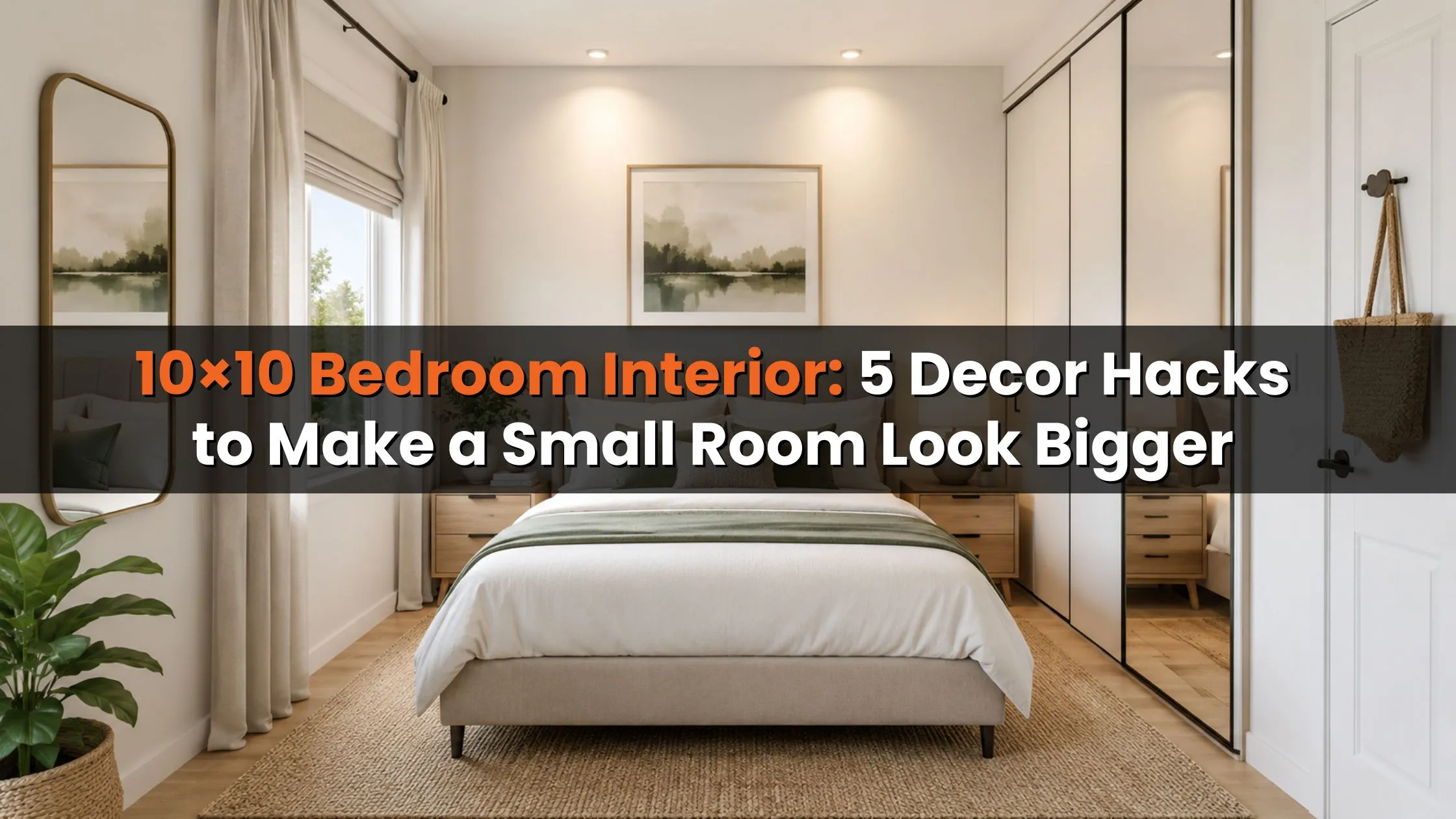
A 10×10 bedroom, it’s about 100 square feet of living area maybe, so it sounds a bit limiting right away. But here’s the deal, that all the seasoned interior designers kind of know in their mind, small rooms aren’t a design problem. More like a design challenge, and challenges come with answers, you just have to look.
Whether you’re fixing up a studio apartment bedroom, a kids room, a guest room, or some modest city flat, the idea of visual expansion can make your 10×10 kind of feel a lot more open, chic, and breathable, almost like it has extra air. The tricky part is well, not so much what you add to the room but more how you lean on what you already have and arrange it.
In this guide, we'll walk you through 5 proven decor hacks, backed by interior design principles, that will visually double your small bedroom's footprint. No expensive renovations. No structural changes. Just smart, strategic styling.
View this post on Instagram
Hack 1: Start With the Right Color Palette
Color is the fastest, cheapest way to change how a room feels. Light, neutral tones reflect natural light instead of absorbing it. Walls appear to step back. The room breathes.
|
Color |
Effect on Space |
Best Use |
|---|---|---|
|
Soft White / Warm Ivory |
Maximum reflection, opens the room |
All four walls |
|
Pale Greige (Gray-Beige) |
Warm, neutral, timeless |
Walls and bedding |
|
Dusty Sky Blue / Sage Green |
Visually receding, fresh feel |
Accent or all walls |
|
Dark / Jewel Tones |
Absorbs light, shrinks space |
Avoid in small rooms |
Paint the ceiling one shade lighter than the walls to draw the eye upward. Use a matte or eggshell finish to diffuse light without harsh reflections. A monochromatic palette across walls, bedding, and curtains creates seamless visual flow, the eye reads the room as one uninterrupted space.
Also Read: 10 Modern Parapet Wall Designs for Independent Houses
Hack 2: Get the Furniture Scale Right
The most common mistake in little bedroom design is somehow fitting standard furniture into a room that actually can’t take it. Like a queen bed in a 10×10 space, leaves almost nothing for usable floor space. Scale really matters more than the brand or the exact finish, and the whole vibe can feel off even if everything looks fine in photos.
|
Bed Size |
Dimensions |
Suitability for 10×10 |
|---|---|---|
|
Twin XL |
38" × 80" |
Best, maximum floor space |
|
Full / Double |
54" × 75" |
Ideal, comfort and space balance |
|
Queen |
60" × 80" |
Workable, needs careful layout |
|
King |
76" × 80" |
Not recommended |
The Top Pick: A Full Double platform bed with a pretty low headboard , kind of keeps that visual line down so the ceiling just feels taller somehow. Also pick furniture with visible legs, so light can slide underneath without getting blocked. Instead of big wide dressers, go for tall narrow wardrobes, that take up less horizontal room. And for the night area, use wall mounted floating nightstands , so you actually clear the floor.
Leave 2–4 inches between furniture and the wall. It is a small gap that gives the room visual breathing room.
Hack 3: Use Mirrors to Double Your Perceived Depth
No tool really creates that illusion of space as reliably as a good mirror placed just right. It reflects both the light and what’s in the room back at the viewer too, kind of doubling everything the eye takes in, like it’s more open, more airy.
Most effective placements:
- Large floor mirror opposite the window, reflects natural light and simulates a second window
- Mirrored wardrobe sliding doors with storage, mirror, and space expander combined
- Decorative mirror above the headboard have the focal point that reflects the full room
- Mirror gallery wall with multiple frames that amplify light from varied angles
Always reflect something beautiful, a window, lamp, or artwork, and use thin, light-colored frames.
Hack 4: Layer the Lighting Properly
A single overhead bulb creates flat, harsh light. It makes rooms look smaller and less designed. Layered lighting adds depth, dimension, and perceived space.
|
Lighting Layer |
Purpose |
Best Options |
|---|---|---|
|
Ambient |
Primary source |
Recessed LED downlights, flush pendant |
|
Task |
Functional light |
Wall-mounted swing-arm sconces |
|
Accent |
Mood and atmosphere |
LED strips behind headboard, fairy lights |
Warm-white bulbs at about 2700K–3000K are the way to go, because cool white kind of makes compact spaces feel clinical or too sharp. Put in dimmable switches also, so you can soften everything as you like. And for the curtains, hang them from ceiling to floor, not only a little above the window, that little change helps wash the whole room with light more evenly.
Hack 5: Reduce Visual Clutter Through Smart Storage
Visible clutter kinda shrinks the apparent size of a room , faster than anything else. What you don’t really see seems to matter just as much as what you do, or maybe even more.
Storage principles that work:
- Use closed storage, with wardrobes and drawers, for everyday items rather than open shelving, kind of less visually messy.
- Maximize under-bed space by adding built-in drawers, or even vacuum bags, so things stay more compact.
- Build vertically, ceiling-height wardrobes above wide low furniture ,so you gain height without losing comfort.
- Group the open-shelf stuff into matching baskets for a uniform clean look that feels a bit more organized.
Minimalist styling rule set: keep a maximum of 3 items on each surface. Anchor the whole space with a 5×8 ft rug, with the front bed legs resting on it, like firmly placed. Go for one large artwork rather than several little frames , and try to keep it consistent throughout. Also, use only two complementary patterns, and stick to a three-color palette all the way through the room, no extra tones creeping in.
Also Read: Best Modern Kitchen Design Ideas for Indian Homes in 2026
Common Mistakes to Avoid
- Choosing furniture before deciding layout, get placement and scale right first
- Ignoring vertical space: the wall area above eye level is consistently wasted in small bedrooms
- Using undersized rugs: a rug that does not anchor the bed fragments the room
- Skipping layered lighting: one overhead source is never enough
- Blocking the window: natural light is the most powerful space-expander available; never interrupt it with furniture
Quick Comparison: What Works vs. What Does Not
|
Element |
Do This |
Avoid This |
|---|---|---|
|
Color |
Light neutrals, monochromatic |
Dark tones on all four walls |
|
Furniture |
Scaled-down, exposed legs |
Oversized, floor-hugging pieces |
|
Mirrors |
Large, placed opposite a window |
Small mirrors, poorly positioned |
|
Lighting |
Warm, layered sources |
Single harsh overhead bulb |
|
Storage |
Closed, vertical, hidden |
Open, overcrowded shelving |
|
Curtains |
Ceiling-height, sheer fabric |
Short, heavy, dark drapes |
Final Thoughts
A well-designed bedroom interior doesn’t really need more square footage; it needs smarter choices. The right color palette, furniture that’s sized and scaled the right way, mirrors placed with intention, lighting that’s layered instead of just bright, and disciplined storage can make a 10×10 space feel much bigger.
Get the layout and color right first. Then mirrors and lighting next. Control clutter last. Follow that sequence and the results will hold for years.






Ans 1. Use light neutral colors, scaled furniture with exposed legs, large mirrors, layered warm lighting, and hidden vertical storage, no renovation needed.
Ans 2. Soft white, warm ivory, pale greige, and dusty sky blue reflect natural light and make walls appear to recede.
Ans 3. A Full/Double bed (54"×75") gives the best comfort-to-space balance; Twin XL works if you want maximum floor area.
Ans 4. Yes, a large mirror opposite a window reflects light and depth, doubling perceived size; mirrored wardrobe doors are the most practical option.
Ans 5. Layered lighting (ambient, task, accent) adds depth; always use warm white bulbs at 2700K–3000K.
Ans 6. Use under-bed drawers, ceiling-height wardrobes, and closed cabinets, the less visible the storage, the larger the room feels.
Ans 7. Avoid king-size beds, wide low dressers, and legless furniture, they dominate floor space and visually compress the room.
Ans 8. A 5×8 ft rug works best, place it so the front two bed legs rest on it to ground the space.
Ans 9. Yes, three items per surface and a three-color palette reduce visual clutter and immediately open up the room.
Ans 10. Use sheers to maximize natural light; for privacy, add slim blackout blinds mounted behind them.