
✦ AI Summary
Table of Content
▲- The Manufacturing Signal Gurgaon Was Sending All Along
- What the China Plus One Strategy Actually Means on the Ground
- Manesar: From Factory Town to Full-Spectrum Real Estate Hub
- Global City: The ₹1,00,000 Crore Project Rewriting the Rules
- What This Means for You: Buyer, Investor, or End-User
- Conclusion
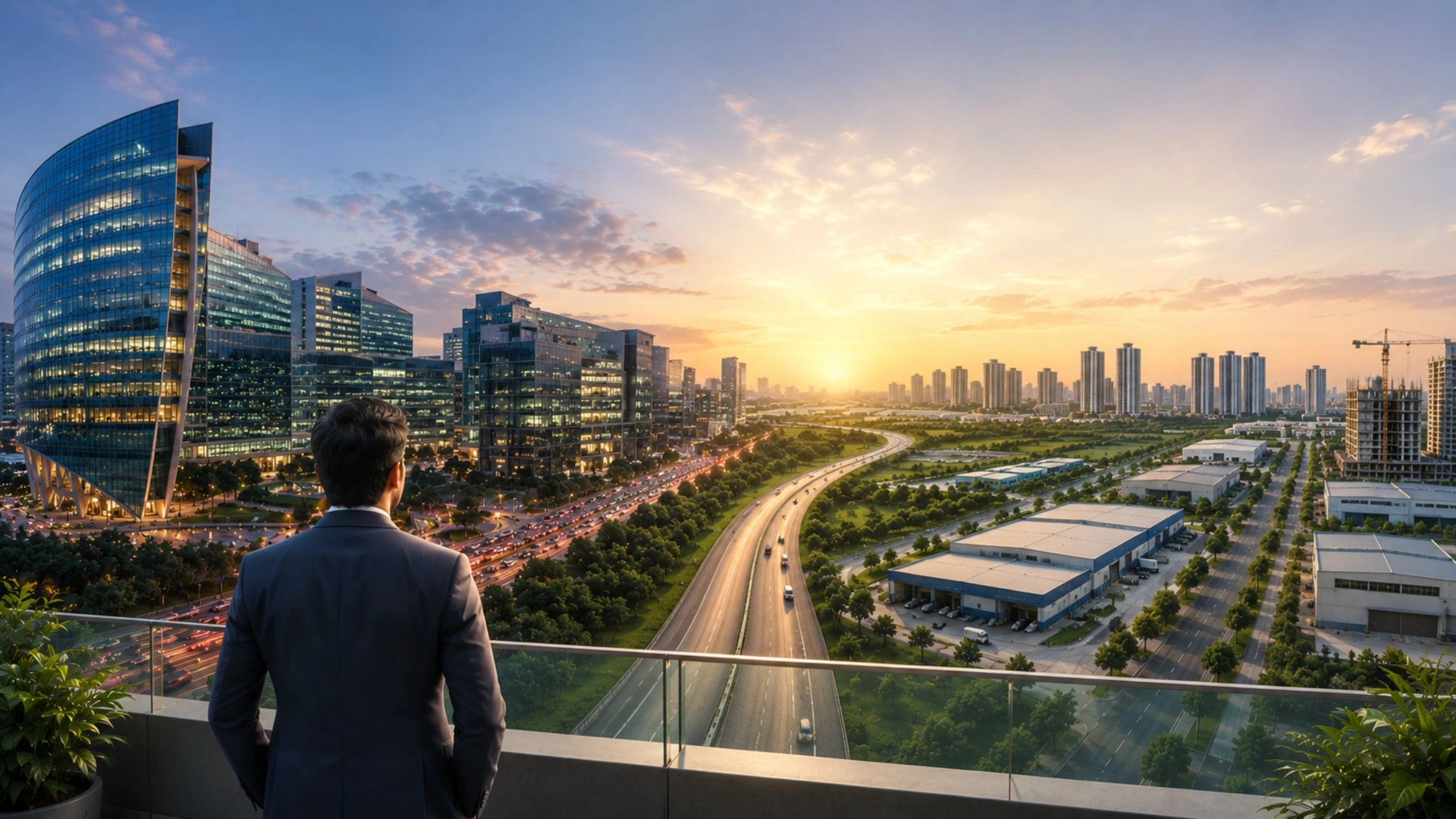
Gurgaon real estate has been telling investors something important for the last few years, and most people have been too busy watching Golf Course Road to really catch it. The place that built its identity on IT parks and BFSI towers is now quietly taking a second turn, and arguably it’s bigger than the first one. This time it’s not being pushed by software firms, it’s being pulled by factories. Global manufacturers are nudging supply chains away from China, and the industrial strip running from Manesar toward the new Global City stretch is showing up as one of their most preferred Indian stops. The property market is reacting the way you’d expect, land prices keep climbing, warehousing demand is surging, and a fresh wave of integrated township development is only just starting, you know.
The question is not whether Gurgaon has industrial infrastructure. It clearly does, and it has had it for decades. The real question is whether the current wave of global manufacturing investment is structurally different from what came before. The answer, by nearly every indicator available, is yes.
The Manufacturing Signal Gurgaon Was Sending All Along
Gurgaon's industrial story did not begin with the China Plus One strategy. It began with Maruti Suzuki setting up its Manesar plant and attracting an ecosystem of auto-component suppliers around it. What is different now is the scale, the source of demand, and critically, the real estate categories being impacted.
For years, Gurgaon's property market was essentially a two-track story, premium offices in Cyber City and Golf Course Road on one side, and affordable-to-mid residential on the other. Manufacturing activity was happening in Manesar and IMT zones, but it was not the headline driver of real estate investment decisions. That separation is now collapsing.
Cyber City vs. The New Industrial Corridors: A Reality Check
|
Parameter |
Cyber City / Golf Course Road |
Dwarka Expressway / Manesar / Global City |
|---|---|---|
|
Primary Demand Driver |
IT & BFSI corporates |
Global manufacturing & logistics |
|
Key Asset Type |
Grade A office, premium retail |
Industrial plots, warehousing, mixed-use townships |
|
Price Movement (2020–2024) |
Moderate, rental-led |
High, capital value appreciation |
|
Growth Stage |
Mature, income-generating |
High-growth, early-to-mid cycle |
|
Investor Profile |
Institutional, HNI |
Industrial occupiers, mid-segment residential buyers |
|
Infrastructure Edge |
Metro, expressway connectivity |
DMIC corridor, NH-48, Dwarka Expressway |
Key Insight: Cyber City is not losing relevance. What is changing is that it no longer has a monopoly on where value gets created in Gurgaon. The industrial corridors are producing capital appreciation at rates the established office belt simply cannot match right now.
What the China Plus One Strategy Actually Means on the Ground
The phrase “China Plus One” gets used enough in business coverage that it starts sounding sorta abstract. But it isn’t really. It’s basically describing a particular, very measurable kind of shift: multinational companies that used to keep most manufacturing in China are now setting up parallel, or sometimes replacement production capacity in other countries. India is the biggest winner of this change across Asia, and inside India, the NCR industrial belt, anchored by Gurgaon , keeps landing at the top of location shortlists.
Why global manufacturers are picking the Gurgaon belt specifically, and not so much elsewhere
- Logistics advantage: It gives direct line access to Indira Gandhi International Airport, plus NH-48 which is basically the country’s most critical cargo spine. That’s a big deal for time sensitive shipments
- DMIC positioning: Manesar and the new Global City project both sit inside the Delhi Mumbai Industrial Corridor ,which is widely seen as India’s most ambitious industrial infrastructure push
- Supplier ecosystem: After decades of doing automotive, electronics, and pharma work here, there’s now this dense mature supplier network that new entrants can tap into right away, rather than waiting years to build local capability
- Policy environment: With Haryana’s single window clearances, competitive plot pricing under HSIIDC allotments, and PLI scheme benefits that stretch across multiple sectors, the usual setup friction is getting reduced fast
- Workforce depth: The NCR area brings one of the largest concentrations of skilled industrial and technical manpower in all of India, so scaling teams tends to be smoother
Also Read: 8 Expressway Corridors Driving India’s Next Real Estate Growth Wave
Manesar: From Factory Town to Full-Spectrum Real Estate Hub
No location really catches the factory effect on Gurgaon real estate more clearly than Manesar. For a long time, it was mostly just the place everyone mentioned for the Maruti Suzuki plant, plus a few auto ancillary units and that kind of stuff . But now Manesar has kind of shifted, it’s not just industrial anymore, it has become a more spread out blend of factories, jobs, and residential property too, like a proper diversified market.
The setting up of IMT (Industrial Model Township) Manesar, by HSIIDC kinda created a more structured framework, which then pulled in hundreds of small medium and large enterprises, across automotive electronics and pharmaceutical manufacturing. The widening of National Highway 48 reduced travel times to Gurgaon and the airport significantly. And the township's positioning within the DMIC corridor gave it an infrastructure credibility that purely private industrial parks cannot replicate.
What is now driving real estate demand across Manesar:
- Grade A warehousing: E-commerce, auto-component, and FMCG companies are securing large-format logistics facilities around Manesar and Farukhnagar at pace
- Industrial plots: Those HSIIDC allotments in the IMT zone, yeah they’re oversubscribed, so private developers like M3M end up putting out their own industrial plot offerings, mostly to catch the overflow demand that keeps coming in.
- Residential absorption: The professionals and workers living/working around the industrial belt are still creating this steady demand for mid segment apartments and, you know, integrated townships, because they need places that actually fit their daily life.
- Relative affordability: And in Manesar, property prices stay meaningfully below central Gurgaon, which makes it kinda one of the rare NCR locations where both end users and investors still feel there’s real value, not just hype.
Global City: The ₹1,00,000 Crore Project Rewriting the Rules
If Manesar's growth has been organic and gradual, the Global City project represents a deliberate, government-backed effort to accelerate the factory effect into a city-scale transformation.
Global City Project: Key Facts at a Glance
|
Parameter |
Detail |
|---|---|
|
Developer |
HSIIDC (Haryana State Industrial & Infrastructure Development Corp.) |
|
Location |
Sectors 36, 36B, 37, 37B, Gurgaon |
|
Total Area |
1,000+ acres |
|
Estimated Investment Potential |
~$15 billion (₹1,00,000 crore) |
|
Industrial Plot Range |
5 to 100 acres |
|
Connectivity |
Dwarka Expressway, NH-48, Pataudi Road, Central Peripheral Road |
|
Urban Planning Concept |
15-Minute City |
|
Corridor |
Delhi-Mumbai Industrial Corridor (DMIC) |
What makes Global City structurally different from older township announcements is basically its integrated design and yes, not just a residential township with a tiny retail component bolted on. It meshes workspaces, industrial plots, residential towers, retail spaces, and social infrastructure into one self-sustaining urban ecosystem, planned to match international standards. The whole 15-minute city idea, so that residents can reach work, healthcare, education, and leisure without long commutes, is actually built right into the master plan.
Key Insight: For investors watching where the next cycle of property value creation in Gurugram will originate, Global City is not a distant speculative bet. It is an HSIIDC-backed, DMIC-anchored project with $15 billion in projected investment and direct access from one of NCR's fastest-appreciating expressway corridors.
What This Means for You: Buyer, Investor, or End-User
The factory effect is not uniform across asset classes. It is creating differentiated opportunities depending on what you are looking for:
|
Profile |
Best Opportunity |
Key Locations |
|---|---|---|
|
Industrial Investor |
HSIIDC / private industrial plots |
IMT Manesar, Sectors 36–37, Farukhnagar |
|
Logistics / Warehousing Investor |
Grade A built-to-suit or park units |
Manesar, Farukhnagar, NH-48 belt |
|
Residential End-User |
Integrated township near employment zones |
New Gurgaon sectors, Manesar |
|
Residential Investor |
Capital appreciation play |
Dwarka Expressway, Sectors 36B, 37B |
|
Commercial Office Investor |
GCC-adjacent office demand |
Global City periphery, New Gurgaon |
Also Read: Listed REITs in India Announce ₹8900 Crore Distribution for FY26 Investors
Conclusion
Gurgaon Real Estate is no longer a one-chapter story. Cyber City wrote the first chapter with IT parks and corporate towers. Global manufacturing is now authoring the next, and by nearly every measure, it is a bigger, longer, and more geographically expansive story. From IMT Manesar's industrial renaissance to the ₹1,00,000 crore ambition of Global City, the factory has firmly become the new anchor of Gurugram's property map. For anyone buying, investing, or tracking the market, the message is straightforward: the next wave of real estate value in this city will not come from a software company's lease renewal. It will come from a factory floor.


Ans 1. Global manufacturing expansion driven by the China Plus One supply chain strategy, large infrastructure projects like the Delhi-Mumbai Industrial Corridor, and government-backed developments like Global City are creating new and sustained demand for industrial, commercial, and residential properties well beyond Gurgaon's traditional tech corridors.
Ans 2. Global City is a 1,000+ acre integrated mixed-use development by HSIIDC (Haryana State Industrial and Infrastructure Development Corporation), located in sectors 36, 36B, 37, and 37B of Gurgaon. With an estimated investment potential of $15 billion, it combines industrial plots, workspaces, residential towers, and social infrastructure within the DMIC corridor.
Ans 3. Yes, Manesar presents a strong investment case backed by the IMT industrial ecosystem, NH-48 connectivity improvements, relative affordability compared to central Gurgaon, and consistent residential demand from professionals working in the surrounding industrial belt.
Ans 4. The China Plus One strategy refers to global companies building manufacturing capacity outside China to reduce supply chain risk. Gurgaon's industrial belt, with its logistics access, DMIC positioning, and existing supplier ecosystem, is a primary beneficiary, directly increasing demand for industrial plots, warehousing, and worker housing.
Ans 5. Dwarka Expressway has unlocked Gurgaon's new growth corridor. Property values along this belt surged from approximately ₹9,400 per sq ft in 2020 to over ₹18,000 per sq ft by 2024, making it one of the NCR's fastest appreciating micro-markets, driven by new township launches and Global City's proximity.
Ans 6. Four asset classes are seeing the highest demand: Grade A warehousing and logistics parks, industrial plots within HSIIDC zones, integrated residential townships near industrial employment hubs, and commercial offices catering to GCC (Global Capability Centre) operations near the new industrial corridors.
Ans 7. IMT Manesar is an Industrial Model Township developed by HSIIDC hosting hundreds of enterprises across automotive, electronics, and pharmaceutical manufacturing. Its presence has directly triggered rising demand for commercial spaces, warehousing facilities, and residential properties across the Manesar micro-market.
Ans 8. The DMIC provides guaranteed world-class industrial infrastructure, logistics connectivity, and policy support along the Delhi-Mumbai freight route. Properties within or adjacent to the DMIC, including Manesar and Global City sectors, carry a structural infrastructure premium that directly supports long-term value appreciation.
Ans 9. Cyber City is Gurgaon's established IT and BFSI commercial hub, anchored by DLF, primarily serving technology and financial services companies on a mature, income-generating curve. Global City is a new-generation HSIIDC-backed development designed around global manufacturing, mixed-use urban planning, and international infrastructure standards, currently at the high-growth, early-cycle stage.
Ans 10. The highest-opportunity zones based on infrastructure pipeline, industrial activity, and price appreciation momentum are: Dwarka Expressway sectors (36, 36B, 37, 37B for Global City proximity), IMT Manesar (industrial plots and affordable residential), Farukhnagar (Grade A warehousing), and New Gurgaon sectors within the DMIC belt.