
✦ AI Summary
Table of Content
▲
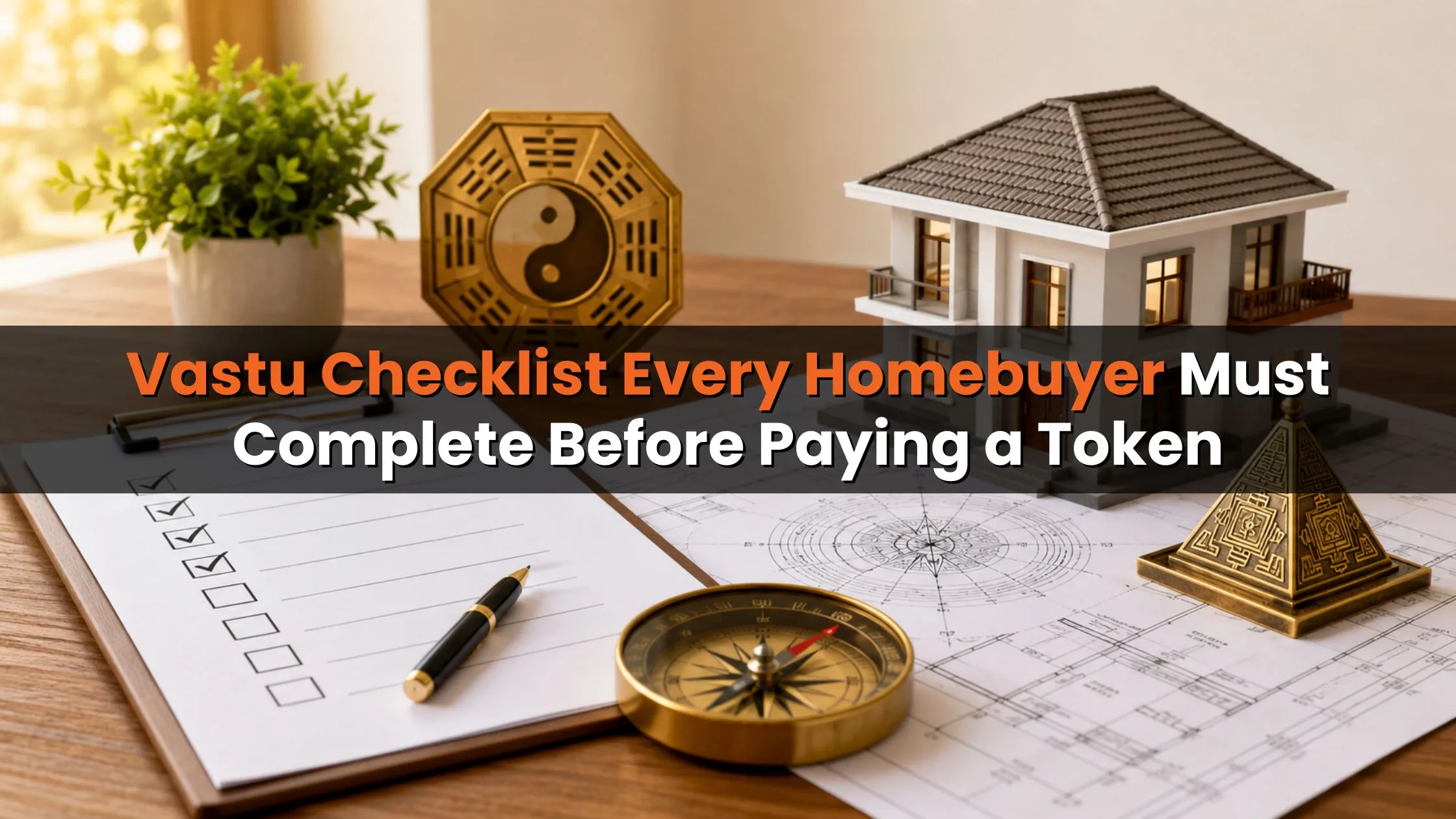
Homebuyers usually don’t think about Vastu before they pay the token amount, but once the money leaves the buyer’s account, there is very little that can be done by anyone to correct improperly constructed homes or kitchens that are located in wrong positions. Therefore, it’s important to look at your floor plan and any negotiations that could occur before you actually make a decision about your home and then use directions, center, entrances and a Vastu perspective to assist you with the evaluation of the house.
This isn't about superstition holding up a deal. It's about knowing which flaws are fixable later and which ones are baked into the concrete the day construction finishes.
What Is a Vastu Checklist and Why It Matters Before Token Payment
Here's the thing about token payments in Indian real estate: the moment that amount changes hands, the deal stops being theoretical. Builders and sellers treat it as a near-final commitment, and walking back usually costs you the token itself, sometimes more. A Vastu Checklist done before that point gives you a clean window to negotiate, ask for changes, or simply walk away, none of which is easy once money is on the table.
Also Read: Vastu Colors for Living Room: Attract Wealth and Positivity to Your Home
Plot-Level Vastu Checks
Plot Shape
Square and rectangular plots are the gold standard here. Anything irregular, an L-shape, a triangular cut corner, a wedge, throws off the balance Vastu practitioners look for.
Why it works: Once a foundation is poured on an irregular plot, there's no fixing the geometry. This is one of the few Vastu flaws that money can't undo later.
Brahmasthan (Plot Center)
The center of the plot, called the Brahmasthan, should stay open or lightly built. No pillars, no staircases, no toilets sitting right in the middle.
Why it works: This zone is treated as the energetic anchor of the whole property. Build over it, and the imbalance is considered to ripple outward into the rest of the home.
Road-Facing Direction and Slope
East and North-facing road access is generally favored, ideally the land slopes from South to North or West to East.
Why it works: Both align with the directions associated with sunrise energy, which Vastu treats as the foundation for sustained prosperity in a home.
Entrance and Direction Checks
Main Entrance Position
North, East, or Northeast, that's the entrance sweet spot. South and Southwest entrances are the ones that tend to need remedies down the line.
Why it works: These directions are considered the natural gateway for positive energy entering a home, which is exactly why North and East-facing properties often carry a price premium in the market.
Staircase Direction
A staircase that rises clockwise, starting from the South or West, fits the Vastu mold. One sitting in the Northeast or dead center doesn't.
Why it works: A staircase eating into the Brahmasthan or Northeast zone is considered one of the more disruptive dosha types, and it's expensive to relocate once built.
Room-Wise Vastu Verification
Kitchen, Bedroom, and Pooja Room
The kitchen belongs in the Southeast, with the cook facing East. The master bedroom does best in the Southwest. The pooja room, if there is one, ideally sits in the Northeast.
Why it works: Each of these zones corresponds to an element, fire for the kitchen, stability for the bedroom, spiritual energy for the pooja space, that Vastu maps directly onto room function.
Toilet Placement
Keep toilets out of the Northeast and away from the center. Northwest or South works better.
Why it works: A toilet sitting in a sacred zone like the Northeast is one of the more commonly flagged doshas during resale inspections, and buyers notice.
Also Read: 5 Things You Must Hang on Your Main Door to Attract Positive Energy
Favorable vs Unfavorable Directions Table
|
Room/Element |
Favorable Direction |
Unfavorable Direction |
|---|---|---|
|
Main Entrance |
North, East, Northeast |
South, Southwest |
|
Kitchen |
Southeast |
Northeast |
|
Master Bedroom |
Southwest |
Northeast |
|
Pooja Room |
Northeast |
Southwest |
|
Toilet |
Northwest, South |
Northeast, Center |
|
Staircase |
South, West |
Northeast, Center |
|
Water Tank |
North, Northeast |
Southeast, South |
Tip: Carry a compass app and the floor plan during your site visit. Directional overlays on paper catch violations a quick walkthrough almost always misses.
Surrounding Environment Checks
A plot can check every internal box and still run into trouble outside its boundary. Avoid properties facing a T-junction or dead end, and keep some distance from cremation grounds or hospitals if possible.
Important: Not every flagged direction is a dealbreaker. Some Vastu doshas, color choices, mirror placement, furniture orientation, have workable remedies. Structural ones, plot shape, fixed toilet locations, generally don't. Knowing which bucket a flaw falls into is the actual point of doing this checklist before you pay anything.
Pre-Token Buyer Checklist
|
Check |
What to Verify |
|---|---|
|
Plot Shape |
Square or rectangular, no irregular cuts |
|
Brahmasthan |
Center remains open, no pillars or staircase |
|
Main Entrance |
Falls in North, East, or Northeast |
|
Kitchen |
Southeast corner, East-facing cooking platform |
|
Toilet |
Avoids Northeast and center zones |
|
Staircase |
Clockwise rise, starts from South or West |
|
Surroundings |
No T-junction, dead end, or sensitive structures nearby |
|
Remedy Feasibility |
Existing dosha has a realistic, affordable fix |
Conclusion
The purpose of the Vastu checklist is not to prevent people from making more purchases by creating additional rituals which will make the process of buying property longer but rather to ensure that you are aware of any defects in your property investment prior to making your initial payment. Your due diligence is critical in determining whether an asset you wish to own contains any flaws or deficiencies that would affect its value.
You must investigate the shape of the property, the direction of the entries into the building, the layout of your building, and the surrounding properties prior to purchasing an asset; this will allow you to make a well-informed purchasing decision. Your asset will be available for you to purchase next week if you complete the 'token payment', however, you will no longer have any ability to negotiate any structural defects found after making your initial token payment.







Ans 1. It's a structured set of checks, covering plot shape, the Brahmasthan, entrance direction, room placement, and surrounding structures, that a buyer verifies before committing financially to a property, ideally before paying any token amount.
Ans 2. Some can. Color schemes, furniture orientation, and minor placements are usually fixable. Structural issues like an irregular plot shape or a fixed toilet location in the Northeast typically require major renovation, if they can be fixed at all.
Ans 3. North, East, and Northeast are considered the most favorable directions for a main entrance, associated with the energy of the rising sun and linked to sustained prosperity for the household.
Ans 4. For higher-value purchases or under-construction units where the floor plan can still be cross-checked, a one-time consultation before the token stage is generally a worthwhile investment.
Ans 5. Yes. Vastu-compliant homes tend to move faster on resale, since a significant share of Indian buyers actively screen for directional compliance during their own property search.
Ans 6. Brahmasthan refers to the central zone of a plot or home. Vastu principles call for this area to remain open or lightly constructed, treating it as the energetic core of the property.
Ans 7. Generally yes, North and East-facing properties tend to command a price premium in most Indian markets, though the exact gap varies by city, locality, and overall buyer demand.
Ans 8. Determine first whether the flaw is remediable, color or furniture-based fixes, or structural, plot shape or fixed plumbing. Structural flaws are worth using as leverage in price negotiation rather than walking away outright.
Ans 9. The kitchen should ideally sit in the Southeast corner of the home, with the cooking platform positioned so the cook faces East while preparing food.
Ans 10. It's considered one of the more commonly cited Vastu doshas, since the Northeast is treated as a sacred, energy-sensitive zone. Buyers and Vastu consultants both tend to flag this during inspections.