
✦ AI Summary
Table of Content
▲- What is Patta Chitta in Tamil Nadu?
- Why Patta Chitta is Important
- Who Can Apply for Patta Chitta?
- Documents Required for Patta Chitta Application
- Step-by-Step Process to Apply for Patta Chitta Online
- How to Verify Patta Chitta Online
- Patta Chitta Online vs Traditional Land Record Process
- Common Reasons for Patta Transfer
- Common Mistakes to Avoid While Applying
- Benefits of Digital Land Record Management
- Challenges Property Owners Should Monitor
- Conclusion
The most critical part of transacting any real estate transaction in Tamil Nadu is verifying the title deed of the property. The Government of Tamil Nadu has made it easier for people to access their land records by creating an online service called the Patta Chitta where all transactions are done electronically rather than going into the local government offices. Now, landowners can check their own ownership information, see how their land is classified and apply for their Patta Chitta records from anywhere using the internet without having to make several trips to a local governmental office.
If you're looking for agricultural land, residential property, or need to verify historical family property records then knowing about how the Patta Chitta system works can help you avoid future problems with your inherited property and help ensure the successful completion of all of your real estate transactions. This guide will provide you everything you need to know about the Patta Chitta including who is required to have one, how to apply for one online step-by-step, and what the most common reasons for applicants to get rejected or have delays with their requests.
What is Patta Chitta in Tamil Nadu?
Patta Chitta is a combined land record document maintained by the Revenue Department of Tamil Nadu. Understanding it properly requires knowing what each component historically represented and how they've been merged.
Patta is the ownership record of the legal document that identifies who holds title to a specific piece of land. It contains the owner's name, patta number (a unique identifier for the holding), survey number and subdivision, the land's extent and location within the village-taluk-district administrative hierarchy, and relevant revenue information. A Patta is essentially the government's official recognition of who owns a specific land parcel.
Chitta was traditionally the classification record maintained separately by revenue authorities; it recorded the nature and use of the land. Whether a parcel was classified as agricultural, wetland, dryland, residential, or some other category was the information the Chitta contained. This classification matters practically because different land types have different rules around use, transfer, and development permission. Today, both records have been integrated into a single digital document known as Patta Chitta.
Information Available in Patta Chitta
The document typically contains:
- Property owner's name
- Patta number
- Survey number and subdivision details
- Land area and extent
- Village, Taluk, and District details
- Type of land classification
- Ownership status
- Revenue records information
This information helps establish ownership and verify property details before any transaction.
Also Read: Stamp Duty and Registration Charges in Tamil Nadu 2026
Why Patta Chitta is Important
Patta Chitta is often considered one of the most critical documents during property transactions in Tamil Nadu.
- During property purchase before signing any sale agreement and certainly before making any payment, a buyer should verify the Patta Chitta to confirm that the seller is the registered owner in government records, that the land extent matches what's being sold, and that the land classification matches the intended use.
- For home loan applications banks and housing finance companies require Patta Chitta as part of their property due diligence because it provides the independent government verification of ownership that they can't rely on the borrower's own documents to establish.
- During inheritance and succession when property passes to the next generation, updating the Patta to reflect the current owner is essential for the inheriting party's legal standing. Unupdated Patta records create the ownership gaps that turn into disputes at the next generational transition.
- For legal proceedings and tax purposes in any court matter involving land, Patta Chitta is admissible evidence of ownership. For property tax assessments and other revenue purposes, the Patta record determines who is liable.
Without updated land records, property transactions may face delays or legal complications.
Who Can Apply for Patta Chitta?
The Patta Chitta application and verification services are available to a broad range of users who have legitimate interest in a specific land parcel's records. The eligible categories include:
- Property owners
- Buyers after property registration
- Legal heirs
- Joint property holders
- Farmers and agricultural landowners
- Individuals inheriting family property
Applicants must possess valid ownership documents before initiating the application process. For all applications that involve creating or transferring records, valid ownership documentation, registered sale deed, legal heir certificate, or applicable proof depending on the basis of the claim is a prerequisite.
Documents Required for Patta Chitta Application
Assembling complete documentation before beginning the application avoids the frustration of incomplete submissions and the delays that follow. The documents you'll need depend on the nature of your application.
Essential Documents Checklist
- Aadhaar Card
- PAN Card (if applicable)
- Registered Sale Deed
- Encumbrance Certificate
- Property Tax Receipts
- Electricity Bill (if applicable)
- Address Proof
- Passport-size Photograph
- Legal Heir Certificate (for inherited property)
- Partition Deed (if applicable)
Having accurate documentation helps speed up verification and approval.
Step-by-Step Process to Apply for Patta Chitta Online
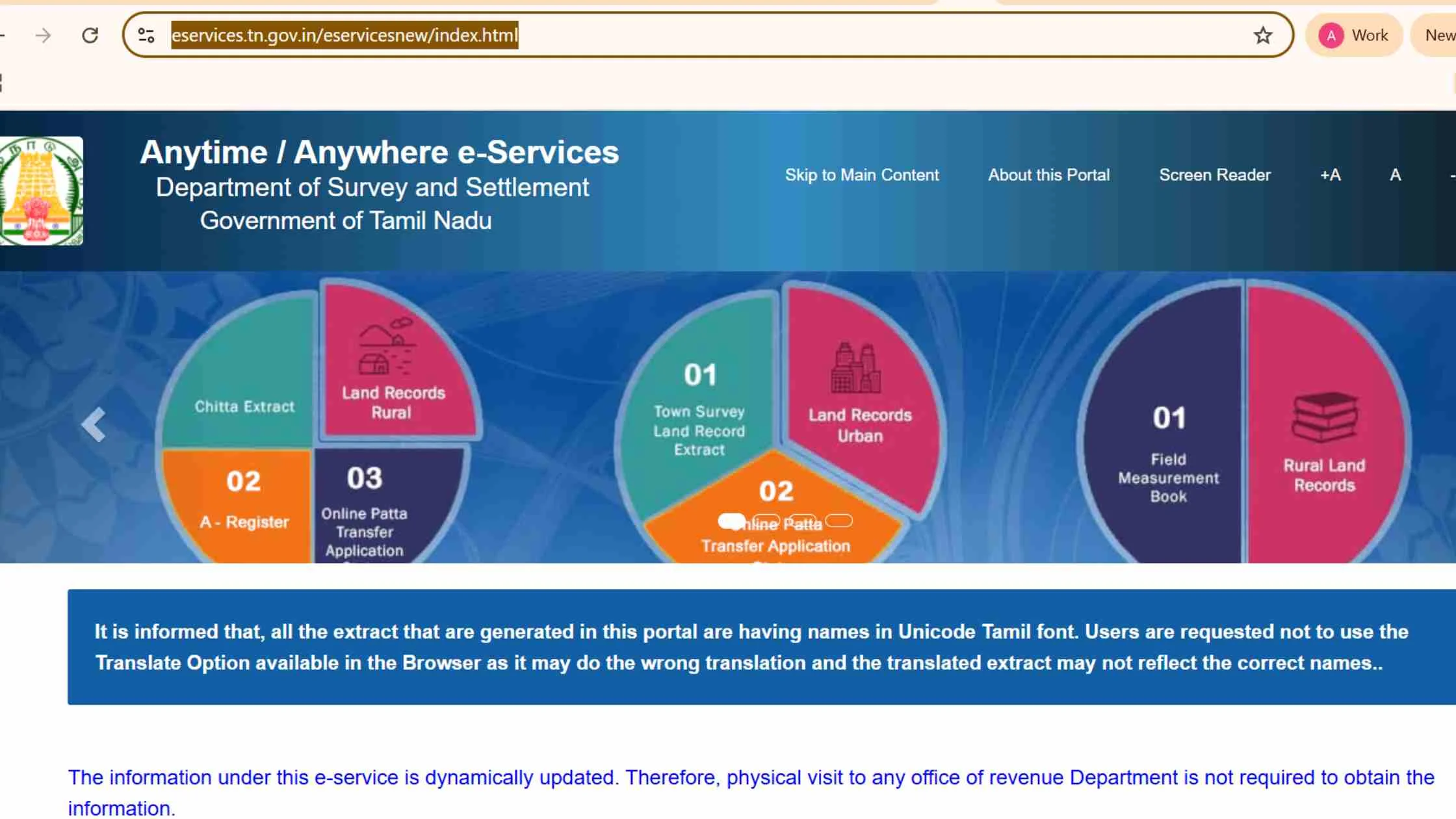
The Tamil Nadu government has made the process convenient through its online land records portal.
Step 1: Visit the Official Portal
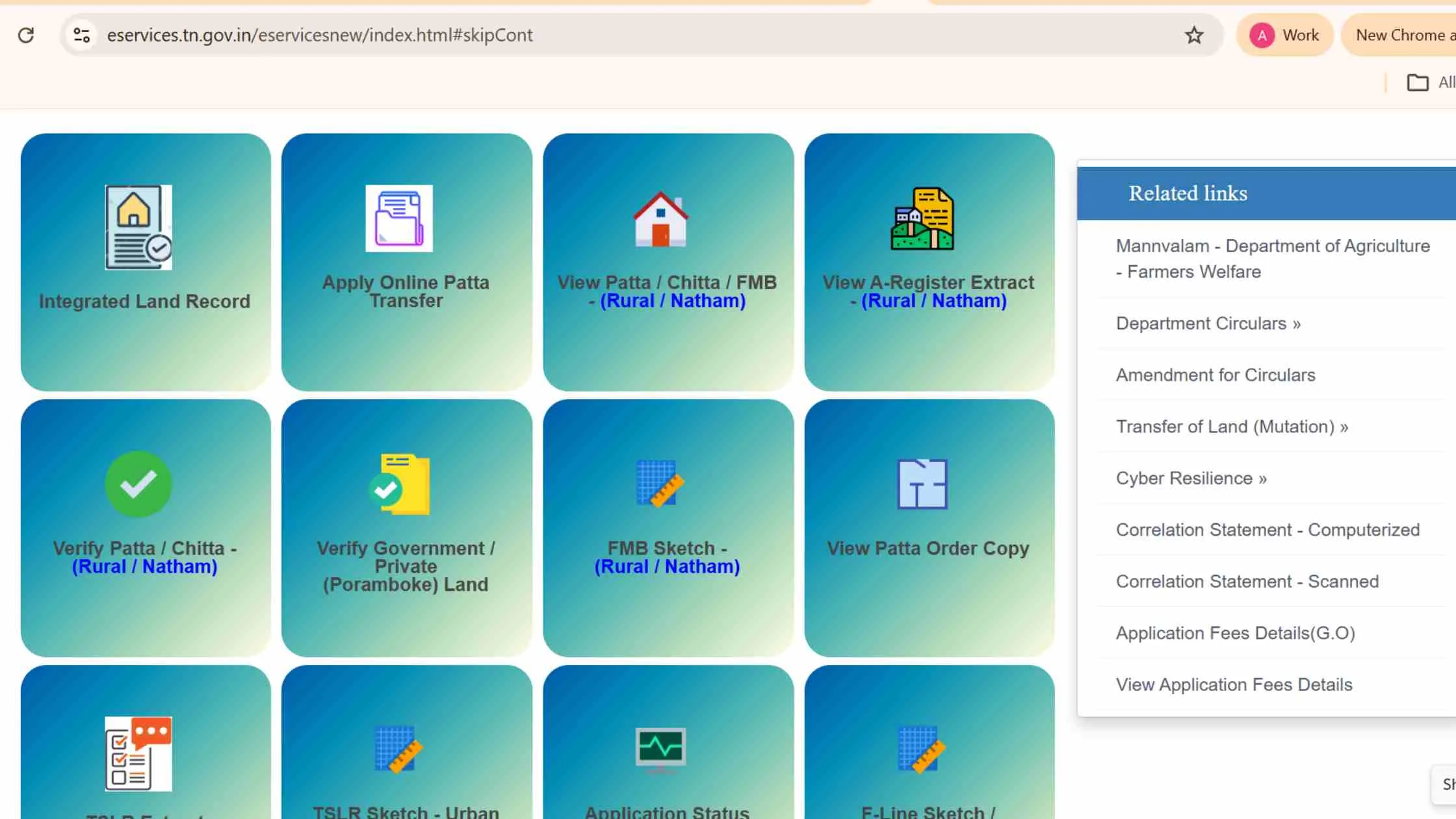
Access the official Tamil Nadu land records website managed by the Revenue Department. Navigate to the Patta Chitta services section (https://eservices.tn.gov.in)
Step 2: Select District and Area Type
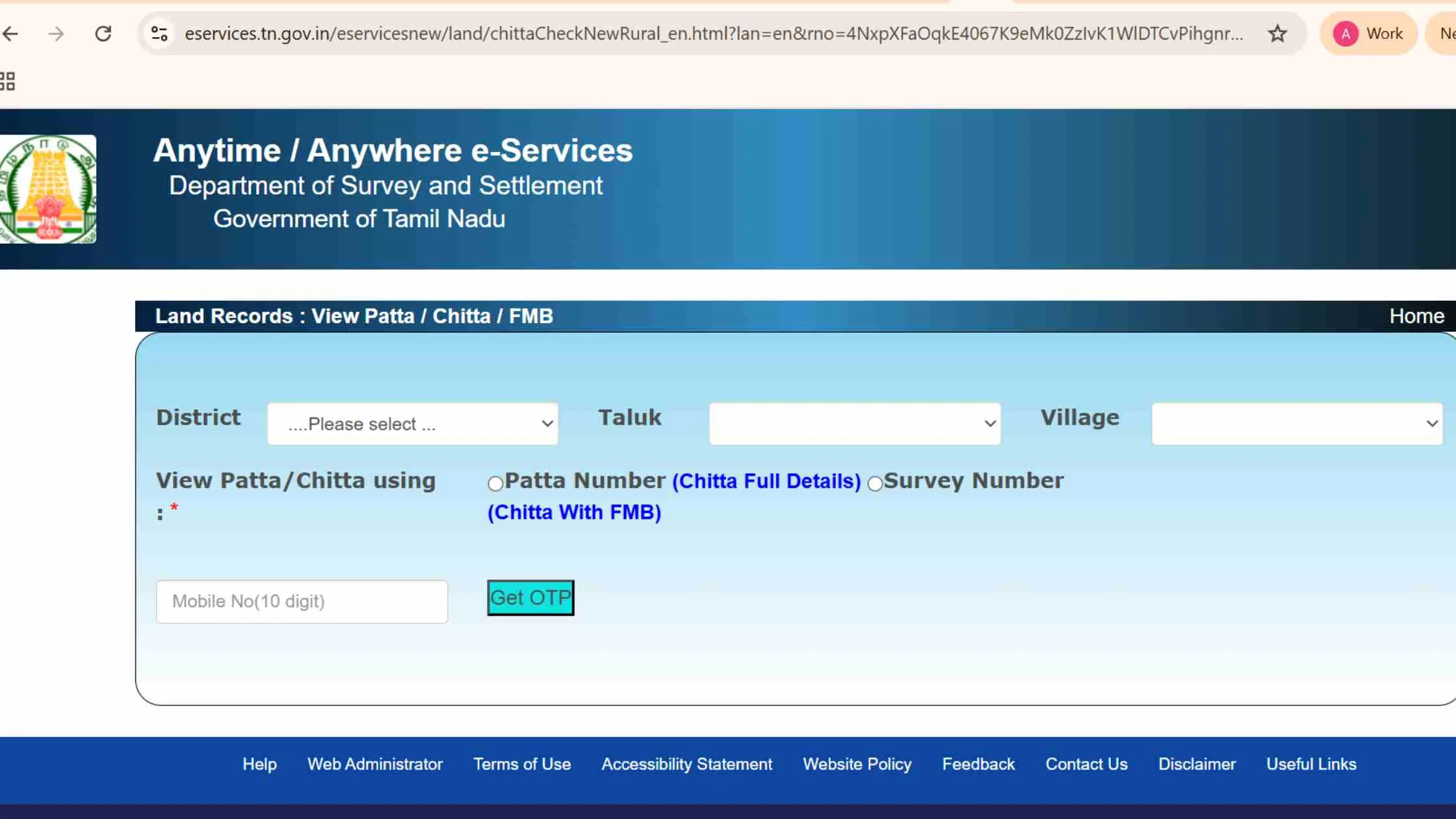
Choose:
- District
- Taluk
- Village
- Urban or Rural property category
Selecting the correct jurisdiction is important for retrieving accurate land records.
Step 3: Enter Property Details
Provide details such as:
- Survey number
- Subdivision number
- Patta number (if available)
Ensure all entries match official registration documents.
Step 4: Submit Verification Details
Applicants may need to provide ownership information and identity details for authentication.
Step 5: Pay Applicable Fees
A nominal fee may be charged for record access, certificate downloads, or application processing.
Step 6: Generate and Download Records
After successful verification, users can view, download, and print Patta Chitta records online. This process eliminates lengthy paperwork and reduces dependency on physical visits.
How to Verify Patta Chitta Online
For buyers conducting pre-purchase verification, the process is simpler and faster than a full application.
Verification Process
- Visit the official portal
- Select "View Patta Chitta"
- Enter district and property details
- Provide survey number or patta number
- Submit the request
- View ownership information instantly
Verification helps identify ownership issues before a transaction is finalized.
Patta Chitta Online vs Traditional Land Record Process
|
Feature |
Patta Chitta Online |
Traditional Method |
|
Accessibility |
Available Online |
Revenue Office Visit Required |
|
Record Retrieval |
Instant |
Time Consuming |
|
Transparency |
High |
Moderate |
|
Application Process |
Digital |
Manual |
|
Status Tracking |
Available |
Limited |
|
Paperwork |
Minimal |
Extensive |
|
Processing Speed |
Faster |
Slower |
|
Convenience |
Excellent |
Moderate |
The digital platform has significantly improved citizen access to land records.
Also Read: Tamil Nadu Introduces Self-Certification for Stilt + Two-Floor Residences
Common Reasons for Patta Transfer
The process of updating Patta records to reflect a new owner becomes necessary whenever land ownership changes. The situations that trigger this requirement include:
- Property purchase where the registered ownership changes from seller to buyer through a registered sale deed. This is the most frequent transfer scenario, and initiating it promptly after registration prevents the accumulated lag between registration and Patta update that creates complications.
- Inheritance of property after the owner's death, where the legal heirs need to update the Patta to reflect the successor ownership. The longer this is delayed, the more complicated the update process becomes as subsequent transactions or further deaths add additional complexity.
- Family partition where jointly held property is formally divided among co-owners, creating separate Patta records for each new individual holding.
- Gift deed execution where property is transferred to another party typically a family member without sale consideration.
- Court order transfers where a judicial order changes the ownership position and the records need to be updated to reflect the court's direction.
Timely transfer ensures government records remain updated.
Common Mistakes to Avoid While Applying
Many applicants face delays because of avoidable errors.
- Entering survey numbers incorrectly is the most frequent and frustrating error. Survey numbers often have subdivision suffixes entering the main number without the subdivision, or entering the wrong subdivision, returning incorrect records. Copy survey numbers directly from the official documents rather than transcribing from memory.
- Uploading poor-quality scans that aren't fully legible causes verification failures and application rejection. Every scanned document should show the complete content with all text readable before upload.
- Applying without a registered ownership document for transfer applications. An unregistered sale agreement or verbal inheritance claim without official heir documentation doesn't satisfy the portal's verification requirements. Ensure the underlying transaction has been formally registered before initiating the Patta transfer.
- Ignoring land classification in the records risks purchasing land that doesn't permit their intended use. A property classified as agricultural land has restrictions on residential development that residential classification doesn't carry.
- Not checking subdivision details may refer to the entire undivided parcel while the actual transaction involves only one specific subdivision. Verifying that the subdivision number matches the land being transacted prevents this mismatch.
- Delaying Patta transfer after registration each day of delay when the official records don't reflect the true ownership creating a window for complications. Initiating the Patta transfer immediately after property registration is the best practice.
Careful verification before submission can prevent application rejection.
Benefits of Digital Land Record Management
Tamil Nadu's online system has transformed property administration.
For Property Owners
- Easy access to records
- Faster verification process
- Reduced paperwork
- Better ownership protection
For Buyers
- Improved due diligence
- Greater transparency
- Lower fraud risk
- Faster property verification
For Government Authorities
- Improved record management
- Better revenue administration
- Enhanced transparency
- Reduced manual workload
Digital records create a more secure and efficient property ecosystem.
Challenges Property Owners Should Monitor
Although the online system has improved efficiency, some challenges still require attention.
- Outdated records from before digitisation properties with long ownership histories may have gaps or inconsistencies in the digitised records where older paper records weren't fully or accurately captured. These discrepancies require formal correction applications that go beyond the standard online process.
- Boundary disputes the Patta Chitta records describe land extent and survey numbers but don't provide the physical ground-level boundary determination that disputed boundaries require. A licensed surveyor's involvement is necessary when actual boundary positions are contested.
- Incorrect survey mapping where the survey records in the digital system don't accurately reflect the actual physical boundaries on the ground. These issues require formal correction through the revenue department's survey process.
- Delayed mutation updates after inheritance or transfer, if the Patta update hasn't been processed, the displayed records still show the previous owner. Checking whether a recently updated record reflects the most recent transaction requires verifying the date of last update.
Regular record verification helps prevent future complications.
Conclusion
Patta Chitta remains one of the most important land ownership documents in Tamil Nadu. It serves as official proof of ownership, helps verify land classification, and supports legal property transactions. With the introduction of online services, property owners can now access records, verify ownership details, and apply for Patta Chitta certificates conveniently from anywhere.
If you plan on buying, selling or transferring a piece of property or want to verify records for your family's property, understanding how to navigate through the Patta Chitta process will help protect that investment. Keeping your records current and using the online portal can be beneficial for property owners in creating a trust and being able to complete meaningful, transparent, and legally accurate transactions in Tamil Nadu.


Ans 1. Patta Chitta is the combined official land record document maintained by the Tamil Nadu Revenue Department that establishes property ownership and land classification. The Patta component records the owner's name, patta number, survey number, land extent, and location. The Chitta component records the land's classification whether agricultural, residential, or other category. Together as a single integrated document, Patta Chitta serves as proof of ownership, is required for home loan applications, enables legal property transactions, supports mutation and inheritance claims, and helps verify land details before purchase. Without updated Patta Chitta records, property transactions face delays and potential legal complications.
Ans 2. To apply for Patta Chitta online in Tamil Nadu, visit the official Tamil Nadu Revenue Department land records portal. Select the District, Taluk, and Village where your property is located and specify Urban or Rural area type. Enter the survey number including any subdivision number and the Patta number if available. Provide ownership and identity details for transfer applications. Pay any applicable processing fee through the online payment system. After verification, view and download the Patta Chitta record. For basic ownership verification, no payment is required. For Patta transfer applications involving ownership changes, supporting documents including registered sale deed or legal heir certificate are needed.
Ans 3. Patta and Chitta are two components of the same integrated land record system in Tamil Nadu that were historically maintained as separate documents. Patta is the ownership record, it identifies who legally owns a specific land parcel and contains the owner's name, patta number, survey number, location details, and land extent. Chitta is the classification that records the nature and use of the land, specifying whether it's agricultural wetland (nanjai), dryland (punjai), residential, or another category. The Tamil Nadu Revenue Department has merged both into a single integrated Patta Chitta document accessible through the online portal, providing both ownership and classification information in one place.
Ans 4. To check Patta Chitta online before buying property in Tamil Nadu, visit the official Tamil Nadu land records portal and select "View Patta Chitta" or the land records verification option. Choose the District, Taluk, and Village where the property is located, and specify Urban or Rural area type. Enter the survey number with subdivision details or the Patta number. The system returns the current registered owner's name, land extent, classification, and other details from government records. Compare these against what the seller has told you, if the owner name, extent, or classification doesn't match the seller's representations, investigate the discrepancy before making any payment.
Ans 5. Documents required for Patta transfer in Tamil Nadu depend on the reason for the transfer. For transfer after property purchase, you need the registered sale deed, encumbrance certificate, property tax receipts, Aadhaar card, and previous owner's Patta details. For inheritance-based transfer, additionally required are the legal heir certificate establishing the recognised heirs, the death certificate of the previous owner, and any available succession-related documents. For partition-based transfer, a registered partition deed specifying each party's share is required. All documents should be in clear, legible scanned format for online applications, with originals available for any verification that requires physical submission.
Ans 6. A Patta number is a unique identifier assigned by the Tamil Nadu Revenue Department to each land holding under the Patta system. It's different from the survey number, a survey number identifies the physical land parcel in the revenue survey, while the Patta number identifies the ownership holding which may encompass one or more survey numbers or subdivisions. Your Patta number appears in your existing Patta document if you have one, in your registered sale deed from when you purchased the property, in property tax records, and can be retrieved on the Tamil Nadu land records portal by searching with your survey number if you don't have the Patta number directly available.
Ans 7. Yes, Patta Chitta records downloaded from the official Tamil Nadu Revenue Department portal are official government documents that are legally valid for property transactions, home loan applications, and official purposes. The online portal generates digitally signed or officially stamped certificates that carry the same validity as records obtained directly from the Revenue Office. Download the records in PDF format and retain the date of retrieval. For submission to banks and government authorities that require official Patta Chitta documentation, the online download is generally accepted. Some specific applications may require the Certificate with the Sub-Registrar's or Tahsildar's official stamp to verify the specific requirements of the authority you're submitting to.
Ans 8. Land classification in the Patta Chitta indicates the official revenue category of the land, the primary classifications being agricultural wetland (nanjai), agricultural dryland (punjai), and non-agricultural residential or commercial classifications. The classification matters significantly for buyers because it determines what the land can legally be used for. Agricultural land cannot be used for residential construction without obtaining a formal land use conversion permission from the relevant authority. If a seller is selling you land described as suitable for house construction that the Patta Chitta shows as agricultural, you may need to obtain conversion permission before building, an additional time and cost burden that you need to know about before agreeing to purchase.
Ans 9. Patta transfer processing timelines in Tamil Nadu vary depending on the type of transfer, completeness of documentation, and the specific sub-registrar or taluk office workload. Online applications with complete documentation are generally processed faster than older manual processes. Simple post-purchase transfers with complete, accurate documentation can be processed within a few weeks in many cases. Complex transfers involving multiple heirs, partition requirements, or documentation gaps take longer. The online portal provides application status tracking so applicants can monitor progress without making physical office visits. Starting the transfer process immediately after property registration rather than delaying gives the most time to resolve any queries that arise during processing.
Ans 10. To transfer Patta after inheriting property in Tamil Nadu, obtain a Legal Heir Certificate from the relevant government authority typically the Tehsildar confirming who the recognised legal heirs of the deceased property owner are. Obtain the death certificate of the original owner. If there are multiple heirs and all agree on who will hold the property, a registered Family Settlement Agreement or No Objection Certificates from other heirs may be needed. Apply for Patta transfer on the Tamil Nadu land records portal or at the Tahsildar's office providing these documents alongside identity proof. The Patta will be updated to reflect the inheriting party's name once the documentation is verified and accepted.