
Table of Content
▲- What Is the SWAMIH Fund and Why Was It Created?
- How Many Homes Has the SWAMIH Fund Completed So Far?
- Scale and Reach of the SWAMIH Fund Across India
- Financial Impact of the SWAMIH Fund
- Employment and Economic Multiplier Effect
- Governance, Exits, and Fund Performance
- What Is SWAMIH Fund 2 and What Will It Do?
- Why the SWAMIH Fund Matters for Homebuyers
- Conclusion
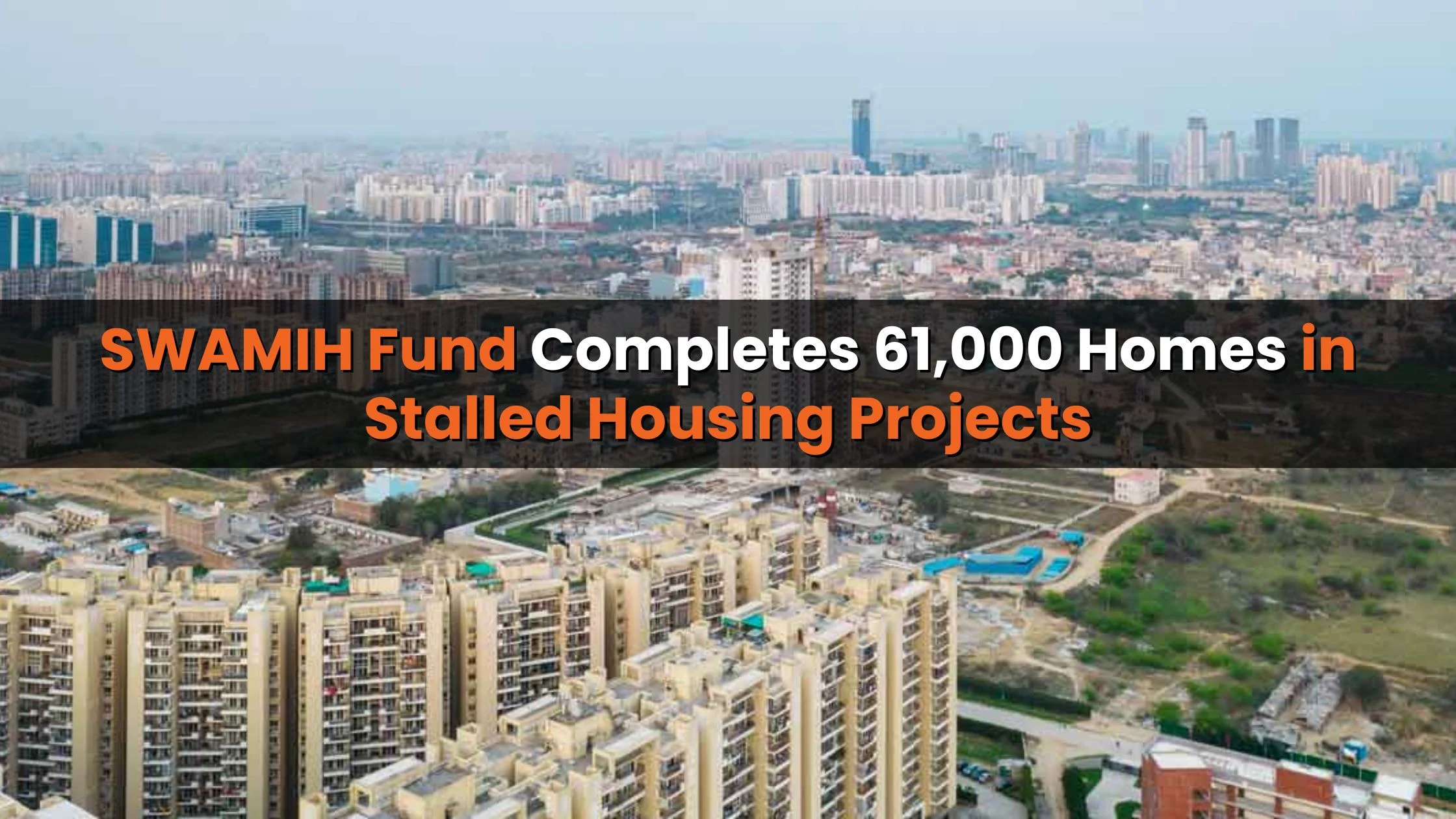
India’s housing stress resolution mechanism, the SWAMIH Fund, has completed over 61,000 homes in stalled residential projects as of December 15, offering long-awaited relief to thousands of homebuyers. Launched to revive delayed affordable and mid-income housing projects, the SWAMIH Fund has emerged as one of the most impactful government-backed interventions in India’s real estate sector. With over one lakh homes expected to be delivered eventually, the fund is playing a critical role in restoring confidence among buyers, developers, and lenders alike.
What Is the SWAMIH Fund and Why Was It Created?
The SWAMIH Fund, short for Special Window for Affordable and Mid-Income Housing, was set up by the Government of India in response to a mounting crisis of stalled housing projects across the country. Thousands of families were stuck paying both EMIs and rent due to prolonged construction delays, often caused by developer insolvency, legal disputes, or non-performing assets.
To address this, the SWAMIH Fund was designed as a last-mile financing solution for brownfield, RERA-registered residential projects that were viable but stressed. Managed by SBI Ventures Limited, a subsidiary of State Bank of India, the fund operates as a social impact investment platform with strict governance and asset management standards.
Also Read: India’s Real Estate Sector Raises Rs 17,867 Crore via Capital Markets in FY26 YTD
How Many Homes Has the SWAMIH Fund Completed So Far?
As per official data released by the finance ministry, the SWAMIH Fund has delivered approximately 61,000 homes across 110 projects till December 15. This includes over 7,000 units under rehabilitation and Economically Weaker Sections (EWS) categories.
The total expected delivery stands at over 1 lakh homes, which would directly benefit more than 4 lakh people nationwide. These completions represent one of the largest coordinated efforts to revive stalled residential projects in India’s history.
Scale and Reach of the SWAMIH Fund Across India
The SWAMIH Fund has a pan-India footprint, underscoring the widespread nature of housing stress and the scale of intervention required.
Key highlights of its reach:
- 145+ residential projects in the portfolio
- Presence across 30 cities
- Over 127 projects unlocked with funding support
- 90+ million sq ft area under development
Importantly, around 44% of the total area supported by the SWAMIH Fund falls under Low-Income Group (LIG) and Mid-Income Group (MIG) housing, aligning with its mandate to prioritise affordability and inclusivity.
Financial Impact of the SWAMIH Fund
Beyond home delivery, the SWAMIH Fund has delivered significant financial and fiscal outcomes.
Capital and Revenue Impact:
- ₹37,400 crore capital unlocked across funded projects
- ₹6,900 crore contributed to Centre and states through GST, stamp duty, and statutory dues
- Nearly 50% of drawn capital returned to investors
- ₹3,500 crore returned to the central government out of ₹7,000 crore drawn
These figures demonstrate that the SWAMIH Fund has balanced social impact with financial discipline, a rare achievement in large-scale public-sector interventions.
Employment and Economic Multiplier Effect
The revival of stalled housing projects under the SWAMIH Fund has generated strong downstream economic activity.
Employment and Material Demand:
- 36,000+ jobs created, including 3,500 permanent roles
- Demand generated for 20 lakh tonnes of cement
- Over 5.5 lakh metric tonnes of steel consumed
This ripple effect highlights how housing completion not only benefits homebuyers but also stimulates allied industries such as construction materials, logistics, and services.
Governance, Exits, and Fund Performance
Strong governance has been a defining feature of the SWAMIH Fund. The fund follows active asset management practices, regular monitoring, and disciplined capital deployment.
Performance Metrics:
- 55 full exits achieved
- 44 partial exits completed
- Entire investible corpus committed before December 5, 2025
This structured approach has helped ensure timely execution while maintaining accountability across stakeholders.
What Is SWAMIH Fund 2 and What Will It Do?
Recognising the success of the initial programme, the government announced the SWAMIH Fund 2 in the Union Budget 2025–26.
Key details of SWAMIH Fund 2:
- ₹15,000 crore blended finance facility
- Contributions from government, banks, and private investors
- Target to complete another 1 lakh housing units
- Focus on faster execution and expanded coverage
The launch of SWAMIH Fund 2 signals continued policy support for resolving housing stress and strengthening buyer confidence.
Also Read: Indian Real Estate Sees 16% Dip in Foreign Investment at $3.65 Billion
Why the SWAMIH Fund Matters for Homebuyers
For thousands of families, the SWAMIH Fund has meant relief from years of uncertainty. By enabling project completion, it has helped buyers finally move into their homes and escape the financial burden of dual payments.
Equally important, the fund has restored faith in India’s residential real estate ecosystem by proving that stalled projects can be revived with the right mix of capital, governance, and oversight.
Conclusion
The completion of 61,000 homes under the SWAMIH Fund marks a significant milestone in India’s real estate recovery journey. More than just a financing vehicle, the fund has become a blueprint for resolving housing stress at scale combining social impact, financial prudence, and execution discipline. With SWAMIH Fund 2 on the horizon, the initiative is set to continue transforming the lives of homebuyers while strengthening the credibility of India’s housing sector.





Ans 1. The SWAMIH Fund, or Special Window for Affordable and Mid-Income Housing, was set up by the Government of India to revive stalled residential projects. It provides last-mile financing to viable but stressed RERA-registered projects, helping thousands of homebuyers complete their homes.
Ans 2. As of December 15, the SWAMIH Fund has completed approximately 61,000 homes across 110 stalled projects. In total, over one lakh homes are expected to be delivered once all projects are fully executed.
Ans 3. The fund primarily supports affordable and mid-income housing, including Low-Income Group (LIG) and Mid-Income Group (MIG) units. It also includes rehabilitation projects, ensuring that both financially weaker families and mid-level homebuyers benefit from completed projects.
Ans 4. By completing stalled projects, the SWAMIH Fund has restored confidence among buyers, developers, and lenders. It has unlocked over ₹37,400 crore of capital, generated jobs, boosted construction materials demand, and ensured timely project delivery while maintaining strong governance standards.
Ans 5. Homebuyers benefit by finally receiving possession of their homes, ending years of financial strain from paying both EMIs and rent. The fund also improves legal and financial certainty, making stalled projects viable and restoring faith in India’s residential property market.
Ans 6. SWAMIH Fund 2, announced in the Union Budget 2025–26, is a ₹15,000 crore blended finance facility that aims to complete another one lakh housing units. It will expand coverage, accelerate execution, and continue resolving housing stress across India.
Ans 7. The fund has created over 36,000 jobs, including 3,500 permanent positions, and generated strong demand for construction materials such as cement and steel. Its execution has stimulated allied industries and contributed to broader economic growth.
Ans 8. The fund is considered successful because it combines social impact with financial discipline. Through structured asset management, monitoring, and timely capital deployment, SWAMIH has completed thousands of homes, returned capital to investors, and strengthened trust in India’s real estate ecosystem.