
✦ AI Summary
Table of Content
▲
"Mudroom" is a term borrowed from colder Western climates with boots, coats, and snow to manage it doesn't really translate to Indian homes. What every Indian household actually needs is a well-placed, well-ventilated shoe storage solution near the entrance, since removing footwear at the door is close to universal practice here. Before getting to design ideas, though, there's a genuinely common habit worth checking first one that most decor content never mentions.
Before You Buy a Rack: Check This If You Live in an Apartment
Keeping a shoe rack just outside the flat's front door, in the shared building corridor, is; extremely common across Indian apartments. It's also, in many housing societies, technically against the rules. Society bye-laws generally restrict private use of common areas, corridors, staircase landings, and refuge spaces for exactly this kind of personal storage, and disputes over this have gone as far as formal complaints citing specific bye-law violations, with fines or forced removal of the items as the outcome. Beyond the rules themselves, a rack placed near a refuge area door or blocking part of an escape corridor is a genuine fire-safety concern, not just a technicality.
This doesn't mean you can never store shoes near your door; it means checking your specific society's rules before setting up a permanent corridor rack, and, where corridor storage isn't allowed, planning your shoe storage inside the flat's entryway instead, which the rest of this guide focuses on.
Shoe Rack Placement as per Vastu
For readers who want this factored in, the consensus across multiple Vastu sources is fairly consistent: the southwest or west corner of the entrance is considered the favourable placement, associated with grounding, earth-element energy suited to storage. The northeast corner should be avoided, since it's considered a spiritually significant zone that heavier storage is believed to disrupt. Sources also broadly agree that the rack should sit to the side of the entrance, not directly facing the main door, and should be a closed cabinet rather than an open shelf, both for the Vastu principle of keeping the entrance visually clean, and for the very practical reason that an open rack looks cluttered and exposes dust and odour to the room.
You can also explore our guide to Vastu decor ideas for your home entrance for other ways to keep the entryway organised and visually balanced.
A few secondary details vary between sources; some allow the south corner as an acceptable alternative, others mention the southeast only if southwest genuinely isn't available. Treat the southwest/west-favoured, northeast-avoided pattern as the reliable core guidance, and don't worry too much about resolving every minor disagreement beyond that.
For a broader guide to entrance-related Vastu considerations, see our article on Vastu tips for home entrance.
Keeping Shoes Hygienic Through the Monsoon
This is where Indian conditions demand more specific guidance than generic shoe-storage content usually gives. Rain-soaked soles create genuinely favourable conditions for bacterial growth and mildew, so a few adjustments matter specifically during the monsoon months:
- Choose a rack with a raised or elevated base, keeping shoes off a potentially wet floor and supporting airflow underneath.
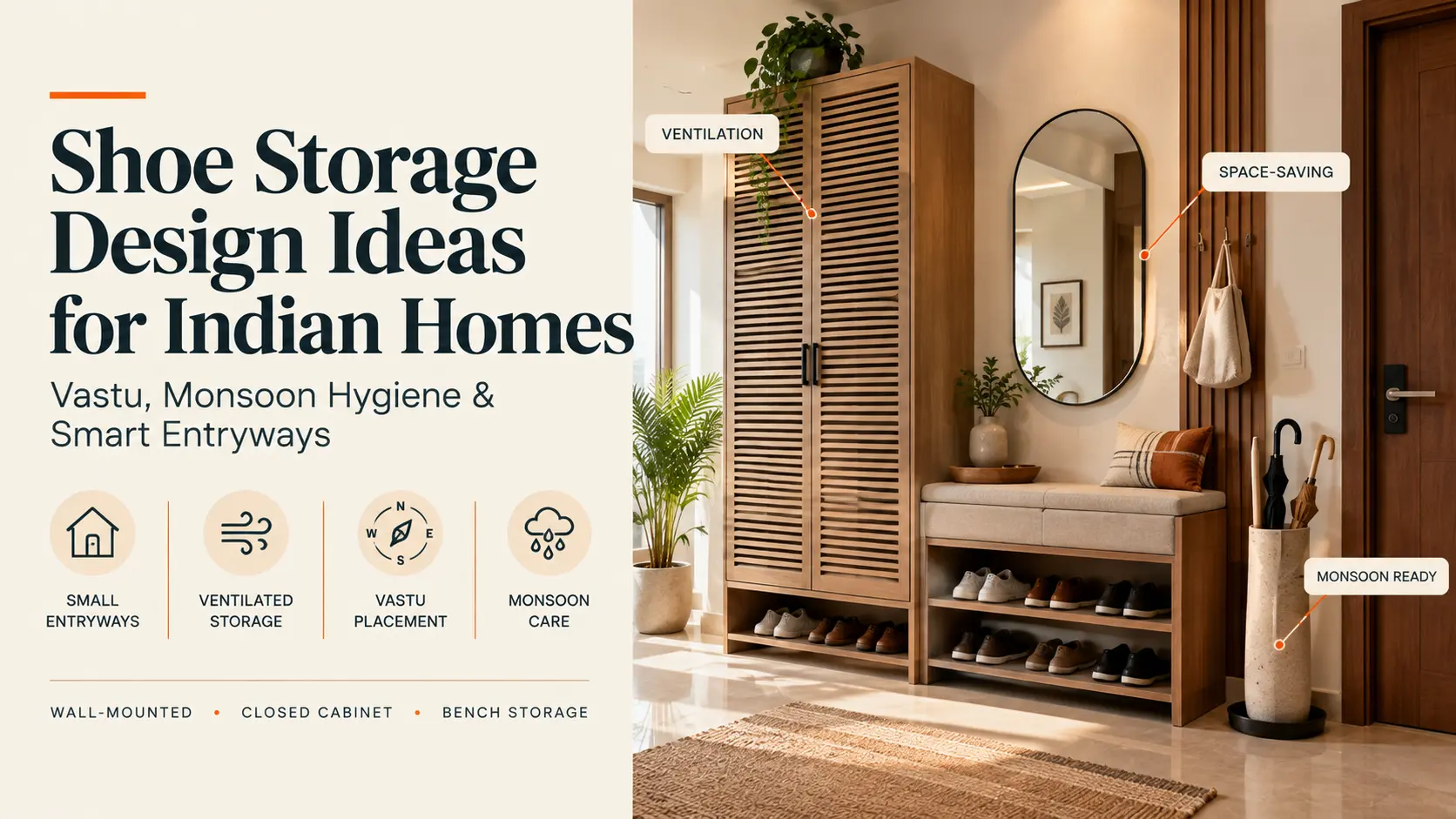
- Prioritise ventilation over a fully sealed cabinet; slatted doors, small vents, or hole-punched panel designs let shoes actually dry rather than trapping moisture inside a closed box, which is exactly what encourages odour and mould.
- Use moisture absorbers, silica gel packets, or a small charcoal sachet inside the cabinet during the wettest months specifically.
- Let shoes dry fully before storing them, rather than putting damp footwear straight back into a closed rack after being caught in rain.
- Keep outdoor shoes separate from indoor slippers, both for hygiene and to limit how much street dust and moisture actually enters the living space.
Design Ideas for Small Indian Entryways
For a compact apartment entrance, a wall-mounted cabinet with slatted or hole-punched doors frees up floor space entirely while still allowing shoes to breathe genuinely useful for leather footwear specifically. A stackable, modular rack lets you start with a basic two-tier unit and add layers as your household's shoe collection grows, a practical, incremental approach for a growing family rather than committing to one large piece upfront.If you're working with limited apartment space, our guide to best interior upgrades for apartments has more ideas for using vertical and multifunctional storage.
Where space allows even a small bench, a bench-integrated storage unit with shoes below and a padded seat on top makes putting on and removing shoes considerably more comfortable, and doubles as a natural "decompression" spot between the outside world and the rest of the home. If umbrellas are a regular part of your entryway too, a slim umbrella stand with a built-in drip tray or drainage hole prevents the puddle-and-slip problem a bare umbrella against the wall usually creates during the rains.





Ans 1. Check your specific housing society's bye-laws first many restrict private use of shared corridors and refuge areas, and this can lead to fines or forced removal, particularly if the rack obstructs a fire escape route.
Ans 2. The southwest or west corner of the entrance is the strong consensus favourable direction. The northeast corner should be avoided.
Ans 3. Closed, with ventilation a closed cabinet with slats or small vents keeps the entrance visually clean while still allowing shoes to dry and breathe, avoiding the odour buildup a fully sealed cabinet can cause.
Ans 4. Use a raised or elevated rack, prioritise ventilation, add moisture absorbers like silica gel or charcoal, and let shoes dry fully before putting them back in storage.
Ans 5. A wall-mounted, slatted-door cabinet saves floor space while allowing airflow; a stackable modular rack lets you expand storage gradually as needed.
Ans 6. No more guidance, both Vastu-based and practical, recommends placing it to the side of the entrance rather than directly opposite the main door.
Ans 7. It's better to keep them separate, both for hygiene and to limit how much outside dust and moisture make it further into the home.