
✦ AI Summary
Table of Content
▲
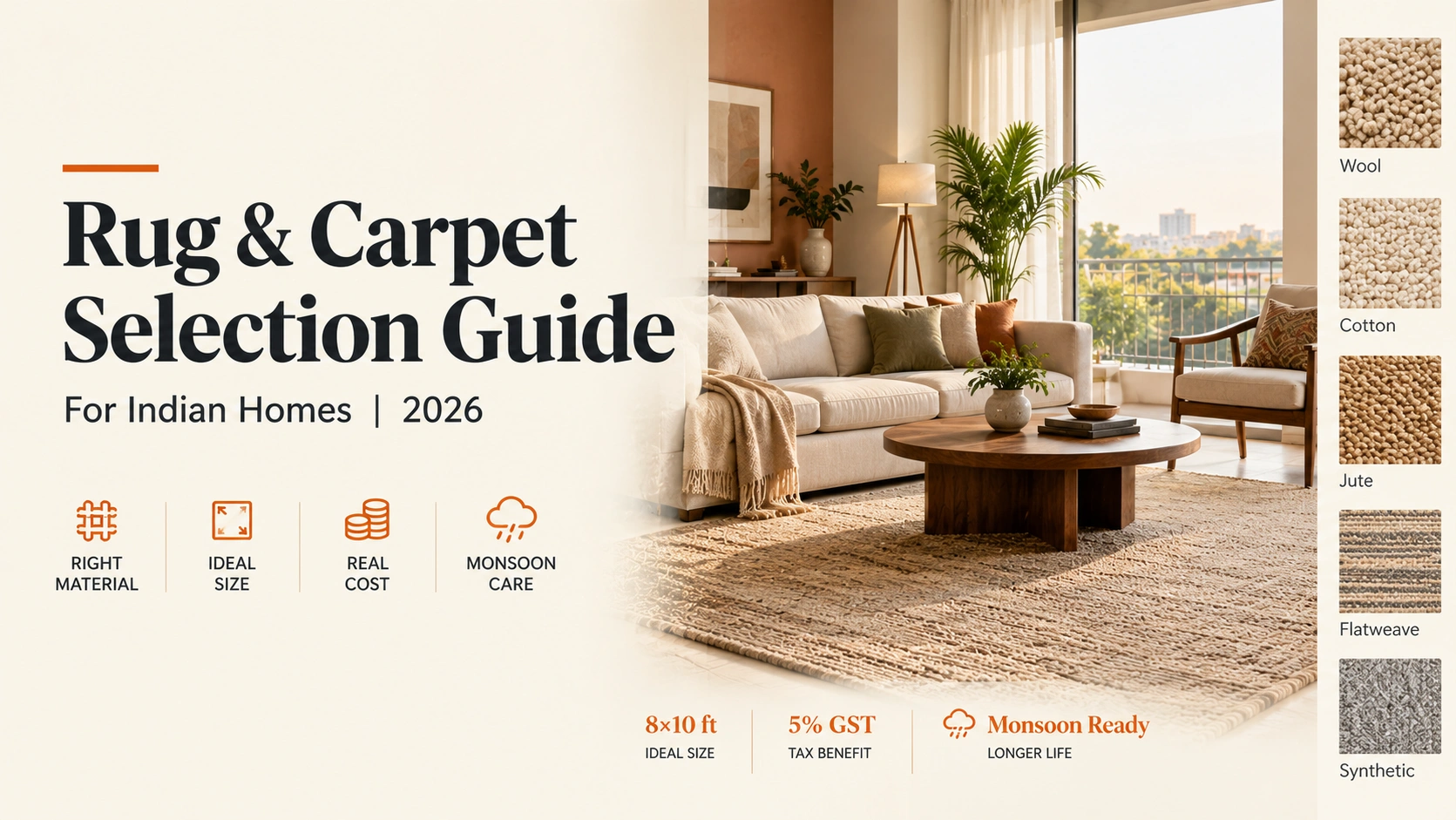
A rug is one of the few furnishing decisions in an Indian home where the climate genuinely dictates the right answer more than taste does. The same wool rug that feels perfect in a Shimla living room can smell faintly of damp wool in a Kochi monsoon. This guide sticks to what actually determines a good buy: material suited to your climate, size that matches your furniture, and a price that reflects what the market actually charges.
Choosing the Right Material for Indian Weather
Wool remains the standard recommendation for most Indian homes, and for good reason: it's naturally stain-resistant, doesn't trap heat the way synthetic fibres do, and a well-made hand-knotted wool rug can genuinely last decades. It performs well across most of India's climate range, from dry interior heat to moderate humidity, though in a consistently damp coastal home it still needs proper ventilation to avoid a musty smell over time.
Cotton dhurries are the practical, lightweight choice for hot, humid regions. They're flatwoven, so there's no pile to trap dust or moisture, they're machine-washable in smaller sizes, and they don't hold heat the way a thick pile rug does a real advantage through an Indian summer.
Jute and sisal suit high-traffic, dusty areas well since there's no pile for dust to settle into, though they're less comfortable underfoot and can feel rough for a bedroom.
Synthetic fibres (nylon, polypropylene) are durable and inexpensive, but cheap synthetic blends, especially high-pile shaggy styles, trap heat and can develop an odour in humid months. If budget calls for synthetic, choose a low-pile, well-ventilated design over a thick shag.
For households with pets, children, or dust allergies, avoid loop-pile weaves; specifically, loops snag on claws and hold allergens deeper than a cut pile or flatweave.
The choice of rug should also work with the broader room design, especially where flooring, furniture, and textiles need to feel coordinated. For more inspiration, explore these floor carpet designs for home.
What Size Rug Do You Actually Need?
Getting the size wrong is the single most common rug mistake, and it's avoidable with simple rules tied to your furniture, not your room.
Living room: the rug should be large enough that at least the front legs of every major seating piece rest on it. For a standard mid-size living room, 8×10 ft is the most versatile choice; larger rooms suit 9×12 ft. The rug should also reinforce the furniture layout rather than compete with it. For more ideas on creating a practical Indian living room, see our guide to simple Indian middle-class living room ideas.
Dining table: add roughly 24 inches (60 cm) of rug beyond the table's edge on every side, so chairs stay on the rug even when pulled back. A 6-seater rectangular table typically needs a 6×9 ft rug; an 8-seater needs 8×10 ft or larger.
Bedroom: for a standard Indian queen or king bed, choose a rug that extends at least 18–24 inches beyond the sides and foot of the bed, so your feet land on it, not the floor, when you get up. A 9×12 ft rug works well for a king bed placed with about two-thirds of the rug extending from under the bed.
As a general rule, when you're between two sizes, buy the larger one; an undersized rug reads as an afterthought, while a properly sized one anchors the room.
Hand-Knotted, Hand-Tufted, or Flatweave What's the Real Difference?
Hand-knotted rugs, the kind Bhadohi and Kashmir are internationally known for, are the most durable and long-lasting option, since each knot is tied individually and there's no glue backing to fail over time. They cost more but are the right choice for a rug you expect to keep for years in a high-traffic living room.
Hand-tufted rugs use a stencilled design with yarn punched through a fabric backing, held with glue. They're more affordable and quicker to produce, but the backing can degrade and shed over years of heavy use, a reasonable choice for a lower-traffic room or a shorter-term budget.
Flatweave (dhurries, kilims) have no pile at all, are reversible, lightweight, and the easiest of all types to clean genuinely well-suited to Indian heat and dust, as noted above.
Construction is only one part of the decision; the rug's colour, pattern and relationship with the rest of the room also matter. See these floor carpet designs for home for additional design references.
What Should You Actually Pay? (Cost and GST)
Prices vary enormously by material and construction, but as a rough benchmark, a good-quality hand-tufted wool rug typically runs ₹350–900 per sq ft, meaning a standard 6×9 ft (54 sq ft) rug lands around ₹19,000–₹49,000, and an 8×10 ft (80 sq ft) around ₹28,000–₹72,000. Hand-knotted wool or silk-blend pieces cost meaningfully more given the labour involved.
On tax: under GST 2.0, effective 22 September 2025, all carpets and rugs under HSN Chapter 57 handmade and machine-made alike attract a uniform 5% GST. This replaced the earlier structure where handmade carpets were taxed at 5% but machine-made ones at 12%, so if you see a machine-made carpet quoted with 12% GST added, that figure is out of date and worth querying with the seller.
Caring for Your Rug Through an Indian Monsoon
This is the one area where Indian conditions demand genuinely different advice than a Western rug-care guide would give. During the monsoon, ventilate the room well and use a dehumidifier where possible; avoid vacuuming a rug while it's still damp, since this can push moisture deeper into the fibres. Sun-dry the rug when weather allows, and blot spills immediately rather than rubbing them in. For wool and hand-knotted rugs specifically, a professional clean every 12–18 months is worth the cost, and rotating the rug quarterly helps it wear and fade evenly under India's strong natural light.
Rugs can also be used to define smaller outdoor spaces, but balcony rugs need a different approach to moisture and weather exposure. See our guide to balcony makeover ideas for more ideas.








Ans 1. Wool is generally the best all-round choice, stain-resistant, doesn't trap heat, and durable for decades. Cotton dhurries suit hot, humid regions better; jute suits high-traffic, dusty areas.
Ans 2. Large enough that the front legs of your main seating rest on it, 8×10 ft works for most mid-size living rooms, 9×12 ft for larger ones.
Ans 3. For a long-term, high-traffic room, yes, hand-knotted rugs have no glue backing to degrade and last considerably longer. For a lower-traffic room or tighter budget, hand-tufted is a reasonable compromise.
Ans 4. A uniform 5% GST applies to all carpets and rugs under HSN Chapter 57, handmade or machine-made, effective from GST 2.0 on 22 September 2025.
Ans 5. Ventilate the room, avoid vacuuming while damp, sun-dry when possible, and choose a lower-pile or flatweave design in consistently humid regions.
Ans 6. Not necessarily, but avoid thick, cheap synthetic shag rugs specifically they trap heat and can develop odour in humidity. A low-pile synthetic is a reasonable budget option.
Ans 7. Add about 24 inches beyond the table's edge on all sides so chairs stay on the rug when pulled back typically 6×9 ft for a 6-seater, 8×10 ft or larger for 8 seats.