
✦ AI Summary
Table of Content
▲
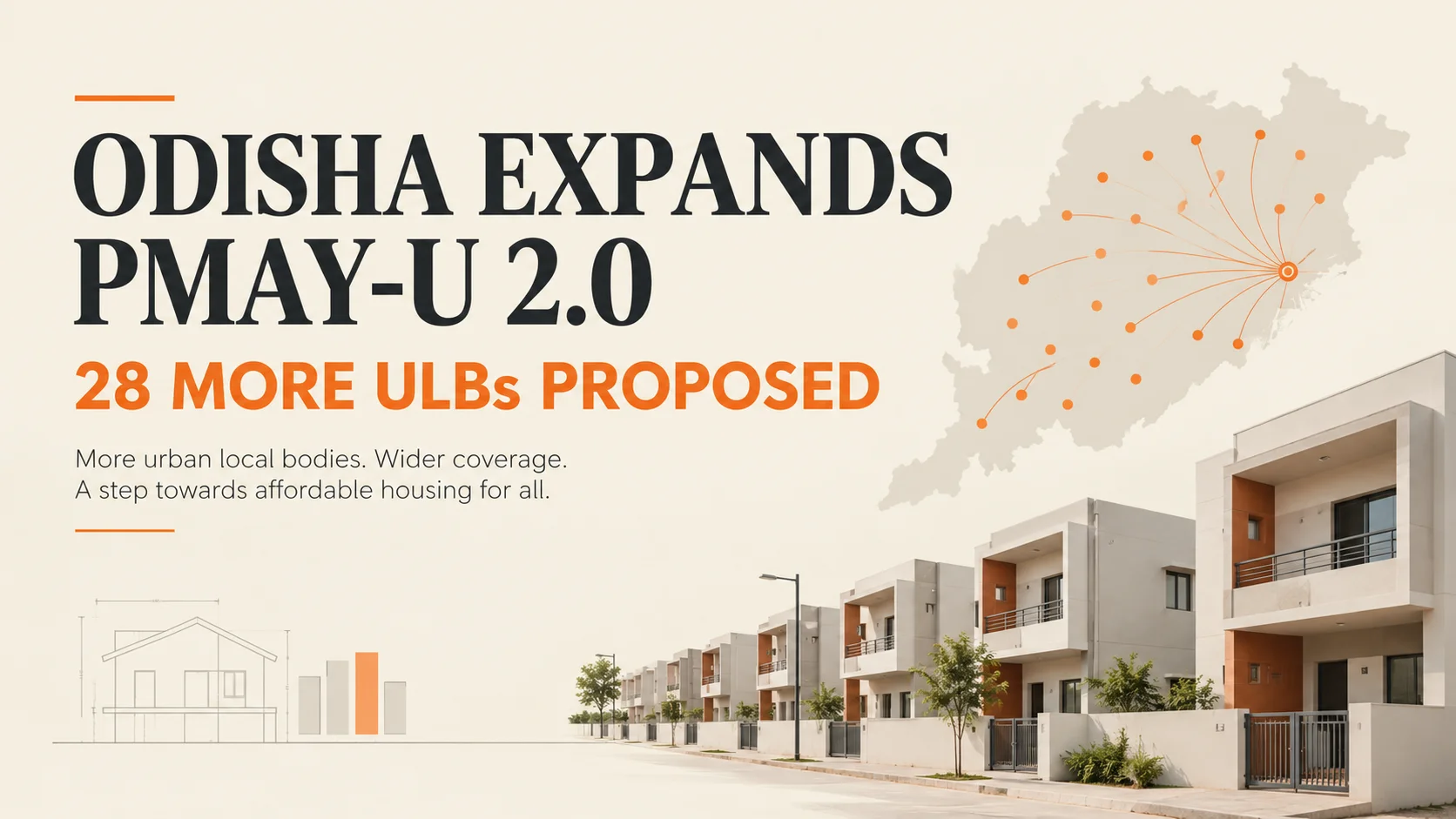
Bhubaneswar: Odisha has proposed bringing 28 more urban local bodies (ULBs) under the Pradhan Mantri Awas Yojana-Urban 2.0, a move that could extend the central housing programme to all 100 ULBs in the state.
The Housing and Urban Development Department has directed executive officers of the proposed ULBs to begin identifying eligible beneficiaries and undertake preparatory work for implementing the scheme.
The proposal comes as Odisha is already progressing with PMAY-U 2.0. The state has sanctioned 24,625 houses so far, with construction at different stages across participating urban areas.
28 ULBs proposed for inclusion
The latest proposal would bring 28 additional urban local bodies into PMAY-U 2.0.
The move could widen access to the housing programme in smaller towns, where demand for affordable housing has been increasing.
According to the department's instructions, executive officers of the proposed ULBs will undertake beneficiary identification and facilitate enrolment in accordance with PMAY-U 2.0 guidelines. The process will include checking applicants' housing and income status.
Among the ULBs named in the report are Badamba, Narasinghpur and Salipur in Cuttack district and Pallahara in Angul district.
The proposed inclusion does not mean that houses have already been sanctioned for families in these ULBs. Individual beneficiaries will still have to meet the scheme's eligibility conditions and go through the required verification process.
If approved and implemented, the expansion would take PMAY-U 2.0's coverage across Odisha to all 100 ULBs.
Odisha has already sanctioned 24,625 houses
The proposed expansion comes against the backdrop of ongoing PMAY-U 2.0 implementation in the state.
Odisha has already sanctioned 24,625 houses under the scheme. Of these, 23,464 sites have been geo-tagged, while foundation work has begun for 3,134 houses. Another 2,008 houses have reached the completion stage, according to figures reported by the state's housing and urban development authorities.
These figures cover different stages of the housing pipeline. A sanctioned house is not necessarily under construction, while geo-tagging, foundation work and completion represent subsequent stages of implementation.
The addition of 28 more ULBs will therefore create a new beneficiary-identification and enrolment pipeline alongside the existing construction programme.
What is PMAY-U 2.0?
PMAY-U 2.0 is the Centre's urban housing programme for eligible families living in urban areas who do not own a pucca house anywhere in India.
The scheme came into effect on September 1, 2024 and is designed to support eligible EWS, LIG and MIG households through four verticals: Beneficiary Led Construction (BLC), Affordable Housing in Partnership (AHP), Affordable Rental Housing (ARH) and the Interest Subsidy Scheme (ISS).
The programme is intended to help eligible households construct, purchase or rent homes at affordable costs.
Under the operational guidelines, EWS households are generally defined as those with annual income up to ₹3 lakh, LIG households as those with annual income between ₹3 lakh and ₹6 lakh, and MIG households as those with annual income between ₹6 lakh and ₹9 lakh.
Another important condition is that the beneficiary family should not own a pucca house anywhere in the country.
Who could benefit from the Odisha expansion?
The proposed expansion could make more urban households eligible to seek assistance under PMAY-U 2.0, provided they satisfy the scheme's conditions.
Broadly, the programme covers:
- EWS: Annual household income up to ₹3 lakh
- LIG: Annual household income above ₹3 lakh and up to ₹6 lakh
- MIG: Annual household income above ₹6 lakh and up to ₹9 lakh
The income categories are only one part of the eligibility assessment. Applicants must also meet the housing ownership conditions and other requirements prescribed under PMAY-U 2.0.
For the 28 proposed ULBs, local officials will first have to identify potential beneficiaries and verify their eligibility.
This means households in these areas should not treat the proposal as an automatic approval of housing assistance. The actual benefit will depend on individual eligibility and subsequent enrollment.
Why the expansion matters for smaller towns
The proposed inclusion is particularly relevant because it extends the administrative reach of PMAY-U 2.0 beyond the ULBs already participating in the programme.
Smaller urban centres often face a different housing challenge from large cities. Land availability may be better, but household incomes, formal housing supply and access to housing finance can vary significantly.
Bringing more ULBs into the scheme gives local administrations a framework through which eligible households can be identified and connected with central housing assistance.
The success of the expansion, however, will depend on implementation at the local level.
Beneficiary identification, document verification, enrolment and construction monitoring will all need to move in sequence. The experience of the existing ULBs will also be relevant as Odisha takes the programme to more urban areas.
Odisha's wider affordable housing push
The PMAY-U 2.0 expansion is taking place alongside other affordable housing initiatives in Odisha.
The state has been exploring rental housing as another way of addressing urban housing needs. In February 2026, Odisha began identifying vacant and unused government buildings that could potentially be converted into affordable rental housing for urban migrants, workers and other households unable to immediately purchase homes.
The state is also implementing affordable housing projects through public-private partnerships. Five projects across Bhubaneswar, Cuttack and Rourkela were reported to involve more than 5,000 dwelling units for economically weaker and lower-income households.
These initiatives indicate that Odisha's urban housing strategy is extending beyond individual ownership housing to include rental and partnership-based models.
What happens next?
For the 28 proposed ULBs, the immediate task is beneficiary identification.
Executive officers will have to identify potential applicants, verify their housing and income status and facilitate enrolment under the PMAY-U 2.0 guidelines. The process will determine which households qualify before housing assistance can move forward.
The proposal itself should therefore not be interpreted as a sanction of 28 new batches of houses.
It is an expansion of the programme's proposed geographical coverage.
If the proposal is implemented, PMAY-U 2.0 will have a presence across all 100 ULBs in Odisha. The next measure of progress will be how efficiently the newly proposed ULBs move from beneficiary identification to verified enrolment and, eventually, completed homes.
For Odisha, the latest proposal adds another layer to an already active urban housing programme with the focus now shifting towards bringing more local bodies and eligible households into the system.

Ans 1. Odisha has proposed adding 28 more Urban Local Bodies under PMAY-U 2.0. If implemented, the scheme would cover all 100 ULBs in the state.
Ans 2. Odisha has sanctioned 24,625 houses under PMAY-U 2.0, according to the latest reported figures.
Ans 3. A total of 23,464 sites linked to sanctioned houses have been geo-tagged, according to the reported state figures.
Ans 4. As of the latest reported update, 2,008 houses had reached the completion stage.
Ans 5. PMAY-U 2.0 covers eligible EWS, LIG and MIG families living in urban areas that do not own a pucca house anywhere in India, subject to other scheme conditions.
Ans 6. Under the operational guidelines, EWS households have annual income up to ₹3 lakh, LIG households have income above ₹3 lakh and up to ₹6 lakh, and MIG households have income above ₹6 lakh and up to ₹9 lakh.
Ans 7. No. ULB inclusion expands the scheme's coverage. Individual applicants must still meet the eligibility requirements and complete the required verification and enrolment process.
Ans 8. The reported list includes Badamba, Narasinghpur and Salipur in Cuttack district and Pallahara in Angul district, among the 28 proposed additions.