
✦ AI Summary
Table of Content
▲- What is the SVAMITVA Scheme and why does it Matter?
- Why Has Madhya Pradesh Approved This New Scheme?
- Major Benefits for Rural Property Owners
- SVAMITVA Before and After Registration
- No Stamp Duty or Registration Charges for Beneficiaries
- How Will the Scheme Be Implemented?
- Why This Decision Matters for Madhya Pradesh Real Estate
- Conclusion
For many years, millions of families throughout rural areas of Madhya Pradesh have been living on land that has been passed down to them from their ancestors without any documented proof of ownership. Even though family members occupied and used these lands for generations, having no title deeds has historically made it difficult to obtain loans from banks, resolve issues of land ownership and establish legally recognized possession of the land.
In an effort to promote rural property rights, the Madhya Pradesh Cabinet has approved the establishment of the SVAMITVA Adhikar Abhilekh Nispadan Evam Panjiyan Yojana 2026. This new program will allow eligible landowners to register their property and obtain recognized proof of ownership through title deeds based on their participation in SVAMITVA program activities.
The decision is expected to benefit millions of rural residents by giving them legal ownership documents that can be used for financial and administrative purposes.
What is the SVAMITVA Scheme and why does it Matter?
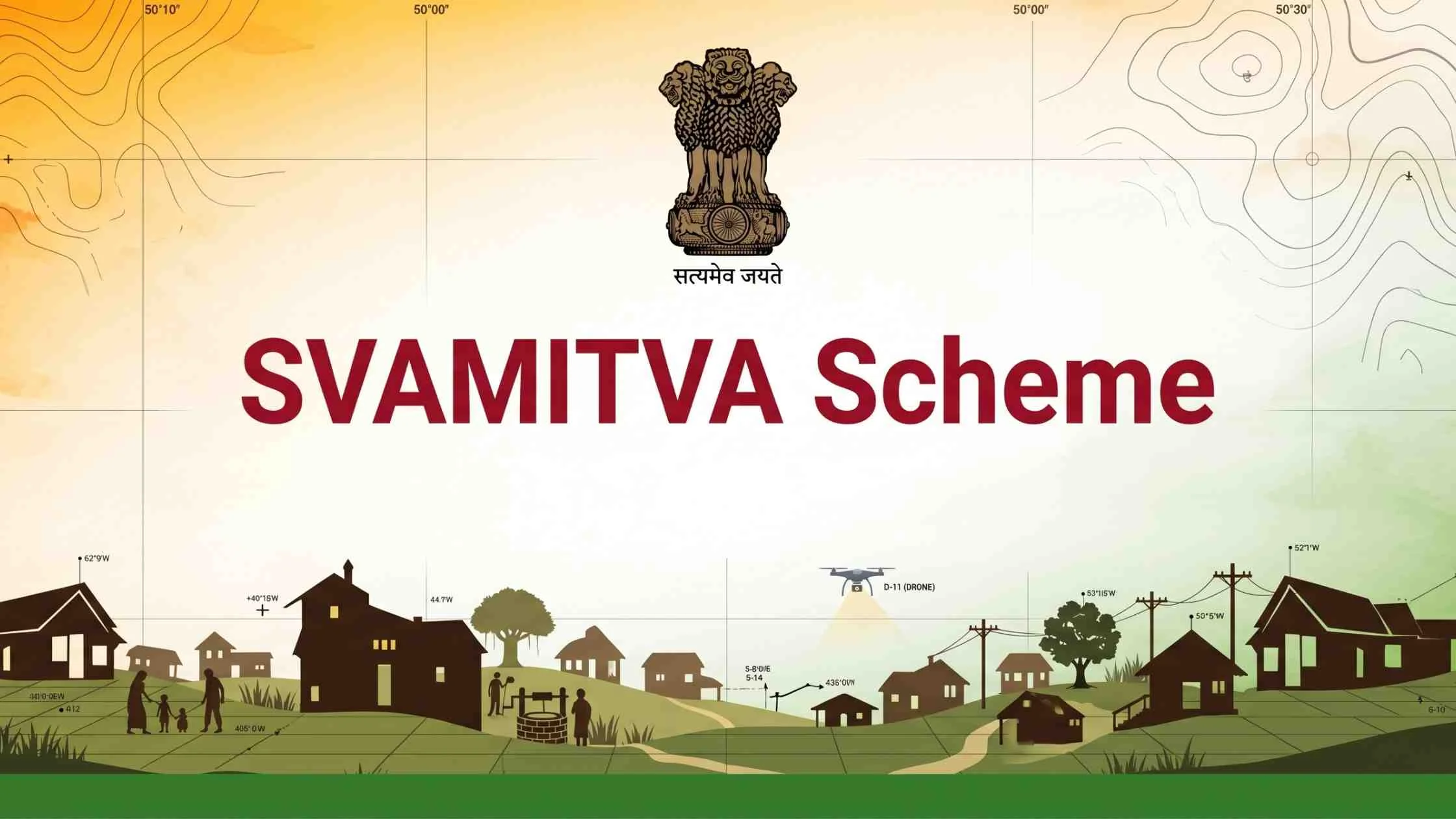
Launched in April 2020 through India’s Ministry of Panchayati Raj and the Ministry of Rural Development, the SVAMITVA scheme provides undisputed evidence of ownership of land in the rural areas of India. Using advanced technology and survey methods, the scheme is creating ownership records for over 600,000 villages across 28 states of India.
The use of drone technology is a noticeable change from previous methods of surveying. This new technology has a much higher degree of accuracy than traditional manual surveys and the results will be available much more quickly than previously done by manual means. The SVAMITVA scheme will provide villages with an understanding of their land’s boundaries and current use for the purpose of conducting business with the local government–which can lead to improvements in the quality of life for the residents.
Key objectives that SVAMITVA was designed to achieve
- Creating accurate, digitally mapped property records for rural habitations that didn't previously exist in formal government records
- Reducing the land and boundary disputes that arise from unclear property demarcation, where neighbours contest boundaries because nothing was formally recorded
- Giving villagers their first legally documented property ownership rights, enabling them to use their property as a recognised financial asset
- Improving access to institutional credit by providing the ownership documentation that banks require as collateral for loans
- Strengthening village-level planning and administration by creating a comprehensive database of property ownership
Also Read: Madhya Pradesh Circle Rate 2025 Complete Property Guide
Why Has Madhya Pradesh Approved This New Scheme?
The SVAMITVA Adhikar Abhilekh Nispadan Evam Panjiyan Yojana 2026 creates a formal registration mechanism to convert SVAMITVA ownership records into legally registered property documents. The scheme's design reflects an understanding that simply creating records isn't sufficient if beneficiaries can't afford or navigate the registration process to turn those records into legal titles.
Understanding the practical significance of what Madhya Pradesh has approved requires understanding what the absence of title deeds actually costs rural families because it's not an abstract administrative inconvenience. It's a concrete, daily economic limitation.
Credit access is the most immediate cost. When a rural family needs money for medical treatment, for a child's education, for rebuilding after a disaster, for starting a small business, the formal banking system's first question is: what collateral can you offer? The family's home, which may be worth lakhs of rupees, should logically serve as collateral. Without a registered title deed, it cannot. The family is pushed toward moneylenders who charge interest rates that formal credit never would.
Ownership disputes are the second major cost. Without formal documentation, any sufficiently motivated neighbour, relative, or outsider can contest a family's claim to their property. Disputes about boundary lines, inheritance rights, and succession are endemic in rural India's unregistered property environment and they're expensive, stressful, time-consuming even when you're in the right.
Transaction limitations are the third cost. Selling, transferring, or using undocumented rural property for any formal purpose is complicated, opaque, and subject to being challenged. Families who need or want to transact their property; whether to sell, to gift, to mortgage, or to pass to the next generation clearly face obstacles that simply don't exist for holders of registered title deeds.
All of these costs compound over generations. Property without documentation becomes harder to prove ownership of over time as original occupants pass away and the chain of possession becomes more difficult to establish without records.
Major Benefits for Rural Property Owners
The approval of the scheme is expected to bring several economic and legal benefits for rural households.
Easier Access to Loans
One of the biggest advantages is improved access to credit. Property owners can use registered title deeds as collateral for:
- Home construction loans
- Agricultural loans
- Business expansion loans
- Education financing
- Other institutional credit facilities
Registered ownership documents significantly improve a borrower's credibility with banks and financial institutions.
Reduced Property Disputes
Clear ownership records can help minimize disputes related to:
- Property boundaries
- Inheritance claims
- Unauthorized occupation
- Ownership verification
Increased Property Value
Properties with legally recognized ownership documents generally enjoy greater market acceptance and higher transaction transparency.
Stronger Economic Security
Legal ownership creates a valuable asset that families can leverage for long-term financial stability and wealth creation.
SVAMITVA Before and After Registration
|
Particulars |
Before Registration |
After Registration |
|
Ownership Proof |
Limited or informal |
Legally recognized |
|
Loan Eligibility |
Difficult |
Easier access |
|
Property Disputes |
Higher possibility |
Reduced risk |
|
Property Transactions |
Complex |
More transparent |
|
Government Benefits |
Limited documentation |
Better eligibility |
|
Financial Security |
Lower |
Higher |
The comparison captures the fundamental shift the scheme creates converting property from a traditionally undocumented asset that families live on but can't leverage, into a recognised financial and legal instrument that works for them in the formal economy.
Also Read: Omaxe Group Secures ₹75 Crore from WSB Partners for Tier II Real Estate Plots in Indore and Ujjain
No Stamp Duty or Registration Charges for Beneficiaries
One of the most notable aspects of the scheme is that eligible citizens will not have to bear registration-related expenses. The Madhya Pradesh government has announced that the entire expenditure for registration and implementation will be borne by the state. The estimated financial commitment for the initiative is around ₹3,800 crore.
This waiver is expected to encourage widespread participation and ensure that rural families can obtain legal ownership documents without financial burden.
How Will the Scheme Be Implemented?
The state government plans to execute the programme through a special campaign. For smooth implementation, a dedicated committee will be constituted under the Commissioner of Land Resource Management. The committee will:
- Frame operational guidelines
- Monitor implementation progress
- Resolve procedural issues
- Conduct periodic reviews
- Coordinate with relevant departments
Additionally, the government has approved funding for awareness campaigns and publicity efforts to ensure maximum outreach among eligible beneficiaries.
Why This Decision Matters for Madhya Pradesh Real Estate
The MP Cabinet's decision has implications beyond individual families; it represents a meaningful improvement in the state's rural property documentation infrastructure that benefits the broader real estate and credit ecosystem.
Rural credit penetration in MP has been limited partly by the collateral challenge. When rural property is widely undocumented, banks have fewer options for secured rural lending. As title registration spreads across MP's villages, the collateral base for rural lending expands which should improve credit availability for rural households.
Property record management in India's rural areas is often chaotic, fragmented, and inconsistent between different records maintained by different departments. SVAMITVA-driven registration creates a unified, digitally mapped record that different departments can access, improving administrative efficiency and reducing the scope for record manipulation that undermines trust in land records.
Reduced litigation court dockets across India are burdened with land disputes, many of which originate from inadequate documentation in rural areas. As formal ownership records spread through registration, the basis for many of these disputes is removed or significantly weakened, potentially reducing the litigation burden on courts over time.
Increased economic activity when rural property owners can leverage their assets for credit, they can invest in home improvement, agricultural productivity improvement, and small business development in ways that stimulate local economic activity. The economic multiplier from formalising rural property rights is well-documented in development economics literature.
Experts believe that formalizing ownership rights can unlock economic potential by converting undocumented properties into recognized financial assets.
Conclusion
The Madhya Pradesh government has approved the SVAMITVA registration scheme, which will allow for the official title deed of properties in rural areas. This milestone is seen as the beginning of the process to reform rural property ownership by providing residents with legally recorded title deeds that will give them more secure ownership rights and allow them to access financing with their properties while reducing long-time property challenges.
For many Indian families living in rural areas, this will lead to a transformation of their land or properties as previously un-documented physical assets into a legally defined source of economic power, thus facilitating additional growth, investment and financial security.


Ans 1. The SVAMITVA Adhikar Abhilekh Nispadan Evam Panjiyan Yojana 2026 is a Madhya Pradesh state government scheme approved by the Cabinet to formally register property ownership records created under the Central Government's SVAMITVA initiative and issue legally recognised title deeds to eligible rural property owners. The scheme will convert the 68.11 lakh ownership records already created in MP including 48.32 lakh private properties into registered legal documents. The entire registration cost of approximately ₹3,800 crore will be borne by the state, with no charge to beneficiaries.
Ans 2. The SVAMITVA Scheme is a Central Government programme launched to create property ownership records for residential properties in rural inhabited areas that lack formal documentation. Using drone-based surveys and modern mapping technology, the scheme identifies property boundaries, creates accurate cadastral maps of rural habitations, and generates ownership records for individual households. These records document who occupies and owns each residential property in village habitation areas. The MP state scheme extends this by converting the ownership records into legally registered title deeds through a formal registration process at no cost to beneficiaries.
Ans 3. Eligibility for SVAMITVA title deeds in Madhya Pradesh covers rural property owners in village habitation areas who have been identified through the drone-based survey process and have an ownership record created under the SVAMITVA programme. The scheme targets families who have been living on and possessing residential properties in rural areas without formal registered ownership documentation. The specific eligibility conditions and verification process will be detailed in the operational guidelines to be framed by the implementation committee under the Commissioner of Land Resource Management.
Ans 4. There is no cost to beneficiaries under the SVAMITVA registration scheme in Madhya Pradesh. The state government has decided to bear the entire expenditure for registration and implementation — estimated at approximately ₹3,800 crore — without passing any stamp duty or registration charges to eligible rural property owners. This zero-cost approach is specifically designed to ensure that financial barriers don't prevent rural families from obtaining their registered title deeds. The state's decision to absorb the full cost reflects the scheme's focus on reaching the most economically vulnerable rural households.
Ans 5. SVAMITVA registered title deeds will help rural families access bank loans by providing formal property ownership documentation that banks and housing finance companies accept as collateral for secured lending. Without registered title, rural families cannot mortgage their homes to obtain formal credit and are forced to rely on informal moneylenders at significantly higher interest rates. With a registered title deed, families can approach scheduled commercial banks for home construction and renovation loans, agricultural loans, small business loans, and personal loans — all at regulated interest rates significantly lower than informal credit sources.
Ans 6. Madhya Pradesh has created more than 68.11 lakh ownership records under the SVAMITVA programme, of which approximately 48.32 lakh are private properties. The remaining records cover common or institutional properties in rural habitations. The new registration scheme is designed to convert all these ownership records into legally registered title deeds, with the implementation process to be monitored by a dedicated committee under the Commissioner of Land Resource Management. This scale makes MP's SVAMITVA registration one of the most ambitious rural property documentation programmes in India.
Ans 7. An ownership record under SVAMITVA is a survey-based document created through the drone mapping process that identifies who occupies and possesses a specific property in a rural habitation. It establishes a factual record of possession but may not carry the full legal force of a formally registered title document. A registered title deed is a document that has gone through the formal property registration process under the Registration Act, been recorded in government registration records, and is legally enforceable as proof of ownership with full evidentiary weight in courts and financial institutions. The MP scheme converts the former into the latter — giving rural property owners the strongest possible legal ownership documentation.
Ans 8. The SVAMITVA scheme reduces property disputes by creating formal, government-backed ownership records that establish clear boundaries and ownership of rural residential properties. Before the scheme, disputes about boundary lines, inheritance rights, and possession claims were common because no formal records existed to definitively resolve them. With registered title deeds establishing property boundaries through drone survey data and ownership through formal registration, the evidentiary bar for challenging ownership becomes much higher. Disputes based on informal memory, verbal claims, or contested informal possession become significantly harder to sustain against a registered title document in legal proceedings.
Ans 9. Drone technology is central to SVAMITVA's ability to create accurate property records at the scale India's rural areas require. Drone-based surveys allow mapping agencies to photograph rural habitations from above with high precision, creating detailed aerial imagery from which property boundaries can be accurately plotted. This approach is faster, more accurate, and more scalable than traditional ground-based manual surveys. The resulting maps show individual property boundaries within village habitations with precision that manual surveys couldn't achieve cost-effectively at this scale. The drone-generated boundary maps form the technical foundation of the ownership records that the MP registration scheme will convert into title deeds.
Ans 10. After receiving SVAMITVA registered title deeds, rural families become better positioned to access a range of government schemes that require property ownership documentation as an eligibility condition. These include housing schemes under PM Awas Yojana that require proof of land ownership for self-construction support, social welfare schemes with property-based eligibility verification, agricultural credit schemes linked to property as collateral, disaster relief and reconstruction assistance, and various state-level development schemes that verify beneficiary eligibility through property records. Many rural families have historically been excluded from schemes they qualify for simply because they couldn't prove formal property ownership.