
✦ AI Summary
Table of Content
▲
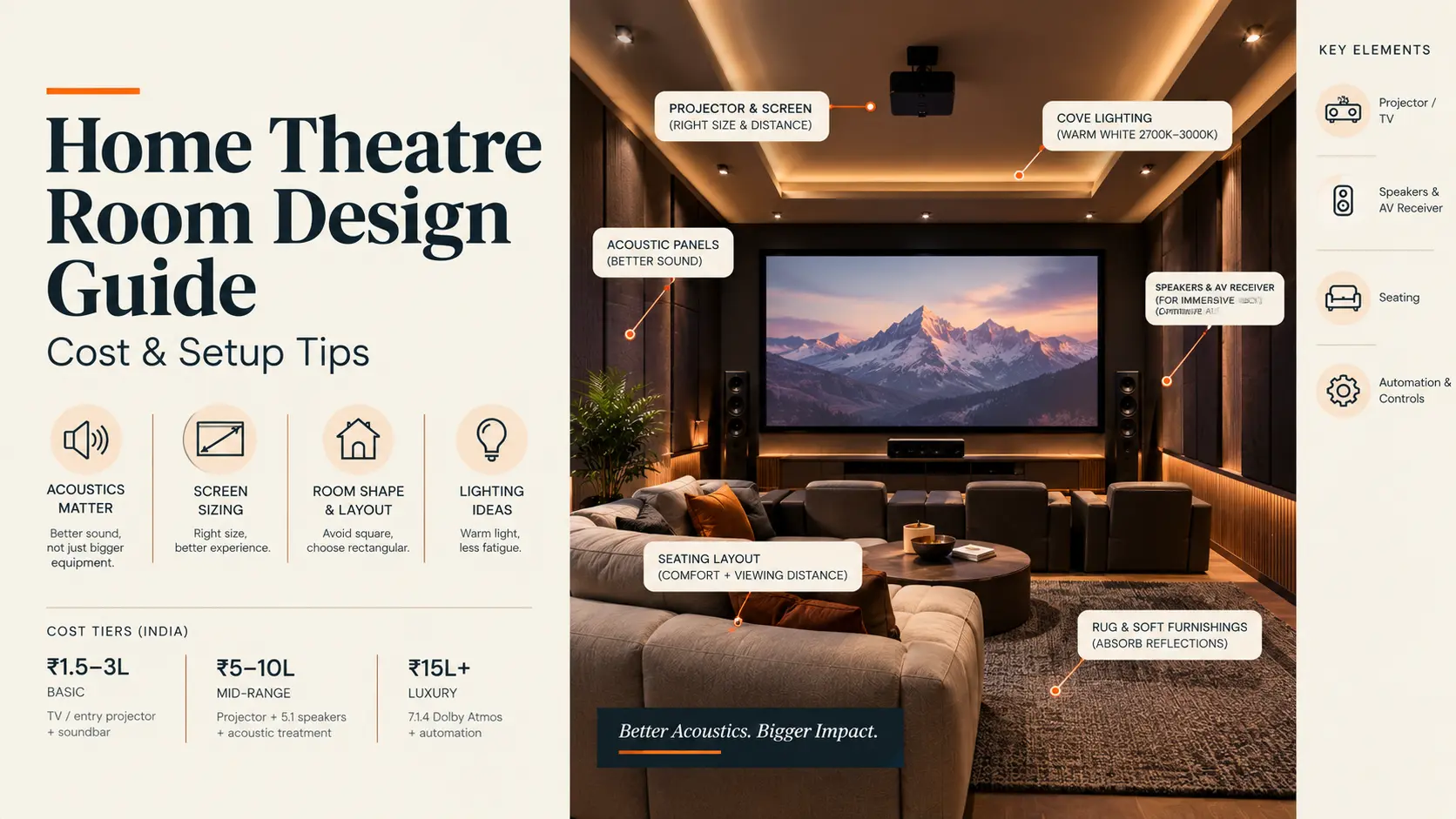
A home theatre can have an expensive projector and premium speakers and still sound disappointing if the room is untreated. Hard walls, glass, flooring and parallel surfaces create reflections and uneven bass that affect dialogue clarity and the listening experience. Acoustic panels, bass traps and other targeted treatments address these room-related problems directly. Recent home-theatre guidance and Indian acoustic specialists similarly place room acoustics among the most important factors in getting the best performance from a system.
Acoustics Matter More Than Equipment: Here's the Proof
The reason acoustic treatment outperforms equipment spending is straightforward. Untreated walls, glass, and hard flooring reflect sound unevenly, smearing dialogue clarity and making bass sound uneven depending on where you sit. No speaker upgrade fixes a room that's actively working against the sound of acoustic panels, bass traps in corners, and soft furnishings absorb and diffuse those reflections, which is why a modest, well-targeted acoustic investment can outperform a much larger equipment upgrade in the same untreated room.
The practical takeaway: if you're planning a theatre with a fixed budget, set aside money for acoustic treatment before finalising how much you'll spend on the projector or speakers, not after.
Dedicated Room or Living Room Setup?
Most Indian homes, especially apartments, don't have a spare room to convert into a theatre, which makes the living-room-integrated setup the realistic path for the majority of readers, not a compromise. This approach keeps existing seating and layout intact and adds a projector, retractable screen, floor-standing speakers, and considered lighting as additions to the room rather than a full conversion, genuinely effective when done deliberately rather than as an afterthought.
A true dedicated room, where it's possible, allows for proper acoustic design and a two-row seating layout, and is worth considering specifically in villas and larger duplex homes where a spare room genuinely exists and won't be missed for other use.
If the setup is being integrated into an existing living room, you can also explore these modern TV unit designs for living rooms for ways to combine the screen, storage, and entertainment equipment.
Getting the Room Shape and Screen Size Right
Room shape: perfectly square rooms should be avoided for a dedicated theatre; they create standing waves and uneven bass response. Rectangular rooms with non-integer ratios between width, length, and height perform noticeably better acoustically. A minimum of roughly 12×16 feet gives enough space for a proper single or two-row layout with correct viewing distance, and a ceiling height of 9–10 feet is generally considered ideal, giving room for a false-ceiling treatment without feeling low.
Subwoofer placement: always in a front corner or along the front wall, never centred. Centre placement creates standing waves that make bass sound uneven across different seating positions, a simple, often-overlooked fix.
Screen size: the widely used formula is recommended viewing distance = screen width × 1.2 for 4K content. This matters specifically for Indian apartment living rooms, most of which in cities like Noida and Delhi run 180–280 sq ft; for a room this size, an 85"–100" screen is the sensible range. Going larger than that at typical Indian living-room viewing distances causes neck strain and makes individual pixel structure visible up close, undermining the exact cinematic effect a bigger screen is meant to create.
Lighting That Actually Works for a Theatre
Cool white light (5000K and above) causes noticeable eye fatigue during extended viewing and should be avoided in a theatre space. Warm white bias lighting (2700K–3000K), kept at very low intensity, is the standard recommendation, ideally on a dimmer tied to the AV system so lighting drops automatically when playback starts. Cove-lit false ceilings, with a continuous LED channel run around the ceiling's perimeter, often in a pyramid or tray design, are currently the most requested ceiling style for Indian home theatres, since the same ceiling shell adapts well to both a dedicated room and a living-room-integrated setup. If you are planning the ceiling alongside the theatre, explore these modern false ceiling designs for halls for ideas on cove lighting, recessed lighting, and ceiling layouts.
For a broader understanding of how to plan lighting across different spaces, see our guide to lighting ideas for Indian homes.
What Does It Actually Cost?
Costs across current Indian sources vary enormously, but they cluster into three genuine tiers once you look at what actually changes at each level:
Basic (₹1.5–3 lakh): a large TV or entry projector with a soundbar, simple layout, no dedicated acoustic treatment. Suits a living-room-integrated setup on a moderate budget.
Mid-range (₹5–10 lakh): a proper projector, discrete 5.1 speaker system with an AV receiver rather than a soundbar, dedicated recliners, and basic acoustic treatment. In a dedicated room of roughly 150 sq ft, discrete speakers with a proper receiver consistently outperform a soundbar at the same price point.
Luxury (₹15 lakh and above, extending past ₹50 lakh): a dedicated, fully acoustically treated cinema room with 7.1.4 or higher Dolby Atmos configuration, laser projection, motorised recliners, and full home automation integrating display, audio, lighting, and curtains under single-point control.
Actual costs vary meaningfully by city, brand selection, and installation complexity, so treat these as planning tiers rather than a fixed quote, but the underlying principle holds across every tier: acoustic treatment and room design deliver more real improvement per rupee than an equipment upgrade in an untreated room.
If false ceiling work is part of the theatre renovation, also factor in the false ceiling cost per square foot in India before finalising your overall interior budget.








Ans 1. No, A living-room-integrated setup with a projector, retractable screen, and considered lighting works well and is the realistic option for most Indian apartments that don't have a spare room.
Ans 2. Use the formula: recommended viewing distance = screen width × 1.2 for 4K content. For a typical 180–280 sq ft Indian living room, an 85"–100" screen is the sensible range.
Ans 3. Acoustic treatment panels, bass traps, and soft furnishings reduce uneven sound reflections that no speaker upgrade can fix on its own. A documented case showed ₹45,000 of acoustic treatment outperforming further spending on an already ₹8 lakh equipment setup.
Ans 4. Always in a front corner or along the front wall never centred, since centre placement creates standing waves that make bass sound uneven across different seats.
Ans 5. Avoid perfectly square rooms, which create standing waves. Rectangular rooms with non-integer width-to-length-to-height ratios perform better acoustically.
Ans 6. Warm white bias lighting (2700K–3000K) at low intensity, ideally on a dimmer tied to the AV system. Avoid cool white (5000K+), which causes eye fatigue during extended viewing.
Ans 7. A basic setup with a large TV or entry projector and soundbar runs roughly ₹1.5–3 lakh. Mid-range setups with proper speakers and acoustic treatment run ₹5–10 lakh, and dedicated luxury cinema rooms start around ₹15 lakh and can exceed ₹50 lakh.