
✦ AI Summary
Table of Content
▲
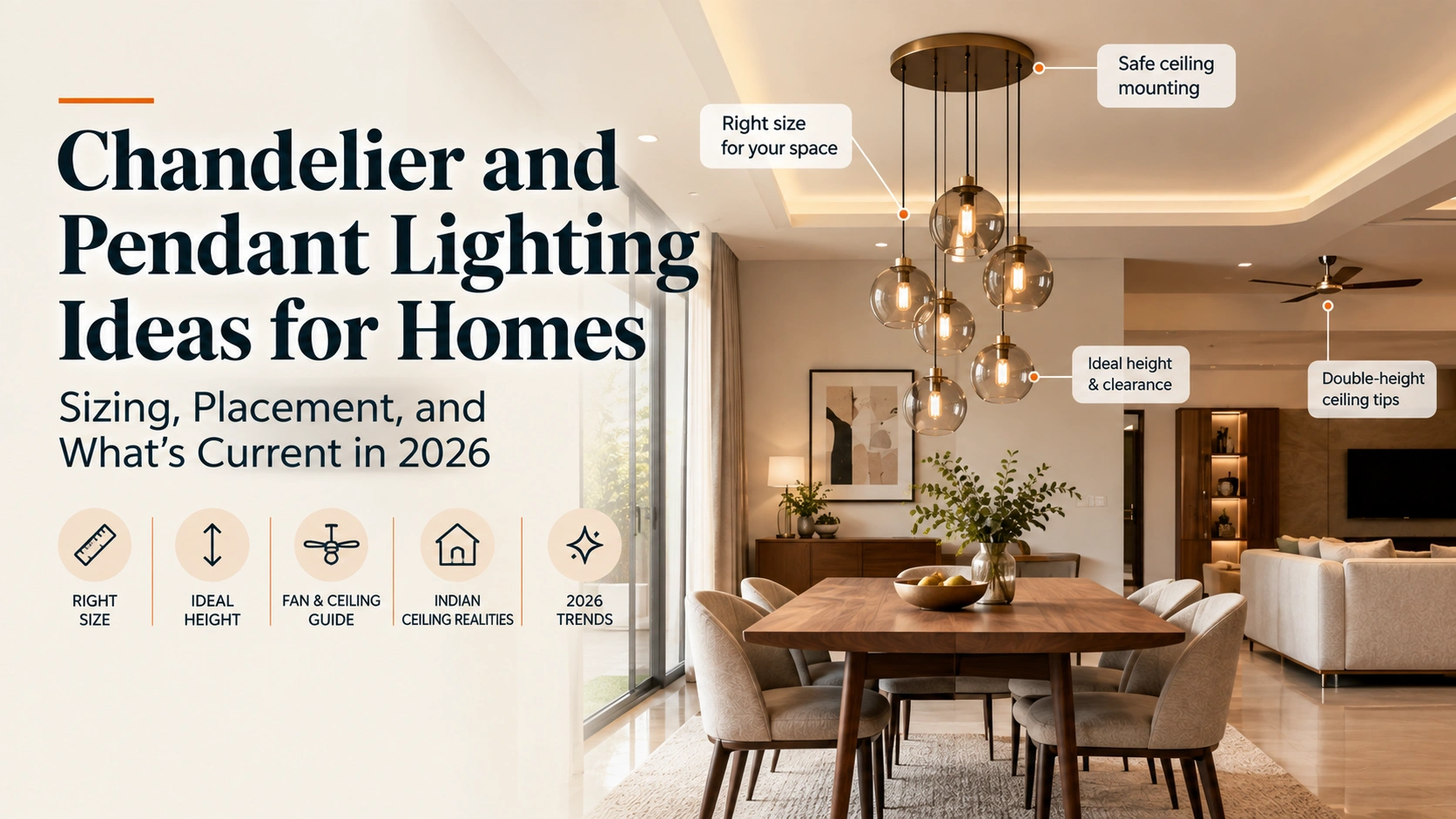
Getting chandelier and pendant lighting right comes down to arithmetic more than taste. A fixture that's the wrong size for its room or table looks like an afterthought or an overreach regardless of how beautiful it is individually, and this is genuinely the most common lighting mistake in Indian homes. Layered on top of that is a set of considerations most lighting content, written for Western, typically air-conditioned and fan-free homes, simply doesn't address: what happens when a chandelier has to share ceiling space with a fan, how a fixture should actually be mounted into a false ceiling without becoming a safety hazard, and how to handle the double-height ceilings common in Indian duplexes and villas.
For a broader room-by-room approach, see our guide to lighting ideas for Indian homes, including chandeliers, pendant lights, recessed lighting and accent lighting.
This guide covers the sizing math first, since it matters most, then the India-specific ceiling realities most guides skip, then current 2026 style trends and realistic cost expectations.
The Sizing Formula: Room-Based and Furniture-Based
There are two distinct sizing situations, and using the wrong one for your contexFor rooms or tables significantly longer than these formulas comfortably cover (generally beyond 10 feet), consider two smaller fixtures spaced evenly along the length, each sized roughly one-third smaller than a single fixture would be, rather than one oversized piece.
Getting the Height Right: Drop and Clearance Rules
Sizing gets a fixture's proportions right; height determines whether it's actually comfortable and functional in the space.
Above a dining table: leave 30 to 36 inches between the tabletop and the bottom of the fixture, extending to 36-40 inches for ceilings above 8 feet. This range keeps the fixture low enough to feel connected to the table and create intimacy, without hanging so low it obstructs sightlines across the table or bumps someone standing up.
In open spaces, foyers, and hallways: maintain at least 7 feet (about 213 cm) of clearance from the floor to the fixture's lowest point in any area where people walk beneath it, a genuine practical and safety consideration, not just an aesthetic one.
Fixture body height relative to ceiling height: as a general rule, add roughly 2.5 to 3 inches of fixture body height for every foot of ceiling height above a standard 8-foot baseline. A taller ceiling needs a visually taller (not just wider) fixture to feel properly proportioned, which is precisely why the double-height ceilings common in Indian homes need their own specific adjustment, covered next.
India-Specific Ceiling Realities Most Guides Miss
Double-Height Ceilings in Duplexes and Villas
Double-height living rooms, common in Indian duplexes, villas, and premium apartment developments, typically run 18-22 feet, considerably beyond what the standard formulas above were designed for. In this situation: first calculate the baseline diameter using the standard room formula (length + width), then scale that figure up by 10-30% depending on how visually dominant you want the fixture to be relative to the room's genuine vertical scale. A normally-sized chandelier, correctly calculated for the room's footprint alone, will look visually lost in this kind of vertical void without this adjustment.
The False Ceiling Mounting Safety Ruler is the single most common sizing mistake.
Room-based sizing, for a chandelier meant to anchor a general space like a living room or foyer rather than sit directly above a specific piece of furniture: add your room's length and width in feet to get the ideal chandelier diameter in inches. A 12 ft × 14 ft room calls for roughly a 26-inch diameter fixture; a 10 ft × 12 ft room calls for roughly 22 inches. This formula is consistently confirmed across numerous independent lighting sources and works reliably for rooms with standard 8-9 foot ceilings.
Furniture-based sizing, for a fixture hanging directly above a dining table or kitchen island, which is the more common real-world scenario and where most sizing mistakes actually happen: size the fixture to one-half to two-thirds of the table or island's length (or width, for a round table). Using the room's overall dimensions instead of the table's dimensions in this scenario is explicitly flagged across multiple sources as the single most frequent sizing error, since a chandelier correctly sized to the room can look badly oversized relative to the specific table beneath it.
This is genuinely the most important, most under-communicated point in this entire topic, and it belongs in a buying guide, not just in specialized false-ceiling construction content where most people would never think to look for it. Ceiling fans and heavy chandeliers must always be fixed directly to the structural RCC (reinforced cement concrete) slab, never to the false ceiling framework itself. A false ceiling made of POP or gypsum board is a decorative, lightweight structure; it is not built to bear the load of a fan or a substantial chandelier, and mounting a heavy fixture to it rather than to the slab above is a genuine, serious safety hazard, not merely a cosmetic or installation shortcut. If you're planning a false ceiling alongside new lighting, this needs to be decided and planned for during the false ceiling's structural design, with mounting hooks or plates cast into the slab in advance, since retrofitting this after the false ceiling is complete typically means breaking and redoing the work.
If you are planning a false ceiling alongside new lighting, compare the design and cost implications with these modern false ceiling designs for halls.
Chandeliers and Ceiling Fans in the Same Room
This coexistence question is a genuinely distinct Indian design challenge that barely registers in Western lighting content, since most homes that content is written for rely on air conditioning rather than ceiling fans. A few practical approaches: in a living room, position the chandelier above a focal point (a coffee table or a defined seating arrangement) while placing the ceiling fan where it can maximise airflow across the room; in a dining room, centre the chandelier directly above the table, as the sizing and height rules above describe, and position the fan for even air distribution rather than directly competing for the same ceiling real estate. For standard 8-foot ceilings specifically, keep the chandelier smaller in scale and hung higher to preserve headroom around the fan; higher ceilings give you more flexibility for a larger chandelier alongside a fan with a longer downrod.
An increasingly popular alternative, covered further below, sidesteps this tension almost entirely: layered lighting using a cove-lit false ceiling for ambient illumination, paired with a smaller decorative pendant or chandelier rather than one large fixture attempting to anchor the whole room, which leaves more central ceiling space genuinely available for a fan.
What's Current in 2026
Sculptural, Asymmetric Chandeliers
Chandelier design in premium Indian homes is genuinely moving away from traditional, heavy, symmetrical crystal structures toward abstract, geometric, and nature-inspired sculptural forms, pieces designed to command attention as a design object even when switched off, particularly favoured as centrepieces in dining rooms or double-height living areas.
For more traditional and contemporary inspiration, explore these ceiling jhumar designs for homes.
Mixed-Material Finishes
The dominant 2026 material direction blends metallic finishes, gold, copper, and antique brass, with frosted, milky, or smoked glass elements, replacing the more uniform single-material chandeliers of previous years. Ribbed and fluted glass texture, once mostly an architectural detail, is now appearing throughout pendant and chandelier design specifically.
The Rise of the Pendant Cluster
A genuinely significant shift in Indian kitchens and dining spaces: rather than a single pendant, designers are increasingly hanging groups of three to five linear pendants over kitchen islands and long dining tables, spaced 24-30 inches apart centre-to-centre, creating both strong task lighting (concentrated light pools exactly where food preparation or dining happens, without the shadows a single central fixture can cast) and a distinctive visual rhythm across the space.
Layered Lighting Over a Single Statement Fixture
The most significant structural shift in premium Indian interiors over the past several years has been away from relying on one central chandelier toward layered lighting systems: perimeter cove lighting integrated into a false ceiling for glare-free ambient wash, combined with recessed downlights and a smaller decorative pendant or chandelier as the visual focal point, rather than one fixture handling both ambient illumination and visual statement simultaneously. This approach also, usefully, sidesteps much of the ceiling-fan coexistence tension covered above, since the ambient lighting layer doesn't compete with the fan for central ceiling space the way a single large chandelier would.
Colour Temperature: Getting the Mood Right
Colour temperature, measured in Kelvin, is one of the most common practical mistakes in Indian home lighting. For living rooms, bedrooms, and dining areas, warm white (2700-3000K) creates the cosy, inviting glow that suits daily living and flatters most interior finishes; gilt and painted details specifically look cheap and cold under cooler light rather than warm and rich. Cooler white (4000K) is better reserved for kitchens and home offices, where task clarity matters more than ambient mood. If a fixture will be used at different times for different purposes (a dining table used for both bright family meals and a dimmer, more intimate setting), confirm it's genuinely dimmer-compatible before purchasing, since this isn't optional for a fixture expected to do both jobs well.
Realistic Cost Ranges in India
For a standard living room (roughly 10×12 ft with 9-foot ceilings), a well-chosen chandelier, mini crystal, small LED ring, or semi-flush design, typically runs ₹12,000-25,000. Costs scale up considerably for larger rooms, double-height spaces, sculptural statement pieces, and premium material finishes (real brass, hand-blown glass), and a genuine pendant cluster of three to five fixtures over an island will generally cost more in total than a single comparable pendant, though it distributes both light and visual interest more evenly across a longer surface.
If the lighting is part of a new ceiling project, check our breakdown of false ceiling cost per square foot in India before setting your overall interior budget.
Common Mistakes to Avoid
- Using the room-based formula for a dining table fixture instead of sizing to the table itself, the single most common sizing error and a direct cause of an oversized, overwhelming result.
- Hanging a dining chandelier too low or too high, missing the 30-36 inch (or 36-40 inch for taller ceilings) drop range, which affects both sightlines across the table and headroom for anyone standing.
- Mounting a heavy chandelier or fan to the false ceiling framework instead of the RCC slab, a genuine safety hazard that must be planned for during the false ceiling's structural design, not decided afterward.
- Choosing a normally-sized chandelier for a double-height space without scaling up 10-30% for the room's genuine vertical volume, resulting in a fixture that looks visually lost rather than commanding.
- Ignoring colour temperature, using cool white light on warm metallic or gilt finishes, which can make an otherwise well-chosen fixture look cold and cheap rather than warm and rich.








Ans 1. Add your room's length and width in feet to get the recommended diameter in inches; a 12 ft × 14 ft room calls for roughly a 26-inch chandelier. This room-based formula applies to a general space; for a fixture over a specific dining table or island, size it to one-half to two-thirds of that furniture's length instead.
Ans 2. Leave 30 to 36 inches between the tabletop and the bottom of the fixture, extending to 36-40 inches for ceilings above 8 feet. This keeps the fixture connected to the table without obstructing sightlines or headroom.
Ans 3. Yes, with planning. Position the chandelier above a focal point (a coffee table or dining table) and the fan where it maximises airflow across the room, rather than having both compete for the same central ceiling space. An increasingly popular alternative is layered lighting, a cove-lit false ceiling plus a smaller decorative fixture, which sidesteps much of this tension.
Ans 4. No, not directly. Ceiling fans and heavy chandeliers must always be fixed to the structural RCC slab, never to the false ceiling framework itself, which isn't built to bear that load. This must be planned during the false ceiling's structural design, with mounting points cast into the slab in advance.
Ans 5. A pendant cluster is a group of three to five linear pendants, spaced 24-30 inches apart, hung together over an island or long table instead of a single fixture. It's an increasingly popular 2026 trend, creating strong, shadow-free task lighting and a distinctive visual rhythm, particularly effective over a long or large island.
Ans 6. Warm white (2700-3000K) suits living rooms, bedrooms, and dining areas, and flatters gilt or metallic finishes. Cooler white (4000K) is better reserved for kitchens and home offices where task clarity matters more than ambient warmth.
Ans 7. For a standard living room with 9-foot ceilings, a well-chosen chandelier typically runs ₹12,000-25,000. Costs increase considerably for larger rooms, double-height spaces, sculptural statement designs, and premium material finishes.