
✦ AI Summary
Table of Content
▲- What Does Residential to Commercial Conversion Mean?
- Is It Legal to Open a Shop in a Residential Property?
- Key Legal Rules for Commercial Use of Residential Property
- Businesses That Are Usually Not Allowed in Residential Areas
- Documents Required for Residential to Commercial Conversion
- Step by Step Process to Open a Shop in Your House
- Residential vs Commercial Property Usage
- Penalties for Illegal Commercial Use
- Things to Consider Before Opening a Shop at Home
- Why Legal Compliance Matters
- Final Thoughts
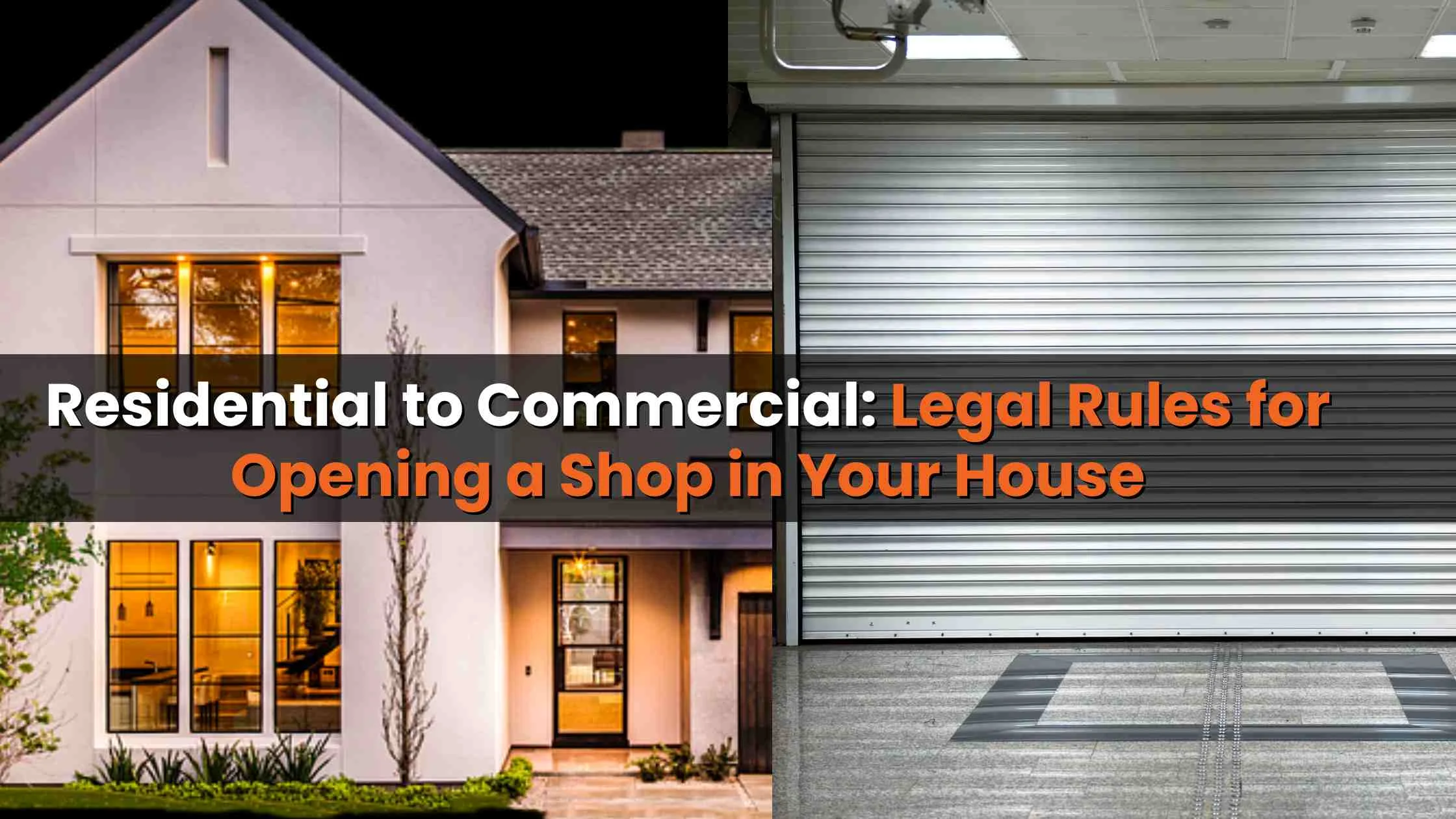
Running a business from home has become increasingly common in India. Homeowners in India currently operate commercial businesses from their residential properties which include small grocery stores, boutiques, clinics and consultancy offices. The shift towards remote work is driven by two main factors which include rising commercial rents and the convenience of working close to home.
The process of transforming a residential property into a commercial space requires more than just installing a shop board at your home. Indian zoning laws, municipal regulations, and housing society rules all play an important role in deciding whether you can legally operate a business from your home.
What Does Residential to Commercial Conversion Mean?
In Indian property and zoning law, converting residential to commercial refers to utilizing a property designated and evaluated as residential for commercial purposes.
- Opening a retail shop
- Running a clinic or office
- Operating a tuition center
- Starting a salon or boutique
- Running a small consultancy business
In India, land and properties are divided into zones under zoning laws. Establishing a business in a residentially-zoned area requires proper conversion and approval which the establishment does not possess. Your operations exceed permitted land use rights which creates multiple legal enforcement issues.
Also Read: Can You Challenge Poor Construction Under RERA? Know Your Legal Rights as a Homebuyer
Is It Legal to Open a Shop in a Residential Property?
Yes, it is legal in many cases, but only after obtaining proper approvals and following local rules. The exact regulations vary from city to city and state to state. Indian law does not adopt an overall prohibitive stance regarding home-based commercial activities. Some professional services have traditionally been accepted or specifically allowed in residential areas due to their minimal impact on traffic, noise, and disturbances. The categories that the majority of municipal frameworks permit consist of:
- Doctors and clinics
- Chartered accountants and lawyers
- Tuition classes and coaching
- Yoga and dance classes
- Small consultancy offices
However, activities that create pollution, heavy traffic, excessive noise, or public nuisance are usually prohibited.
Key Legal Rules for Commercial Use of Residential Property
1. Zoning Laws
Zoning law comes into consideration if commercial activity is legally permitted in your area. Indian cities categorize their land into specific use zones, establishing particular regulations regarding activities allowed in each.
|
Zone Type |
Permitted Use |
|
Residential Zone |
Housing apartments and homes |
|
Commercial Zone |
Shops offices restaurants malls |
|
Industrial Zone |
Factories and manufacturing |
|
Mixed Use Zone |
Residential and limited commercial activities |
Before opening a shop, you must confirm whether your area allows mixed-use development.
2. Municipal Permission
Even in zones where commercial use is allowed, most Indian municipalities demand formal authorization before a residential property begins commercial activities. This is not a formality that you can consider optional; running a business without the necessary municipal permits is a breach that may lead to fines, sealing orders, or both.
Common Permissions Required
- Trade licence
- Shop and establishment registration
- Fire safety clearance for larger setups
- Property tax reassessment
- Local municipal approval
Without approval, authorities may impose penalties or seal the premises.
3. Housing Society Approval
People who live in gated communities and apartment complexes and cooperative housing societies need to obtain additional approvals because their residential areas follow different rules than those established by local municipalities.
The housing society or Resident Welfare Association has specific regulations regarding activities within the complex, and these regulations frequently limit commercial operations regardless of municipal zoning permissions.
Why Society Permission Matters
- Prevents nuisance to residents
- Maintains security and parking control
- Avoids overcrowding and noise complaints
Many societies allow professional work-from-home activities but oppose customer-facing businesses like retail shops or restaurants.
4. Property Tax Changes
Once a property starts commercial operations, municipal authorities may revise property tax rates. Commercial tax rates are usually much higher than residential rates. Authorities across cities have started cracking down on illegal commercial operations running under residential tax slabs.
Local authorities throughout India have stepped up their efforts to identify properties that engage in commercial activities but are taxed at residential rates. Survey programs, satellite imagery, and enforcement based on complaints are employed to detect these circumstances, and when identified, the repercussions involve not only an increased commercial rate moving forward but also possible retrospective evaluations and penalties for the time of underpayment.
Businesses That Are Usually Not Allowed in Residential Areas
Certain businesses are generally prohibited in residential zones because they create safety or environmental concerns.
Restricted Commercial Activities
- Liquor shops
- Automobile workshops
- Timber and construction material shops
- Polluting industries
- Banquet halls
- Hazardous storage businesses
The Supreme Court and local civic bodies strictly regulate such activities.
Documents Required for Residential to Commercial Conversion
Having documents arranged prior to starting the approval process greatly shortens the timeline and eliminates the back-and-forth that arises when submissions are lacking. The necessary documents for the different approval processes consist of:
- Identity proof
- Address proof
- Property ownership papers
- Approved building plan
- Business registration certificate
- NOC from housing society
- Landlord permission if rented property
Incomplete paperwork is one of the biggest reasons for approval delays.
Also Read: Builder Not Giving Possession? How to File a RERA Complaint Online
Step by Step Process to Open a Shop in Your House
Step 1: Verify Local Zoning Rules
Check your property's current zoning classification by visiting the local development authority or municipal corporation website. In many cities, you can find this information online by inputting your property address or survey number.
If your area permits mixed-use or commercial activities, continue. If it is strictly residential, ascertain if your particular business type is eligible as a permitted ancillary use before continuing.
Step 2: Get Society Approval
If your property is located in a housing complex, secure written consent from the managing committee before taking any further action. A spoken agreement among committee members is inadequate; obtain an official written resolution. This safeguards you in case of shifts in societal management and also shows responsible care in your entire compliance history.
Step 3: Apply for Trade Licence
File a trade license application with your municipal corporation. This necessitates your property information, business description, ownership or rental paperwork, and usually a site evaluation.
Processing durations differ by city; in technologically advanced locations such as Bengaluru and Pune, this can be managed online with quicker results, while in other areas it may necessitate visiting physical offices.
Step 4: Register the Business
Depending on your business type, register under:
- Shops and Establishment Act
- GST if applicable
- MSME registration for small businesses
Step 5: Update Property Usage
In some cities and towns, officials request to modify property records from residential to mixed-use or commercial. This action initiates the property tax reassessment mentioned before, which incurs a cost, but it's much better than the penalties of commercial operations being taxed at residential rates.
Residential vs Commercial Property Usage
|
Aspect |
Residential Property |
Commercial Property |
|
Primary Purpose |
Living and housing |
Business operations |
|
Property Tax |
Lower |
Higher |
|
Traffic and Footfall |
Limited |
Higher |
|
Licensing Requirement |
Minimal |
Mandatory |
|
Business Activity Allowed |
Restricted |
Fully permitted |
|
Utility Charges |
Residential rates |
Commercial rates |
Penalties for Illegal Commercial Use
The consequences of conducting business without the necessary approvals are significant enough to justify the investment in legal compliance. Local governments in major Indian cities have increased their law enforcement activities, which target violations of residential property restrictions through commercial operations, and they now impose higher fines as a result of this intensified enforcement.
- Heavy fines
- Sealing of property
- Cancellation of licences
- Increased property tax with penalty
- Legal notices from municipal authorities
In some cities, penalties may reach 1 percent of the total property value.
Things to Consider Before Opening a Shop at Home
- Parking is a bigger problem than many individuals expect. Customer vehicles require a designated area, and if they overflow onto public roads or community parking spots, it will lead to complaints from neighbors and local residents, possibly resulting in a municipal inspection.
- Noise and delivery logistics impact not only your direct neighbours but also your connection with the entire local community. A company that produces early morning delivery trucks, late-night operations, or constant foot traffic in a tranquil residential street will generate tensions that may result in official grievances, conflicts among residents, and municipal scrutiny.
- Certain types of businesses may need upgrades to their utility connections. The costs for commercial electricity connections vary from those for residential connections, and certain businesses need connections with higher capacities or distinct commercial water supply setups. Incorporate these expenses into your business strategy prior to making a commitment.
- Your property's usage history influences its future value and marketability. A property operated commercially without required approvals, or with commercial changes inconsistent with its residential designation, may encounter issues during resale regarding buyer due diligence results and the legal disclosures necessary for prospective buyers
Why Legal Compliance Matters
Following proper legal procedures protects both your investment and your business.
Benefits of Compliance
- Avoids penalties and legal disputes
- Builds trust with customers and neighbors
- Ensures smooth business operations
- Protects long term property value
Authorities in many cities are now actively monitoring illegal commercial usage in residential areas, making compliance more important than ever.
Final Thoughts
Opening a shop or running a business from your house can be financially smart and convenient, but it must be done legally. The regulations that control commercial activities on residential properties include zoning laws and municipal permissions and housing society rules and taxation policies.
Before starting operations, local regulations must be verified and necessary approvals must be obtained while ensuring that your business operations do not disturb the surrounding neighborhood. The establishment of a legally compliant business operation protects you from penalties while it enables your business to achieve sustainable growth throughout its entire duration.




Ans 1. Yes, it is legal to open a shop or run a business from a residential property in India in many cases, but only after obtaining required approvals and ensuring your activity complies with local zoning laws. Professional services like clinics, legal and accounting consultancies, tuition classes, and small consultancy offices are generally permitted in residential areas. Retail shops and customer-facing businesses require verification of mixed-use zoning permission, municipal trade licences, society approval if in an apartment complex, and property tax reassessment. Operating commercially without these approvals constitutes an illegal use that can result in fines, sealing, and other enforcement action.
Ans 2. Running a business from a residential property in India typically requires multiple approvals depending on your city, state, and business type. Core requirements include verifying that your zone classification permits commercial or mixed-use activity, obtaining a trade licence from the municipal corporation, registering under the Shops and Establishment Act of your state, obtaining written approval from your housing society or RWA if your property is in an apartment complex, and updating property tax records to reflect commercial use. GST registration is required if annual turnover exceeds the applicable threshold, and profession-specific licences are required for regulated businesses like medical clinics.
Ans 3. Zoning law is the framework by which Indian municipalities divide land into designated use categories residential, commercial, industrial, and mixed-use and specify what activities are permitted in each zone. For opening a shop in your home, zoning law is the foundational legal consideration: if your property sits in a purely residential zone, most commercial activities are not permitted without a change of use application or specific variance. Properties in mixed-use zones allow limited commercial activity subject to other approvals. Confirming your zone classification at the local development authority or municipal corporation is the mandatory first step before pursuing any other approvals.
Ans 4. Yes, if your property is in a housing society, gated community, or apartment complex, written permission from the managing committee or Resident Welfare Association is required before commencing any commercial activity. Housing societies have independent authority to regulate what activities happen within the complex regardless of what municipal zoning permits. Most societies allow professional work-from-home activities with no external visitors but restrict customer-facing businesses that generate traffic, noise, or parking demands. Getting written committee approval before starting operations protects you if society management changes and demonstrates good faith compliance.
Ans 5. Several business categories are consistently prohibited in residential zones across Indian cities regardless of other approvals sought. These include liquor shops and alcohol retail, automobile workshops and garages, timber and bulk construction material storage, manufacturing operations that generate pollution or industrial waste, banquet halls and event spaces, and businesses involving hazardous materials storage. These prohibitions exist because these activities are fundamentally incompatible with residential character, they generate heavy vehicle traffic, noise, pollution, or safety hazards that cannot be mitigated within a residential setting. No amount of municipal approvals can make these business types legally operational in purely residential zones.
Ans 6. Yes, once your property commences commercial operations, municipal authorities will reassess it at commercial property tax rates, which are significantly higher than residential rates. This applies whether or not you proactively notify the authorities; municipalities across India are conducting surveys and using various identification methods to find properties operating commercially under residential tax slabs. Beyond the higher ongoing rate, retrospective assessment can apply for the period during which you operated commercially without proper tax classification, creating backdated liabilities plus interest and penalties. Budgeting for commercial property tax rates from the start of business operations is essential financial planning.
Ans 7. Documents required for residential to commercial property conversion include identity and address proof of the owner, property ownership papers and title documents, the approved building plan, current property tax receipts, business registration certificate, profession-specific licence if applicable, NOC from the housing society with the managing committee's written resolution, and landlord permission with ownership proof if the property is rented. Depending on your city and business type, additional documents including fire safety compliance records or environmental clearances may be required. Having all documents organised before beginning the application process significantly reduces approval timelines.
Ans 8. Penalties for illegal commercial use of residential property in India range from significant fines to more severe operational disruptions. Fines can reach up to 1 percent of the property's total value in some cities, a substantial sum for any urban property. Municipal authorities can seal the premises, preventing all operations until the violation is remedied through a formal process that can take months. Retrospective property tax assessment at commercial rates for the entire illegal operation period, with interest and penalties, creates large backdated financial liabilities. Business licences can be cancelled. In persistent violation cases, legal notices and court proceedings can complicate property title and future transactions.
Ans 9. Yes, medical practitioners and licensed professionals like chartered accountants and lawyers are generally among the categories most consistently permitted to operate from residential properties across Indian cities. Their activities typically generate limited traffic, don't create pollution or noise, and have historically been treated as compatible with residential areas. However, even these permitted professional activities require a trade licence, professional registration, and housing society approval if applicable.
Ans 10. To check whether your residential area allows commercial activity, visit your city's municipal corporation or development authority website and look for the city's Development Plan, Master Plan, or Zoning Map. Most cities now have these available online where you can search by address or survey number to find your property's zone classification. If the online system isn't clear, visit the local planning or zoning office directly with your property address. Some cities also provide zoning certificates on application. Your property documents may also reference the zone classification, sale deeds and property tax receipts sometimes indicate the approved use category.