
✦ AI Summary
Table of Content
▲- Why have Noida Sector 105 residents received labour cess notices?
- How many houses have received the notices?
- Why are resale property owners receiving old dues notices?
- What has the Labour Department said?
- What is labour cess, and what is it used for?
- What should homeowners do after receiving a labour cess notice?
- Will the notices be withdrawn?
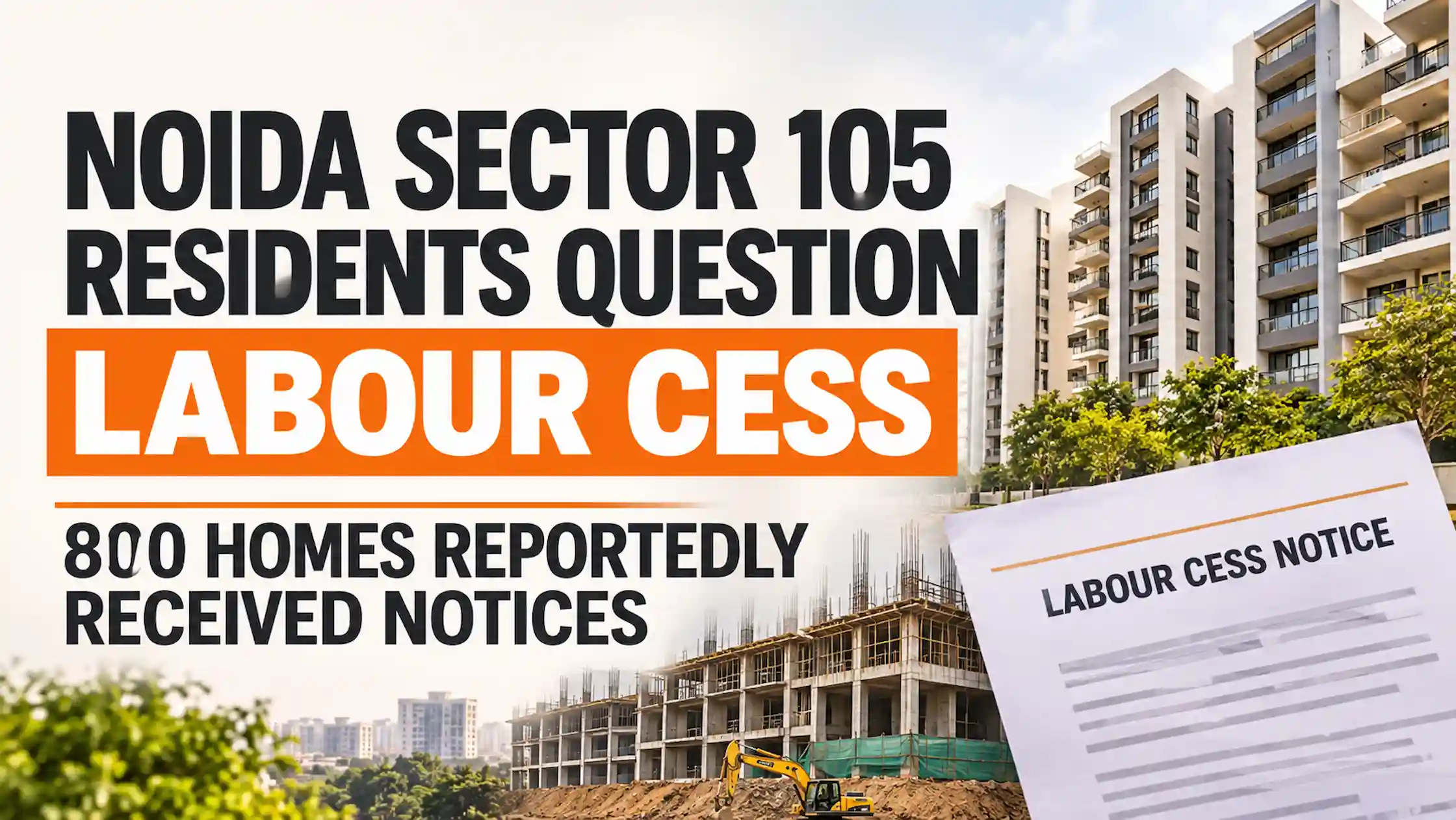
Homeowners in Noida’s Sector 105 have raised concerns over labour cess notices issued for houses constructed several years ago. The residents allege that some demands have been sent despite earlier payments, while resale buyers have also received notices relating to construction carried out before they purchased their properties.
According to the Sector 105 Residents’ Welfare Association (RWA), around 800 of the sector’s 1,044 houses received notices in September 2026. The Labour Department has acknowledged delays in issuing the demands but says the assessments are based on a survey conducted across Gautam Buddh Nagar district in 2017–18.
The dispute centres on how construction costs were assessed, whether previous payments have been recorded correctly and why some homeowners are being asked to settle dues years after their houses were built.
Why have Noida Sector 105 residents received labour cess notices?
The notices relate to labour cess, a levy collected on eligible construction work to fund welfare measures for construction workers. Under the applicable framework, the cess is generally calculated at 1% of the construction cost.
Residents say the latest demands have created uncertainty because some homeowners believe they have already paid the required amount. Others have questioned the construction valuations used to calculate the dues.
The notices refer to a Geographic Information System (GIS) survey conducted by the Uttar Pradesh Building and Other Construction Workers Welfare Board during 2017–18. Labour Department officials have said the exercise covered properties across Gautam Buddh Nagar and was not specifically aimed at Sector 105.
An assessment cited in a notice dated August 10 put the estimated construction cost of one building at ₹1.046 crore. The resulting labour cess demand was ₹1,04,680.94. The notice also referred to interest of 2% per month in the event of non-payment.
Residents have challenged the basis of some assessments, saying the figures may not reflect the actual cost of construction. They have also asked the department to check its payment records before issuing fresh demands.
How many houses have received the notices?
The Sector 105 RWA estimates that around 800 of the locality’s 1,044 houses received labour cess notices in mid-September 2026.
The number indicates the scale of the issue within the sector, although the RWA’s estimate does not establish that every notice is incorrect. Each demand will need to be examined against the relevant construction details, payment history and applicable rules.
RWA president Deepak Sharma has questioned the reliance on an old survey without what residents consider adequate verification at the property level. He has also alleged that homeowners who paid the cess earlier have received demands again.
The concerns extend to senior citizens and people who are currently living outside Noida. For these residents, resolving a disputed assessment may involve gathering old documents and contacting the relevant government office.
Why are resale property owners receiving old dues notices?
Some notices have reached people who purchased their houses after construction was completed. These buyers say they relied on the documents and clearances available when the properties changed hands.
Vipin Kumar Jain, a Sector 105 resident who bought his house in 2022, said the previous owner had told him that the dues were paid. He later received a notice demanding approximately ₹95,000.
Such cases have raised questions about whether the department has matched historical payment records with the correct properties and owners.
The distinction between an outstanding liability and a disputed demand is important. A notice does not, by itself, establish that the amount has been correctly assessed or that a previous payment was never made. Homeowners need to check the details in the notice against their own records and seek clarification where the information does not match.
People dealing with a property transaction can also review the documents used to establish ownership and the history of a property. A property title verification checklist can help buyers understand the importance of checking relevant records before completing a purchase.
What has the Labour Department said?
Rakesh Dwivedi, additional labour commissioner, said the notices were based on the 2017 survey conducted across Gautam Buddh Nagar. He acknowledged that the department had delayed serving some of the notices.
Dwivedi said the department was seeking the cess applicable to the relevant year. He also denied that the current exercise involved demanding interest or imposing penalties, despite the interest warning mentioned in a notice reviewed by Hindustan Times.
The difference between the wording of the notice and the official explanation is one of the issues residents may seek to clarify with the department.
Officials have said that labour cess is calculated at 1% of the total construction cost. Under the earlier rules described by the department, residential houses constructed before 2021 were liable where construction costs reached ₹10 lakh or more. Commercial properties were covered irrespective of that threshold.
The amount applicable to an individual property depends on the relevant facts and rules. The general rate alone does not settle questions about the construction valuation, the year of liability or whether an earlier payment has been credited.
What is labour cess, and what is it used for?
Labour cess is collected under the legal framework for the welfare of building and other construction workers. The funds support welfare measures for eligible workers through the relevant welfare system.
For covered construction work, the levy is generally calculated at 1% of construction cost. The assessment can therefore depend on the cost attributed to the building and the rules applicable to the relevant period.
In Sector 105, the immediate disagreement is not only about the rate. Residents are also questioning how the construction cost was estimated, whether old payments were considered and why notices have arrived years after construction.
These questions need to be resolved through the underlying records rather than assumptions about every notice being valid or invalid.
What should homeowners do after receiving a labour cess notice?
Homeowners who believe a notice is incorrect should review the demand carefully and contact the relevant labour authority to understand the basis of the assessment. The appropriate response will depend on the circumstances of each property.
Useful records may include:
- The labour cess notice and any earlier correspondence with the department.
- Receipts or other evidence of previous cess payments.
- The property’s lease deed and completion certificate, where applicable.
- Construction-related documents that may help establish the building’s age and cost.
- Relevant records from the previous owner if the property was purchased through resale.
Owners should retain copies of the documents submitted and proof of delivery or acknowledgement. If a demand is disputed, they should ask the department to explain how the amount was calculated and whether earlier payments have been taken into account.
A property mutation and Dakhil Kharij guide provides background on property-record updates. Mutation and labour cess are separate matters, however, and completing one process does not by itself establish that all construction-related dues have been settled.
Homeowners facing substantial or contested demands may also wish to obtain advice from a qualified legal professional before deciding how to respond. They should not assume that a demand can be ignored simply because the construction is old or the property has changed hands.
Will the notices be withdrawn?
There is no confirmed blanket withdrawal of the Sector 105 notices in the available report. The dispute remains focused on the assessment method, previous payments and the department’s records.
Residents want the authorities to verify their cases, while the Labour Department maintains that it is seeking cess applicable to the relevant year. The outcome will depend on the evidence and rules considered in individual cases.
For now, homeowners should distinguish between the amount stated in a notice and a liability that has been verified after considering the relevant documents. Clearer records and case-by-case scrutiny will be central to resolving the dispute.




Ans 1. The Labour Department says the notices are based on a GIS survey conducted across Gautam Buddh Nagar in 2017–18. Residents have questioned some assessments and say earlier payments may not have been properly recorded.
Ans 2. The Sector 105 RWA estimates that around 800 of the locality’s 1,044 houses received notices in September 2026.
Ans 3. Officials have stated that labour cess is calculated at 1% of the total construction cost for covered work. The applicable liability depends on the rules and circumstances relevant to the property.
Ans 4. Some buyers say they received demands relating to construction completed before they purchased the property. They have questioned whether earlier payments and property records were checked. The department needs to examine the relevant records to resolve individual disputes.
Ans 5. A notice communicates a demand, but disputed details such as construction valuation and previous payments may need verification. Owners should seek clarification from the relevant authority rather than assume the demand is either automatically correct or invalid.
Ans 6. They should review the notice, previous payment receipts, relevant construction records, lease deed, completion certificate where applicable, and correspondence with the department. They should retain copies of any representation submitted.
Ans 7. The available report does not confirm a blanket cancellation. The department has acknowledged delays in serving notices and says it is seeking cess applicable to the relevant year. Individual cases may require further examination.