
✦ AI Summary
Table of Content
▲- Why NCR Needs a New Urban Model
- Old NCR vs Regional Plan 2041: What Changes
- The 4 Namo Cities: What Are They and Where Will They Come Up
- Transit-Oriented Development and the 30-Minute NCR Vision
- ₹5,000 Crore Central Grant: What It Covers
- What This Means for NCR Real Estate
- Execution Risk: The Plan's Biggest Challenge
- The Bottom Line
- Conclusion
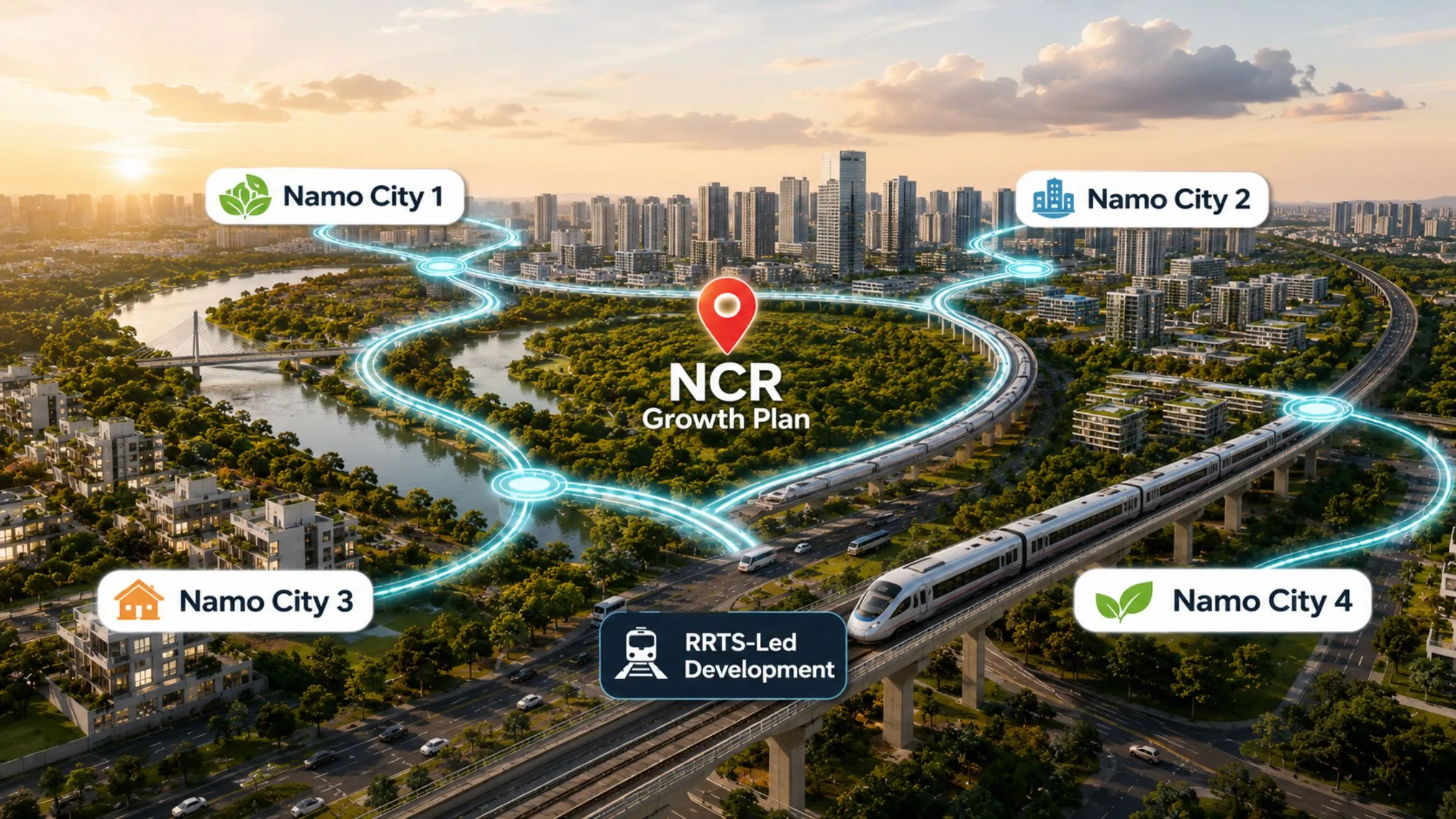
The National Capital Region Planning Board's Regional Plan 2041 is the most sweeping urban blueprint India's largest metro region has ever seen, one that doesn't just propose new cities, but fundamentally rewires how 11 crore people will live, commute, and invest across Delhi-NCR by 2041. Approved by the NCR Planning Board, the plan pivots away from a Delhi-centric growth model and bets big on four greenfield Namo Cities, a ₹5,000 crore central grant, and a transit-first urban future built along Namo Bharat RRTS corridors.
For homebuyers watching property prices in Noida, Gurugram, and Ghaziabad climb year after year, this plan is not just policy, it is a potential reset of NCR's real estate geography.
Why NCR Needs a New Urban Model
Delhi has run out of road, literally. NCR's estimated population will be around 11 crore by 2041 which means an additional 3 crore will need accommodation, jobs, and infrastructure since land constraints have become more restricted due to the pressure put on them by satellite cities that are already over capacity. The current model, where all roads lead to Delhi, cannot absorb this scale.
Knight Frank India's report, 'The Ring of Opportunity', estimates that accommodating this growth will require over ₹20 lakh crore in investments across housing, transport, and civic infrastructure. The Regional Plan 2041 is the policy answer to that investment question.
Key Insight: The NCR has a possibility of almost doubling its inhabitants up to 2041. Lack of decentralized city planning will contribute to housing prices continuing to increase in existing satellite communities, and therefore affordability will continue to define the greatest challenge to the NCR for the next 10 years.
Also Read: National Developers Claim 13% of NCR's New Housing Supply
Old NCR vs Regional Plan 2041: What Changes
Here is a direct comparison of how the new plan departs from NCR's traditional growth model:
|
Aspect |
Old NCR Model |
Regional Plan 2041 |
|---|---|---|
|
Growth Pattern |
Delhi-centric |
Multi-nodal urban network |
|
City Type |
Satellite expansion |
Greenfield Namo Cities |
|
Transit |
Roads & Metro only |
RRTS + Metro + Rail + Highway |
|
Planning Philosophy |
Reactive |
Proactive / TOD-first |
|
Housing Strategy |
Delhi overflow |
Decentralised residential hubs |
|
Investment Target |
No defined corpus |
₹20 lakh crore by 2041 |
The 4 Namo Cities: What Are They and Where Will They Come Up
The centrepiece of the Regional Plan 2041 is the proposal to build four greenfield Namo Cities, one in each participating NCR state. These are not extended suburbs of Delhi. They are semi-greenfield urban hubs designed from scratch around Namo Bharat RRTS transit stations, following the Transit-Oriented Development (TOD) model.
|
State |
Likely Region |
RRTS Corridor |
Growth Focus |
|---|---|---|---|
|
Delhi |
Peripheral zone |
Delhi-Meerut / Alwar |
Mixed-use urban hub |
|
Haryana |
Sonipat / Bawal area |
Delhi-Panipat / KMP belt |
Industrial + Residential |
|
Uttar Pradesh |
Meerut / Jewar belt |
Delhi-Meerut RRTS |
Logistics + Housing |
|
Rajasthan |
Alwar / Bhiwadi |
Delhi-Alwar RRTS |
Manufacturing + Realty |
Each city will integrate residential, commercial, retail, and recreational infrastructure within a walkable radius of a high-capacity transit node. The goal: residents of Namo Cities should be able to reach any major NCR hub within 30 minutes.
Transit-Oriented Development and the 30-Minute NCR Vision
There is an expansion of High Density Development Zones up to 1 km from an RRTS station, Metro Corridor, Freight Corridor and Highway or Expressway with the Regional Plan 2041, which provides a development framework for transit-based and or mixed use urban growth with an emphasis on high-density land uses near to existing or planned transit infrastructure.
The '30-Minute NCR' vision connects all major residential and commercial hubs through an integrated grid of:
- RRTS (Delhi-Meerut, Delhi-Alwar, Delhi-Panipat) Namo Bharat Corridors
- Metro Expansion across Noida, Gurugram, Ghaziabad
- KMP Expressway (Kundli-Manesar-Palwal) & Eastern Peripheral Expressway
- National Highway Upgrades & Improved Rail Networks
Shrivallabh Goyal, CEO of Reliance Model Economic Township, put it plainly: when workers can reach industrial hubs or business parks within half an hour, the geography of where people choose to live changes fundamentally.
₹5,000 Crore Central Grant: What It Covers
To accelerate Namo City development, the Centre has announced a ₹5,000 crore assistance package spread over five years. The package includes:
- Grants for infrastructure creation in greenfield city zones
- Concessional loans for state-level urban development agencies
- Guarantees to attract private real estate and logistics investment
- Funding support for five to eight smart townships modelled on Dholera and AURIC
What This Means for NCR Real Estate
The Regional Plan 2041 will affect certain geographical areas, with industry leaders already incorporating those impacts into their pricing.
- Sonipat is expected to be one of the most prominent beneficiaries due to its availability of affordable housing; ample undeveloped land; and proximity to KMP Expressway. According to Jindal Realty’s Abhay Mishra, this area will continue to be a major focus area for both residential and commercial real estate investors.
- Bhiwadi/Neemrana: Due to the proximity of Delhi/Alwar Rapid Rail Transit Systems (RRTS) and the industrial area zoning, there is the potential for a shift in Grade A warehousing demand.
- Meerut: Meerut could potentially see positive effects from higher-density Transit-Oriented Development (TOD) areas due to the operational Delhi/Meerut RRTS rail system in place.
- Jewar region: Noida International Airport combined with RRTS connectivity positions this corridor as NCR's next commercial growth arc.
Manish Jaiswal, CEO of Eldeco Group, noted that RRTS-connected cities can attract industries, talent, and investment that traditionally concentrated in Delhi's core, a structural shift for NCR's property market.
Also Read: Prestige Estates ₹6,800 Cr NCR Blitz: Noida & Gurugram Set for Twin Launch
Execution Risk: The Plan's Biggest Challenge
Knight Frank cautions that previous NCR regional plans often stalled between policy announcement and on-ground delivery. Delhi's land pooling framework and several highway corridor zones under earlier plans saw prolonged delays. The success of the Regional Plan 2041 will depend on:
- How individual states implement FAR (Floor Area Ratio) norms around transit corridors
- Speed of land acquisition and regulatory clearances for Namo City sites
- Private capital mobilisation to supplement the ₹5,000 crore central grant
- Coordination between four state governments on cross-border infrastructure
The Bottom Line
The National Capital Region Planning Board’s Regional Plan 2041 is a complete rethinking of how one of the fastest-growing urban areas in the world will be able to provide housing, transportation and jobs for its residents over the next 15 years; it is not an incremental change to the existing systems. The four Namo Cities, a ₹20 lakh crore capital investment pipeline, a 30-minute transit grid, and a major move toward Transit-Oriented Development will radically change where to buy property in the NCR, and which cities will shape the real estate for all of North India over the next decade.
For homebuyers and investors, the signal is clear: watch the RRTS corridors. That is where NCR's next value curve is being drawn.
NCR Regional Plan 2041 proposes 4 Namo Cities with ₹5,000 crore central support along RRTS corridors, shifting NCR's growth from Delhi to a multi-nodal urban network targeting 11 crore residents by 2041.
Conclusion
NCR’s housing affordability crisis was never really going to be solved by pushing up even more towers in Gurugram, or by trying to squeeze extra floors into Noida. The National Capital Region Planning Board’s Regional Plan 2041 kind of admits this, and then it makes a bet of ₹20 lakh crore on a more structurally different route. In other words, it wants to build new cities from scratch, wrap them around high speed transit, and then spread the demand across four states instead of locking it into three already overheated corridors.
For homebuyers and investors, the cue is clearer than any NCR plan ever really made it, Sonipat, Meerut, Jewar and Bhiwadi are no longer kind of peripheral gambles theyre more like deliberate policy waypoints, backed by groundwork that is already up and running or moving through construction. It feels like the value curve is getting pushed outward along the RRTS corridors. The entry window, before the market fully prices that change, is getting tighter.


Ans 1. The NCR Regional Plan 2041 is a comprehensive urban development blueprint approved by the National Capital Region Planning Board that aims to decentralise growth away from Delhi, create four greenfield Namo Cities along RRTS corridors, and accommodate a projected NCR population of nearly 11 crore by 2041 through over ₹20 lakh crore in infrastructure investments.
Ans 2. Namo Cities are four proposed semi-greenfield urban hubs to be developed along the Namo Bharat RRTS corridors under the Regional Plan 2041. Each city will follow a Transit-Oriented Development (TOD) model integrating housing, commercial spaces, retail, and social infrastructure around high-capacity public transport stations, with one city planned per NCR state, Delhi, Haryana, Uttar Pradesh, and Rajasthan.
Ans 3. Final locations have not been officially announced. The NCR Planning Board has proposed one Namo City per state, with final sites to be selected through a competitive process among participating states. Likely corridors include the Delhi-Meerut, Delhi-Alwar, and Delhi-Panipat RRTS belts, with cities such as Sonipat, Meerut, Bhiwadi, and Alwar considered strong candidates.
Ans 4. The Centre has announced a ₹5,000 crore assistance package spread over five years, comprising grants, concessional loans, and guarantees to attract private investment into the four Namo City projects and associated smart township developments.
Ans 5. The 30-Minute NCR is the core connectivity goal of Regional Plan 2041, envisioning that all major residential and employment hubs across the region will be linked within a 30-minute travel window through an integrated network of RRTS corridors, metro extensions, highways, expressways, and rail infrastructure.
Ans 6. The plan aims to reduce housing price pressure in Delhi, Noida, and Gurugram by distributing demand across new cities and RRTS-connected peripheral markets. By creating new residential and commercial supply in areas like Sonipat, Meerut, Jewar, and Bhiwadi, the plan seeks to offer affordable alternatives without sacrificing connectivity.
Ans 7. Under the Regional Plan 2041, TOD means developing high-density, mixed-use zones within a 1-kilometre radius of RRTS stations, metro corridors, freight corridors, and major expressways. This approach integrates housing, offices, retail, and public spaces around transit nodes to reduce dependence on private vehicles and promote efficient land use.
Ans 8. Peripheral and Tier-II markets stand to gain the most. Sonipat is widely cited for its affordability and KMP belt proximity; Meerut benefits from the already-operational Delhi-Meerut RRTS; Jewar gains from Noida International Airport and RRTS; and Bhiwadi-Neemrana is positioned for logistics and warehousing demand. All four are named as deliberate growth destinations under the plan.
Ans 9. Unlike previous NCR plans that remained largely aspirational, Regional Plan 2041 is anchored by infrastructure already operational or under implementation, including the Delhi-Meerut RRTS, the KMP Expressway, and Noida International Airport at Jewar. This gives the plan a credible delivery mechanism that earlier blueprints lacked.
Ans 10. Investors should approach with informed optimism. The fundamentals, RRTS connectivity, greenfield city proposals, and ₹20 lakh crore investment pipeline, are real. However, Namo City locations are unconfirmed, state implementation will vary, and execution timelines remain subject to policy momentum. Tracking official NCR Planning Board notifications and RRTS completion milestones is essential before making investment decisions.