
✦ AI Summary
Table of Content
▲
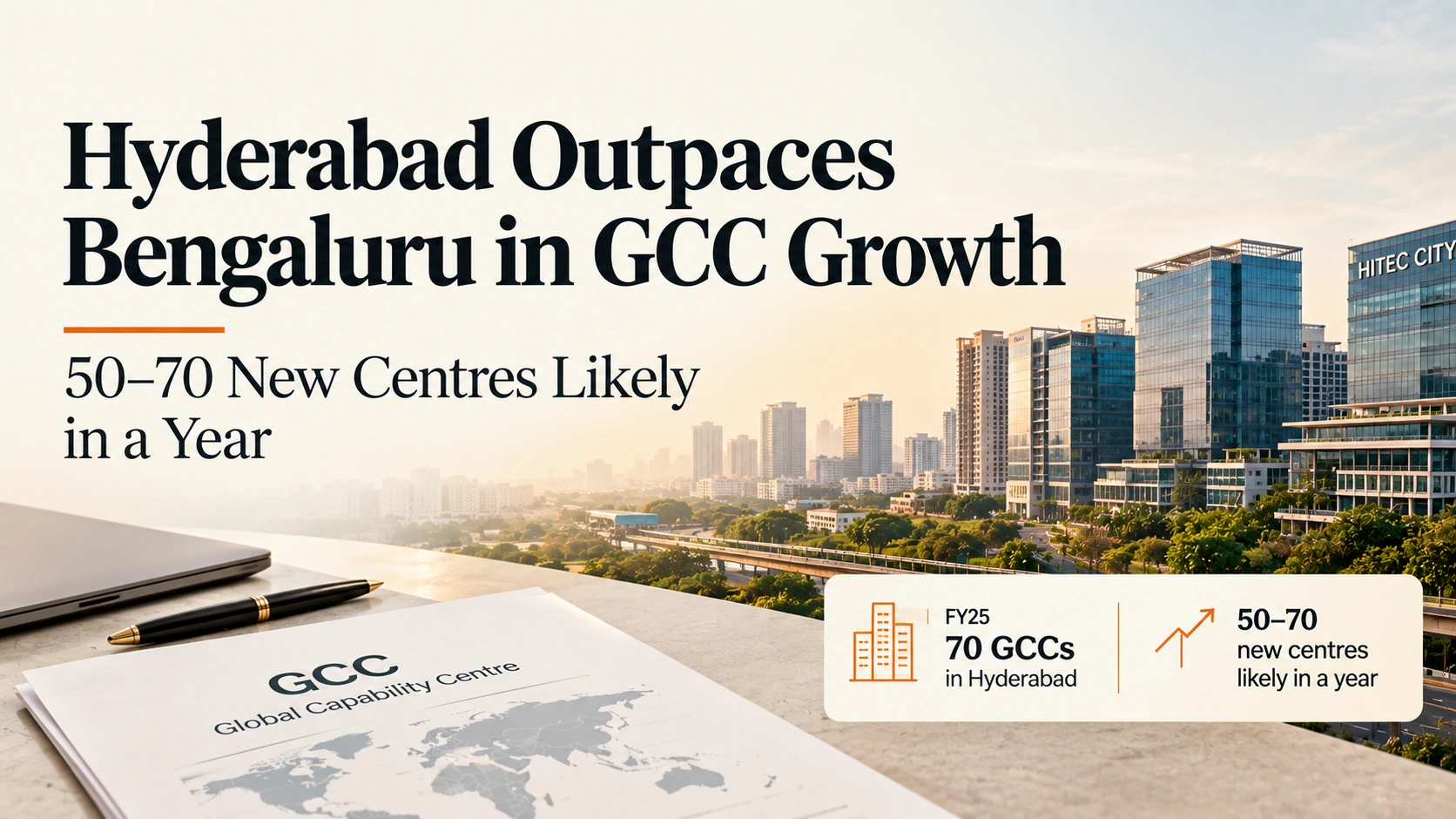
Hyderabad is emerging as one of India’s fastest-growing destinations for Global Capability Centres, with the city expected to add another 50–70 centres over the next year.
According to the report Hyderabad: The Rise of a Global Capability Powerhouse by Anarock Research & Advisory and FICCI, Hyderabad added around 70 GCCs in FY25. This was higher than Bengaluru’s 30–35 additions, Pune’s 15–20 and Chennai’s 12–15 during the same period.
The growth is also beginning to influence Hyderabad’s commercial real estate market. Office leasing by foreign companies setting up GCCs increased from 1.9 million sq ft in 2021 to 4.5 million sq ft in 2025. In the first half of 2026, GCC leasing had already crossed 3 million sq ft.
Hyderabad has fewer GCCs but is adding them faster
Bengaluru continues to have the largest GCC base among the four cities covered in the report, with more than 880 centres. Hyderabad has around 515, followed by Pune with over 475 and Chennai with more than 280.
However, the pace of new additions has shifted in Hyderabad’s favour. The city added nearly twice as many GCCs as Bengaluru in FY25. The report expects Hyderabad to add another 50–70 centres across technology, engineering, banking, financial services and insurance, life sciences, analytics, consulting and digital operations.
As of March 2026, Hyderabad’s GCC ecosystem employed more than three lakh people and accounted for around 20% of India’s total GCCs. The city is gradually moving beyond its earlier identity as an IT services destination and becoming a location for more specialised corporate functions.
From back-office operations to advanced functions
GCCs were initially established in India mainly for technology support, shared services and back-office operations. Their role has since expanded.
Companies are now using Hyderabad centres for artificial intelligence and machine learning, cloud engineering, product development, cybersecurity, financial analytics, fintech, regulatory operations, drug development analytics, clinical data, chip design and embedded systems.
This change matters for commercial real estate because advanced functions generally require larger teams, better-quality office space and more specialised infrastructure. They also tend to create longer-term occupation requirements than short-term support operations.
The Anarock-FICCI report expects Hyderabad’s GCC growth to be supported by its technology talent pool, competitive office costs, established infrastructure, growing banking and life sciences sectors and increasing availability of Grade A office space.
Western Hyderabad likely to remain the main commercial cluster
The western corridor is expected to remain the centre of Hyderabad’s commercial expansion. Areas such as HITEC City, Madhapur and the Financial District have already developed as major office locations, supported by technology companies, residential projects, retail and social infrastructure.
The report estimates that GCCs, IT-ITeS companies, banking and financial services firms, flexible office operators and allied businesses could generate an additional 8–12 million sq ft of office demand in Hyderabad over the next three to five years.
This demand is likely to support office development in established business districts as well as selected emerging locations. However, the impact will not be uniform across the city. Buildings with good connectivity, reliable power, modern amenities and access to a skilled workforce are more likely to attract large occupiers.
For developers, the focus will increasingly be on office quality rather than simply adding more built-up area.
Hyderabad’s office market shows improving demand-supply conditions
Hyderabad currently has around 125 million sq ft of Grade A office stock, representing nearly 15% of India’s Grade A office inventory. Another 36 million sq ft is reportedly in the upcoming supply pipeline.
At the same time, office completions have moderated. New completions fell from a peak of 17.1 million sq ft in 2022 to around 3 million sq ft in the first half of 2026. Despite this reduction in new supply, net office absorption stood at 8.5 million sq ft in 2025 and 5.2 million sq ft in H1 2026.
Vacancy also declined from 26.3% in 2025 to 23.5% in the first half of 2026. The movement suggests that occupier demand is absorbing a larger share of available office space.
Hyderabad’s average office rent is around ₹75 per sq ft per month, below the pan-India average of ₹96 per sq ft. This gives the city a cost advantage, although prime buildings in key corridors are already commanding higher rents.
Office rents may rise in prime locations
The GCC expansion is likely to put further pressure on rents in the most sought-after office districts.
A separate report noted that rents for modern Grade A+ buildings in Madhapur had reached around ₹130–180 per sq ft per month. This is higher than the ₹85–150 per sq ft range reported for Bengaluru’s Outer Ring Road corridor.
The comparison does not mean Hyderabad has become more expensive across the board. It indicates that demand for high-quality office buildings in specific micro-markets is strengthening.
For landlords, this could improve rental income and occupancy. For companies, it may increase the cost of expansion or relocation. The final impact will depend on how quickly new office supply enters the market and whether occupiers are willing to move to emerging corridors.
What the GCC expansion means for residential real estate
The commercial growth is also relevant for Hyderabad’s residential market.
New GCCs bring employees, senior professionals, expatriates, consultants and service providers into the city. This can increase demand for rental homes close to office clusters, particularly in areas with better road access and social infrastructure.
The effect is usually strongest in locations that offer shorter commutes to major employment centres. Demand may rise for apartments, managed housing, co-living spaces and premium rental homes.
However, the arrival of new companies does not automatically guarantee an immediate rise in property prices across the entire city. Residential demand depends on job creation, employee relocation, transport connectivity, school and healthcare access, and the availability of suitable housing.
Investors should therefore examine the specific employment corridor rather than treating the entire Hyderabad market as one uniform opportunity.
Bengaluru remains important despite slower additions
Hyderabad’s faster GCC additions do not mean Bengaluru has lost its position.
Bengaluru still has a much larger GCC base, a deep technology workforce and a mature ecosystem of technology companies, start-ups, research institutions and service providers. Its existing infrastructure and established corporate networks remain important advantages.
Hyderabad’s recent performance instead shows that companies are increasingly evaluating multiple Indian cities. Cost, talent availability, sector-specific expertise, infrastructure and the ability to scale operations are becoming important factors in location decisions.
This competition could benefit occupiers by encouraging cities to improve office infrastructure, connectivity and business services.
What buyers and investors should watch
The next phase of Hyderabad’s commercial real estate growth will depend on whether the projected 50–70 GCC additions materialise and how much office space each centre requires.
Property buyers and investors should track:
- New GCC announcements and actual office occupancy.
- Leasing activity in HITEC City, Madhapur and the Financial District.
- Upcoming Grade A office supply.
- Road and public transport connectivity.
- Rental growth in nearby residential locations.
- Vacancy levels and the quality of new developments.
- The mix of technology, BFSI, life sciences and engineering occupiers.
The broader trend is positive for Hyderabad’s office market, but the benefits will be strongest in locations where employment growth is supported by infrastructure and housing.
Hyderabad’s GCC story is no longer only about lower operating costs. The city is increasingly being considered for engineering, research, analytics and other high-value functions. If the expected additions continue, commercial real estate demand could remain firm through the next three to five years.



Ans 1. Hyderabad had around 515 Global Capability Centres as of March 2026, employing more than three lakh people.
Ans 2. The city is expected to add around 50–70 new GCCs over the next year, according to the Anarock-FICCI report.
Ans 3. Yes. Hyderabad added around 70 GCCs in FY25, compared with approximately 30–35 additions in Bengaluru.
Ans 4. HITEC City, Madhapur and the Financial District are among the city’s key commercial locations, particularly for technology and corporate occupiers.
Ans 5. GCC expansion may support residential rental demand and commercial property activity near major employment hubs. However, price growth will depend on infrastructure, housing supply and actual job creation.
Ans 6. GCCs, IT-ITeS companies, BFSI firms and allied businesses could generate an estimated 8–12 million sq ft of additional office demand over the next three to five years.
Ans 7. No. Bengaluru still has more than 880 GCCs and remains India’s largest established GCC market. Hyderabad is currently growing faster in terms of new additions.
Ans 8. Key factors include talent availability, competitive office costs, infrastructure, Grade A office supply and the city’s growing technology, BFSI, life sciences and engineering ecosystem.