
✦ AI Summary
Table of Content
▲- Which HRERA Bench Do You File With: Gurugram or Panchkula?
- Authority or Adjudicating Officer? Choosing the Right Track
- What Can You File a Complaint About?
- The Complete Filing Process, Step by Step
- The Fee Structure
- Documents You'll Need
- What Happens After You File
- If You're Not Satisfied: Appealing to HREAT
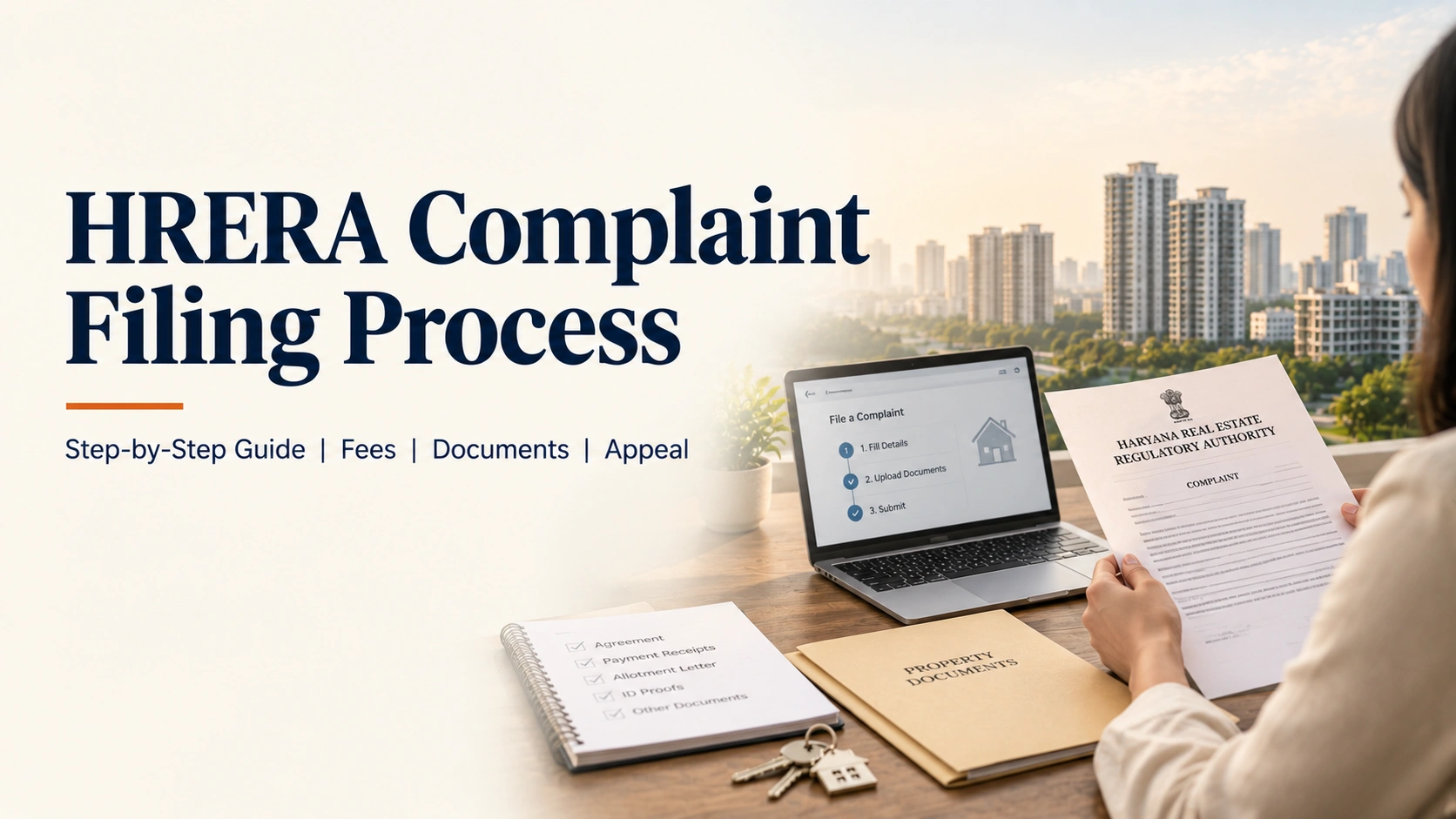
Filing a complaint with the Haryana Real Estate Regulatory Authority (HRERA) involves two things most people get wrong on the first attempt: choosing the correct bench, since HRERA operates as two functionally separate offices, and understanding that submitting the form online is only half the job. Unlike some other state RERAs, HRERA requires you to also physically deliver printed copies of your complaint to the relevant office within 30 days of the online submission, and skipping this step can leave an otherwise valid complaint incomplete.
This guide walks through the entire process: which bench has jurisdiction over your property, whether you need the Authority or the Adjudicating Officer, the exact step-by-step filing sequence, the fees involved, and what happens after you file, including your appeal option if you're not satisfied with the outcome.
For a broader understanding of how RERA protects property buyers, see our guide to RERA rules for homebuyers.
Which HRERA Bench Do You File With: Gurugram or Panchkula?
HRERA functions through two regional offices, and which one you file with depends entirely on where your property is located, not on where you personally live.
HRERA Gurugram handles all real estate matters specifically within Gurugram district, which, given the district's concentration of high-rise apartments, luxury villas, and commercial developments, handles the largest share of HRERA's overall complaint volume.
HRERA Panchkula has jurisdiction over the rest of Haryana, including Faridabad, Panchkula itself, and other districts outside Gurugram.
Confirming this before you begin matters, since the online complaint registration, the physical submission address, and the Demand Draft payee name all differ depending on which bench applies to your property.
Authority or Adjudicating Officer? Choosing the Right Track
This distinction genuinely changes which form you use and what relief you can request, so it's worth settling before you start filling anything out.
A complaint filed with the Authority covers regulatory matters: possession delays, unauthorised plan alterations, construction quality issues, and general non-compliance by the promoter. This is filed using Performa-B, the standard HRERA complaint registration form.
A complaint filed with the Adjudicating Officer is specifically for claiming compensation or interest, distinct from a general regulatory complaint. This uses Form CAO, submitted in triplicate along with the appropriate fee. If your primary goal is financial compensation for a specific loss, rather than an order compelling the promoter to act, this is generally the correct track.
Being precise about which relief you're actually seeking, possession plus interest under the general framework, or a compensation claim specifically, before choosing your form avoids delays caused by filing on the wrong track.
What Can You File a Complaint About?
Common, well-established grounds for a HRERA complaint include:
- Delayed possession: the builder failed to deliver possession by the timeline committed in the registered agreement.
- Unauthorised plan alteration: the builder made changes to the sanctioned layout without obtaining the required consent (generally two-thirds of allottees) or NOC.
- Construction quality defects: structural or quality issues that fall short of what was promised, which can be raised within five years of possession under the Act's defect-liability framework.
- Misrepresentation: the actual delivered unit, its carpet area, amenities, or specifications, differs materially from what was represented at the time of sale.
- General non-compliance: any other failure by the promoter or agent to meet obligations under the Real Estate (Regulation and Development) Act, 2016.
You can generally file a complaint even against a project that isn't formally RERA-registered, since HRERA's mandate extends to addressing grievances against non-compliant developers operating in the state, not solely to registered projects. Before filing, buyers should also verify the project's registration details and available records using the RERA registration certificate.
The Complete Filing Process, Step by Step
- Review the HRERA (Filing of Complaints) Regulations available on haryanarera.gov.in, so you understand the format requirements before you start. If you are unfamiliar with the broader process, our guide on how to file a RERA complaint online explains the basic complaint-filing journey and the documents generally required.
- Visit the HRERA website for your relevant bench (Gurugram or Panchkula) and click on the "Complaint Registration" tab.
- Fill out the online complaint registration form, following the system's prompts, providing your personal details and the specific project and grievance details.
- Note your online complaint number once the form is submitted. Save this carefully; it's used for all future correspondence and status tracking.
- Pay the requisite fee (detailed below), by Demand Draft in favour of the relevant HRERA office, payable at that office's location, or through the online payment gateway.
- Print the required copies. You'll need the Registration Form (Performa-B), typically printed in a number of copies equal to one plus the number of respondents, along with a separately typed, detailed complaint in the prescribed format, in the same number of sets.
- Attach a self-declared certificate confirming that a copy of the complaint has been sent directly to the respondent (the builder or agent named in your complaint).
- Physically submit the complete set, printed Performa-B, the typed complaint, all annexures, and the self-declared certificate, to the relevant HRERA office. This physical submission is required within 30 days of the online submission and is not optional; the online step alone does not complete your filing.
- Also submit a soft copy of the complaint in Word format, along with the complete complaint and annexures in PDF format, as most HRERA offices require both formats.
- Track your complaint status periodically at haryanarera.gov.in using your complaint number, under the portal's status-tracking section.
The Fee Structure
The complaint fee is ₹1,000 per complaint, plus ₹10 per annexure attached to the complaint. This is payable by Demand Draft made out to the relevant HRERA office (Haryana Real Estate Regulatory Authority, Gurugram or Panchkula, as applicable), payable at that city, or through HRERA's online payment gateway. For an Adjudicating Officer complaint under Form CAO, confirm the applicable fee for that specific track at the time of filing, since it's submitted and processed separately from a standard Authority complaint.
Documents You'll Need
Beyond the Performa-B or Form CAO itself, a well-prepared HRERA complaint typically includes:
- The builder-buyer agreement or allotment letter
- Proof of all payments made toward the property
- The project's RERA registration number and details, where the project is registered
- Correspondence with the builder regarding the grievance (delay notices, response emails, and similar)
- Approved building and layout plans, where the complaint concerns unauthorised alteration
- Respondent details, name, address, email, and mobile number, written clearly on legal-size paper as part of the filing
- The self-declared certificate confirming the respondent has been separately notified
What Happens After You File
Once your complaint is registered and the physical copies submitted, HRERA schedules a hearing before the Authority or the Adjudicating Officer, depending on which track you filed under. While exact timelines vary with case volume and complexity, the process is commonly cited as taking around 45 days from filing to resolution for straightforward matters, considerably faster than pursuing the same grievance through civil court. During the hearing process, both parties present their case, and the Authority or Adjudicating Officer issues a written order, which can direct possession, a refund, interest, compensation, or other relief depending on the specific complaint and track filed.
If You're Not Satisfied: Appealing to HREAT
If the outcome isn't satisfactory, either party can appeal to the Haryana Real Estate Appellate Tribunal (HREAT), which reviews decisions made by HRERA and provides a further layer of legal recourse. As with the original complaint, having complete, well-organised documentation and evidence ready strengthens an appeal significantly, and the appeal should generally be filed within the prescribed limitation period following the original order.

_1792140859.webp)


_1792151285.webp)

Ans 1. It depends on where your property is located, not where you live. HRERA Gurugram handles matters specifically within Gurugram district; HRERA Panchkula covers the rest of Haryana, including Faridabad.
Ans 2. A complaint with the Authority, filed on Performa-B, covers general regulatory matters like possession delay, plan alteration, or construction defects. A complaint with the Adjudicating Officer, filed on Form CAO, is specifically for claiming compensation or interest.
Ans 3. Online submission alone is not sufficient. HRERA requires you to also physically submit printed copies of Performa-B, the typed complaint, and all annexures to the relevant office within 30 days of the online submission.
Ans 4. ₹1,000 per complaint, plus ₹10 per annexure attached, payable by Demand Draft in favour of the relevant HRERA office or through the online payment gateway.
Ans 5. Generally yes. HRERA's mandate covers addressing homebuyer grievances against non-compliant developers operating in the state, not only formally registered projects.
Ans 6. Timelines vary with case complexity and volume, but resolution is commonly cited at around 45 days for straightforward matters, considerably faster than pursuing the same dispute through civil court.
Ans 7. You can appeal to the Haryana Real Estate Appellate Tribunal (HREAT), which reviews HRERA's decisions and provides a further avenue for legal recourse.
Ans 8. At minimum: the builder-buyer agreement, proof of payments made, the respondent's details, correspondence regarding your grievance, and a self-declared certificate confirming the respondent has separately been sent a copy of the complaint.