
✦ AI Summary
Table of Content
▲- What Is Land Conversion?
- What Are Circle Rates and Why Do They Matter?
- How Land Conversion Affects Circle Rates
- Example: How Conversion Can Change Circle Rate Impact
- Real Estate Market Effects Beyond Circle Rates
- Land Conversion Process Simplified
- Key Things Homebuyers Should Know
- How Circle Rates Are Updated
- Mistakes to Avoid When Land Conversion Is Involved
- Strategic Considerations for Investors
- Conclusion
Understanding how land conversion affects property value is one of the most important insights for buyers, investors and developers in India’s real estate market. Circle rates, also known as ready reckoner rates, serve as the minimum valuation of a property for stamp duty and registration purposes, and land conversion plays a significant role in shaping these rates. This blog explains what land conversion is, how it influences circle rates, and why it matters to your property’s investment potential.
What Is Land Conversion?
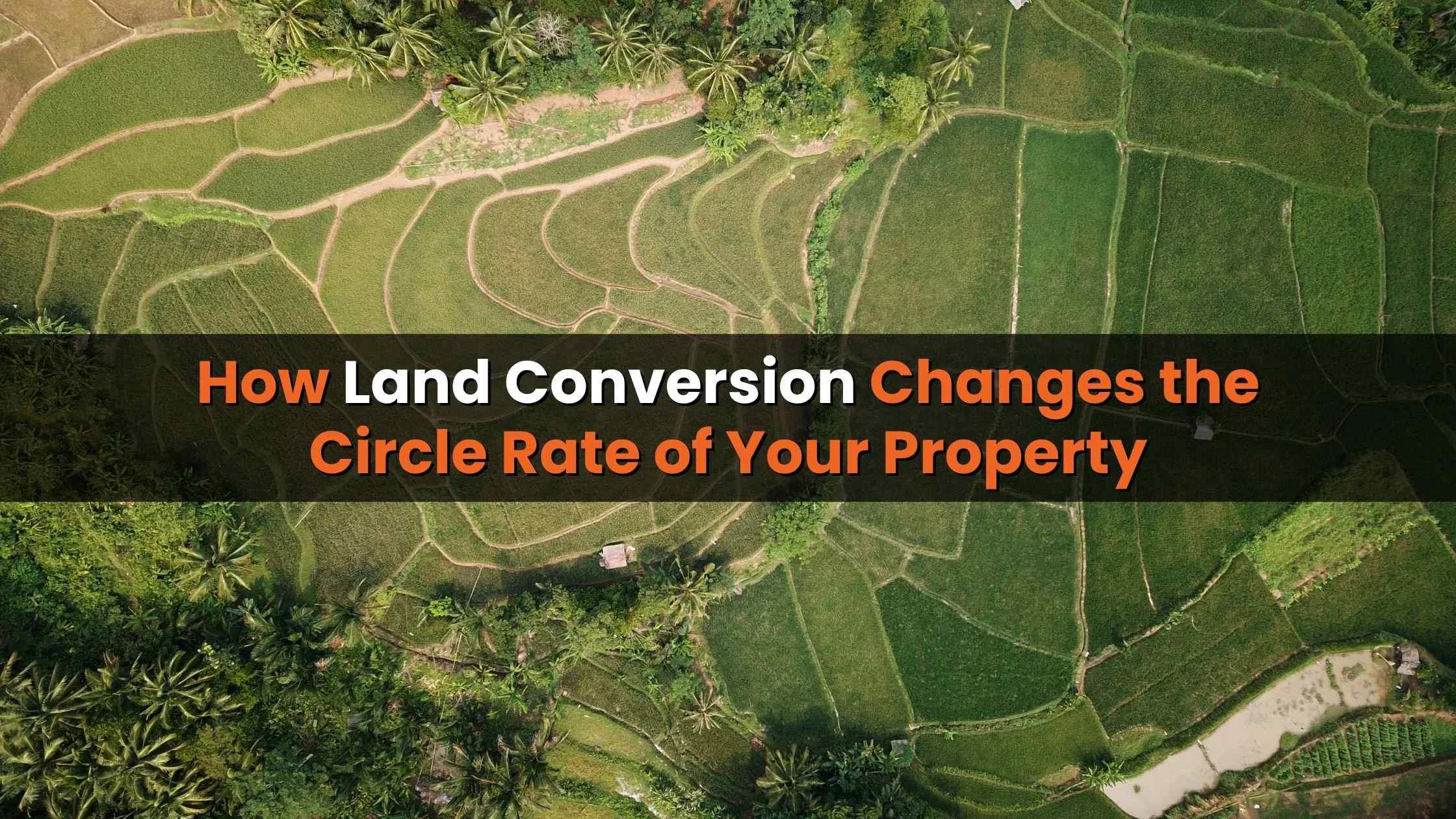
Land conversion is the legal process of changing the designated use of a piece of land for example, from agricultural to residential or commercial. In India, land is broadly categorised into:
- Agricultural land
- Non-agricultural land
- Residential land
- Commercial land
- Industrial land
Before any development, whether for housing, retail, or industrial use, land often needs conversion from its original classification to a category that allows construction and development.
The authority responsible varies by state, but typically includes departments like:
- Town and Country Planning
- Urban Development Authority
- Revenue Department
Land conversion usually requires formal approval, fees and sometimes change in zoning under town planning rules.
What Are Circle Rates and Why Do They Matter?
Circle rate (ready reckoner rate) is the minimum value at which a property can be registered with the sub-registrar. It is used to calculate:
- Stamp duty
- Registration charges
- Property tax assessment
- Capital gains tax (indirectly via stamp duty valuation)
Circle rates are periodically updated by state governments to reflect market conditions. They exist to curb tax evasion and ensure transparent real estate transactions.
If a property is registered below the circle rate, authorities may levy tax on circle rate value, meaning higher costs for buyers.
Also Read: Property Registration and Mutation: What Every Homebuyer Should Know
How Land Conversion Affects Circle Rates
Land conversion plays a direct role in increasing circle rates, often significantly. Here’s how:
1. Change in Land Use Means Change in Value
When land shifts from agricultural or non-commercial use to a buildable category (residential or commercial), its potential increases. This increased potential is reflected in higher circle rates. You can see similar value dynamics in strategic urban corridors like how the North Bengaluru airport corridor drives property demand in projects such as Sattva City’s 50-acre launch.
For example:
- Agricultural land: Lower circle rates due to limited permissible development.
- Residential/commercial land: Higher circle rates because of construction potential.
2. Government Recognition Boosts Market Confidence
Approved land conversion signals that development is legally permitted, which attracts investment, increases demand and pushes up market values and consequently circle rates.
3. Proximity to Infrastructure Impact
Converted land near major infrastructure like metro corridors, highways, or economic zones sees stronger circle rate hikes due to increased demand. This is evident in growing corridors such as Ambernath logistics hub and North Bengaluru airport corridor, where land value appreciation has been strong.
4. Speculative Value and Land Bank Strategies
Developers often convert land as part of land banking strategies, expecting future infrastructure to raise prices. Such large scale conversions send signals that influence updated circle rates over time.
Example: How Conversion Can Change Circle Rate Impact
|
Property Type |
Land Use Before |
Possible Land Use After Conversion |
Typical Circle Rate Change |
Impact on Buyer |
|
Outskirts farm land |
Agricultural |
Residential |
+50% to +300%+ |
Higher registration cost, higher market value |
|
Peripheral land near city |
Agricultural |
Commercial / Mixed-use |
+200% to +500%+ |
Significant rise in circle rate and taxes |
|
Inner city open land |
Non-agricultural |
Retail/Office |
+100% to +400% |
Higher property tax and commercial valuations |
|
Industrial land |
Industrial only |
Industrial + Residential (if permitted) |
+Various |
Better resale and investment potential |
Note: Exact percentage changes vary by city and policy updates.
Real Estate Market Effects Beyond Circle Rates
Land conversion affects more than just circle rates:
Stamp Duty and Registration Costs
Higher circle rates influence stamp duty, registration, and ultimately resale values. A similar effect can be seen in BMC tax dues and MMRDA property tax recovery issues which highlight how official rate changes impact real estate transactions.
Loan Sanctions and Valuations
Banks often use circle rates as part of valuation; converted land with higher circle rates can lead to different loan eligibility.
Developer Pricing Strategy
Developers often set selling rates based on circle rates, higher baseline values influence pricing of homes or commercial spaces.
Capital Gains Tax
Although capital gains tax depends on indexed cost and sale value, higher circle rates often shape declared sale values, affecting tax liabilities.
Land Conversion Process Simplified
- Application Submission
File conversion request with local planning authority with supporting documents (land title, revenue records) - Review and Site Inspection
Zonal office reviews land-use context and conducts inspections if required - Payment of Conversion Charges
Applicants pay conversion charges, which vary by state and district - Approval Order
Once sanctioned, the land’s use gets officially reclassified - Update in Records
Revenue and planning records are updated to reflect new land status
Key Things Homebuyers Should Know
- Always check land use status and whether conversion is complete before buying.
- Circle rates are often revisited after major conversions in an area.
- Legal compliance is critical; unconverted land can delay construction and financing.
- Infrastructure projects often pave the way for future conversions, driving up circle rates (a pattern similar to property price uplift near metro corridors in other Indian cities).
For more on how infrastructure impacts property values, see our guides on corridor-linked price gains.
Also Read: Maharashtra May Increase Ready Reckoner Rates by Over 5% from April 2026
How Circle Rates Are Updated
Circle rates are periodically revised by state revenue or urban departments. Key triggers for revision include:
- Significant land conversion activity
- Infrastructure announcements
- Local market demand and transaction data
- Policy pushes (like affordable housing or smart cities)
Recent urban corridors nationwide have seen this pattern, where conversions near key infrastructure led authorities to adjust circle rates upward.
Mistakes to Avoid When Land Conversion Is Involved
Many buyers make some common mistakes:
- Buying without checking conversion status
- Ignoring updated regulations on land use/zoning
- Basing decisions solely on old circle rates
- Overlooking future infrastructure plans
Good practice includes verifying records with revenue departments and consulting RERA status if residential.
Strategic Considerations for Investors
Investors should treat land conversion as a value catalyst, especially when:
- Land is near upcoming infrastructure (highways, metros)
- Urban expansion zones are planned
- Local policies favor mixed-use development
- Long term demand drivers are strong
Investors should also read our analysis on policy influences such as NCRTC land policy changes which can have far-reaching effects on real estate values beyond basic circle rate trends. For context on how macro policies affect property prices, you may find our article on government land policies reshaping values insightful.
Conclusion
Land conversion doesn’t just unlock development potential it raises circle rates, reshapes local valuations, and alters cost dynamics for buyers and sellers alike. As urbanization accelerates across Indian cities, understanding how circle rates evolve with land use changes is crucial for informed real estate decisions.
A property’s true value is not just its location it is also its legal status and permitted use. Whether you’re buying a home, investing in land, or planning a development, keeping an eye on land conversion patterns provides a powerful edge in the market.





Ans 1. Land conversion is the legal process of changing land use classification such as agricultural to residential or commercial so construction and development can be carried out legally.
Ans 2. When land becomes legally buildable, its development potential rises. Governments revise circle rates upward to reflect higher demand, usability, and infrastructure value.
Ans 3. Yes. Residential and commercial lands have significantly higher circle rates because construction and income generation are permitted.
Ans 4. Authorities update circle rates to match market activity, legal land status, infrastructure growth, and to prevent undervalued property registrations.
Ans 5. Stamp duty and registration fees are calculated on circle rate or transaction value whichever is higher so increased circle rates raise buying costs.
Ans 6. Yes. Converted land attracts more buyers, qualifies for loans easily, and supports higher resale pricing due to legal development permissions.
Ans 7. No. Most states require formal conversion to residential status before construction to avoid legal penalties and project delays.
Ans 8. Yes. Banks use circle rate as a benchmark for property valuation which influences loan eligibility and sanctioned amounts.
Ans 9. Timelines vary by state but typically range from a few weeks to several months depending on zoning rules and document verification.
Ans 10. Common documents include land title records, revenue extracts, zoning certificates, identity proof, and conversion fee payment receipts.