
✦ AI Summary
Table of Content
▲- Delhi JJ Cluster Redevelopment: Location-Wise Details
- What Will the Transaction Adviser Do?
- Why Is Delhi Pursuing In-Situ Rehabilitation?
- How Could the Public-Private Partnership Model Work?
- What Will Determine Eligibility for Rehabilitation?
- What Residents Should Watch for Next
- What the Plan Means for Delhi’s Housing Policy
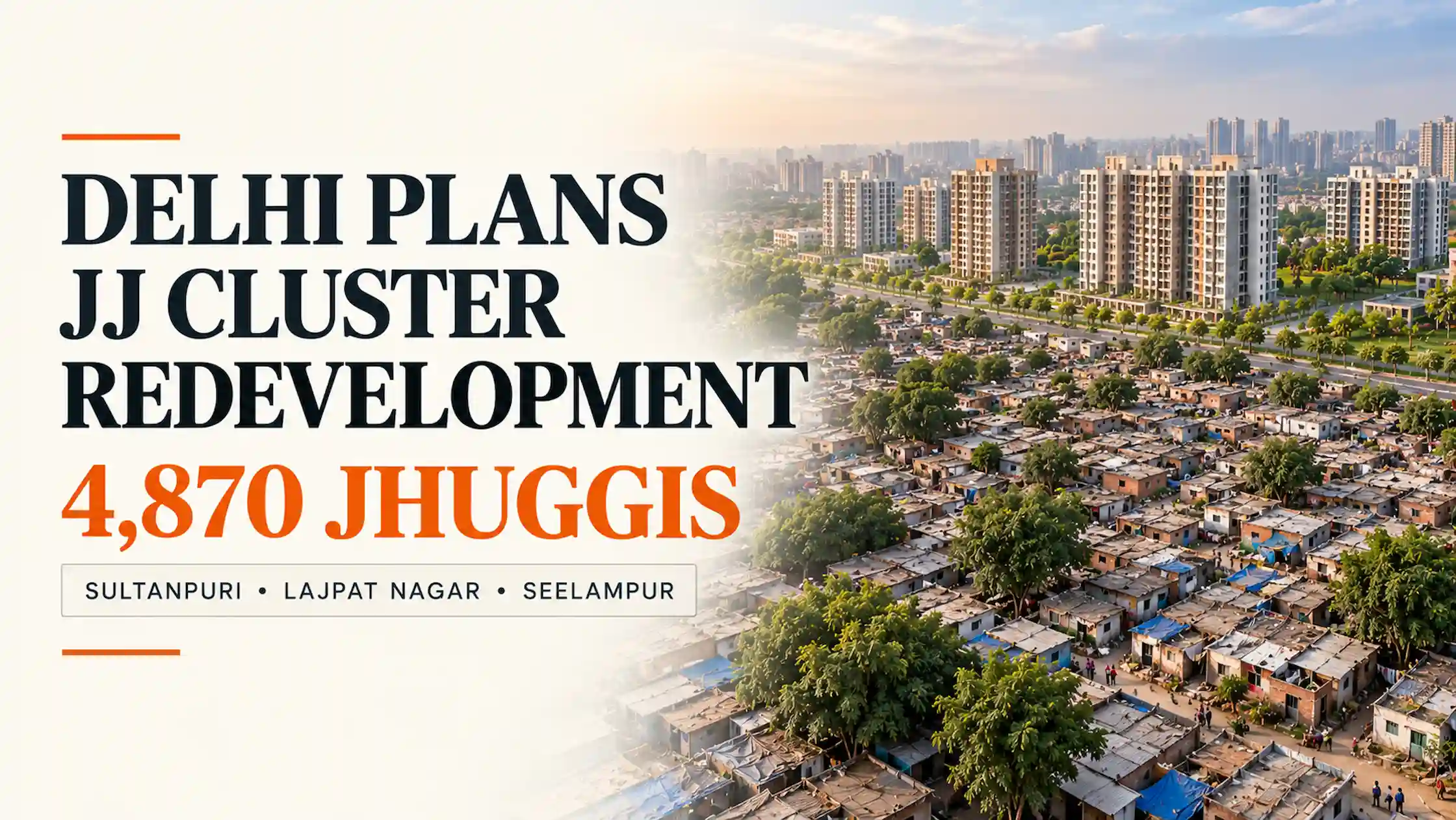
The Delhi Urban Shelter Improvement Board (DUSIB) has initiated the process to assess the redevelopment of 4,870 jhuggis across Seelampur, Sultanpuri and Lajpat Nagar. The proposed projects will initially undergo feasibility studies and developer-selection procedures before any construction decision is taken.
DUSIB has invited proposals to appoint transaction advisers for the three locations. The advisers will assess whether redevelopment is technically and financially viable, examine the approvals required and help the board structure the process for selecting private developers.
The proposed projects cover 1,997 jhuggis in Sultanpuri, 1,630 in Lajpat Nagar and 1,243 in Seelampur. The consultancy exercise is expected to take 16 weeks, according to reports on the requests for proposals issued on October 15.
The initiative forms part of the wider effort to improve housing conditions in Delhi’s existing settlements. However, the current stage concerns project assessment and preparation. It does not mean construction has begun or that residents have received a confirmed relocation or possession date.
Delhi JJ Cluster Redevelopment: Location-Wise Details
The three proposed projects account for a combined 4,870 jhuggis.
|
Location |
Number of jhuggis |
|
Sultanpuri |
1,997 |
|
Lajpat Nagar |
1,630 |
|
Seelampur |
1,243 |
|
Total |
4,870 |
The figures indicate the scale of the proposed exercise. The final number of rehabilitation homes, their design and the project layouts will depend on feasibility studies and subsequent approvals.
The three locations also differ in their surrounding development patterns, access to public transport, land-use conditions and redevelopment potential. These factors will need to be assessed separately rather than assuming that one project structure will suit all three sites.
What Will the Transaction Adviser Do?
The appointment of a transaction adviser is an early step in preparing a public-private partnership project. The adviser is expected to assess the proposed redevelopment, examine the applicable regulatory requirements and support the developer-selection process.
The work may involve reviewing existing site conditions, land-use rules, infrastructure requirements, construction costs and the financial assumptions underpinning the projects. The findings will help establish whether redevelopment can proceed on workable terms while providing rehabilitation housing to eligible residents.
The consultancy is expected to take up to 16 weeks. This is the anticipated duration of the advisory exercise, not a construction deadline or a commitment to hand over homes within that period.
The projects are being pursued separately for Sultanpuri, Lajpat Nagar and Seelampur. This would allow the feasibility and financial viability of each location to be examined according to its specific conditions.
Why Is Delhi Pursuing In-Situ Rehabilitation?
In-situ rehabilitation aims to provide eligible residents with formal housing at their existing location or nearby, rather than moving households to distant parts of the city by default.
For many residents, proximity to employment, schools, healthcare and public transport is an important part of housing security. Workers in domestic services, retail, construction and other occupations may depend on being able to reach workplaces across the city without taking on higher commuting costs.
The location of a rehabilitation home can therefore affect household expenses, travel time and access to essential services. Redevelopment close to an existing settlement may reduce some of these disruptions, although the outcome depends on the design and implementation of each project.
Delhi’s wider planning framework will also shape how existing settlements and housing needs are addressed. The city’s long-term development priorities are relevant to the discussion around Delhi’s Master Plan 2047 and its implications for housing and real estate, particularly where redevelopment must be balanced with infrastructure capacity and land-use planning.
For residents, the quality of the eventual housing will matter as much as the location. Water supply, sanitation, electricity, drainage, access roads and maintenance of shared facilities will influence whether the new homes provide a lasting improvement in living conditions.
How Could the Public-Private Partnership Model Work?
Under a public-private partnership model, a government agency and a private developer participate in structuring and implementing a project. The precise arrangement depends on land conditions, applicable regulations, project economics and the terms approved by the authorities.
In some redevelopment models, the feasibility assessment examines whether the development potential of a site can help finance rehabilitation housing. Any such arrangement would need to comply with applicable land-use rules, building regulations and the conditions approved for the project.
The financial viability of a redevelopment proposal depends on several factors, including permissible building density, construction costs, infrastructure requirements, market demand and the number of homes to be delivered to eligible residents.
DUSIB’s transaction advisers are expected to examine these considerations before the projects move further through the process. The assessment can help determine the appropriate project structure and the terms on which developers may be invited to participate.
Delhi has also considered redevelopment in other parts of its housing stock. For example, the Delhi Development Authority’s move to allow redevelopment of old two-storey dwelling units reflects another part of the city’s broader housing renewal discussion. The policy and beneficiary arrangements are different, but both cases illustrate how redevelopment depends on planning rules, project design and implementation.
No final developer, approved layout or construction schedule for the three JJ cluster projects has been confirmed in the information available at this stage.
What Will Determine Eligibility for Rehabilitation?
Identifying a JJ cluster for redevelopment and determining which households qualify for rehabilitation are separate processes.
Residents will need clear information about eligibility criteria, the documents required and the procedure for verifying household details. Where eligibility depends on a cut-off date or settlement survey, the authorities will need to explain how those rules will be applied.
The wider debate around affordable housing in Delhi also includes government-supported housing programmes. AquireAcres has covered the Pradhan Mantri Awas Yojana and its affordable housing framework, which provides useful background on the broader policy context. However, the eligibility requirements for a JJ cluster redevelopment project should not be assumed to be the same as those for PMAY.
Until project-specific criteria and verified beneficiary lists are published, residents should not assume that every household in a settlement will automatically qualify for a rehabilitation flat.
A transparent verification process will be important in addressing incomplete documents, disputed claims and errors in household records. Residents will also need information on how to check their status and raise objections if their details are recorded incorrectly.
What Residents Should Watch for Next
The next major step is the appointment of transaction advisers and completion of the feasibility exercise. Its findings should help establish whether the proposals can proceed, what approvals are needed and how developers may be selected.
Residents should look for official updates on the following:
- Project feasibility: Whether redevelopment is found viable at each location.
- Planning approvals: Applicable land-use rules, building permissions and other clearances.
- Developer selection: Procurement terms and the identity of any developer appointed.
- Rehabilitation design: Proposed home sizes, layouts and access to basic services.
- Eligibility verification: The rules and documents that determine which households qualify.
- Implementation schedule: Any confirmed timeline for construction, temporary arrangements, relocation if required and possession.
These details will determine how the projects affect existing residents. Until they are published, it is too early to draw conclusions about when rehabilitation homes will be delivered.
What the Plan Means for Delhi’s Housing Policy
The three proposed projects add to the wider discussion about improving housing conditions in established JJ clusters while managing land constraints in a densely developed city.
The approach seeks to combine better housing for eligible residents with private-sector participation in redevelopment. Balancing these objectives will require careful planning. The financial model must support implementation without weakening commitments to residents.
The eventual outcome will depend on more than appointing advisers or selecting developers. The projects will need clear eligibility rules, workable financing, adequate infrastructure and safeguards for households during implementation.
For now, DUSIB’s move marks the beginning of a feasibility and planning process covering 4,870 jhuggis across Sultanpuri, Lajpat Nagar and Seelampur. The next phase will determine whether the proposals can progress to approved redevelopment projects.
The immediate milestone is the feasibility exercise, not the start of construction. Further details on approved plans, eligible beneficiaries and delivery schedules will be needed before residents can assess what the proposals mean for their homes.




Ans 1. The Delhi Urban Shelter Improvement Board (DUSIB) is assessing redevelopment of three jhuggi-jhopri (JJ) clusters in Sultanpuri, Lajpat Nagar and Seelampur.
Ans 2. The proposed plan covers 4,870 jhuggis: 1,997 in Sultanpuri, 1,630 in Lajpat Nagar and 1,243 in Seelampur.
Ans 3. No construction commencement has been confirmed. The process is at the feasibility assessment and developer-selection preparation stage.
Ans 4. DUSIB plans to appoint transaction advisers to assess project feasibility, help secure approvals, structure the projects and support the selection of private developers.
Ans 5. The consultancy is expected to be completed within 16 weeks, according to reports on DUSIB’s proposal. This is not a confirmed construction or completion deadline.
Ans 6. The initiative aims to assess the feasibility of rehabilitating residents and improving housing through redevelopment, with private-sector participation being considered as part of the project structure.