
✦ AI Summary
Table of Content
▲- What is UP Awas Vikas?
- What kind of properties can buyers find?
- Where does UP Awas Vikas have projects?
- How are UP Awas Vikas properties allotted?
- What should you check before applying?
- Is a UP Awas Vikas property cheaper?
- Why is UP Awas Vikas expanding its plans?
- What should homebuyers keep in mind?
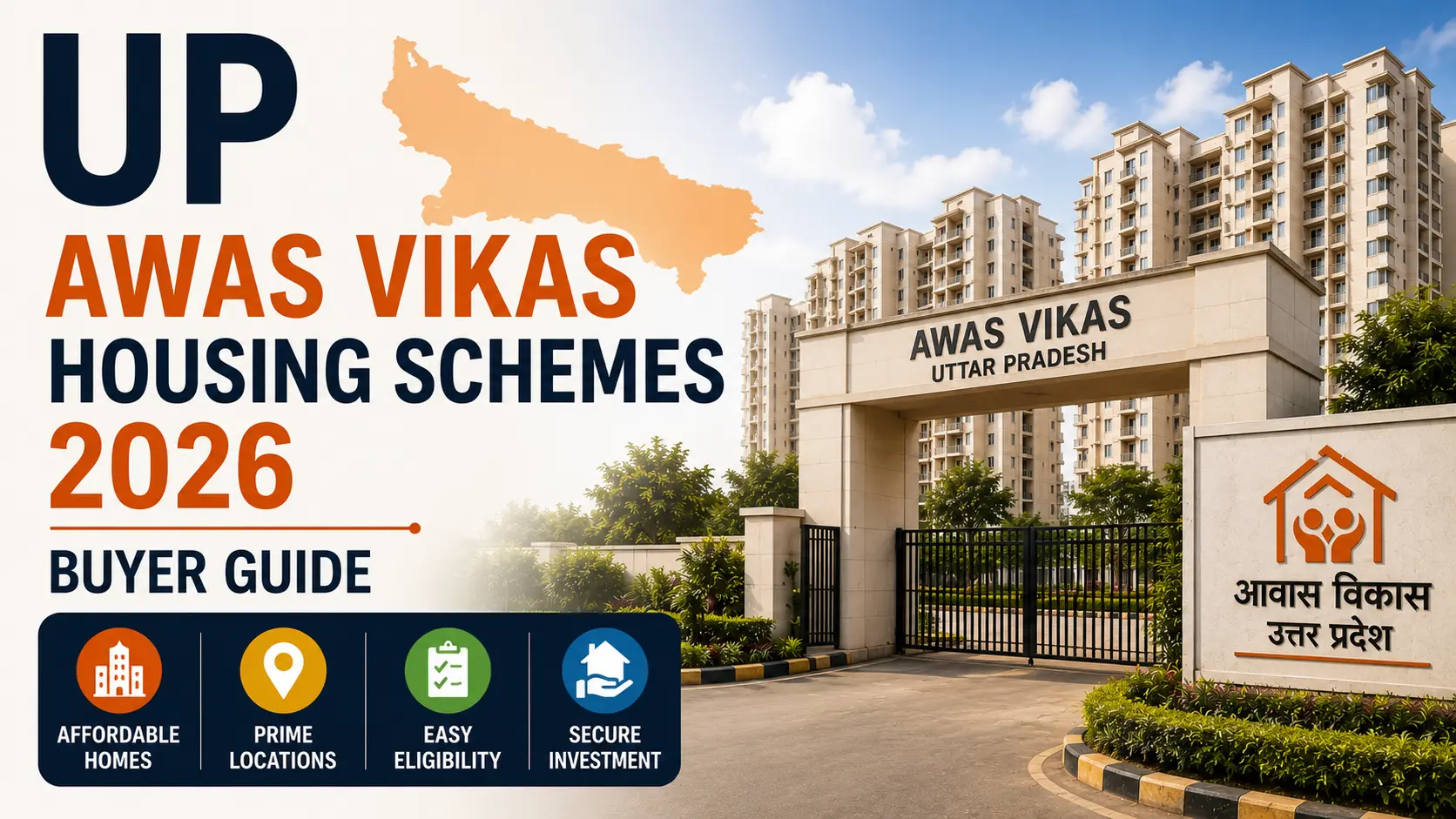
For a homebuyer in Uttar Pradesh, a property offered by the Uttar Pradesh Awas Evam Vikas Parishad (UPAVP) can look attractive for a fairly simple reason: the project comes through a government housing agency.
But that does not mean every Awas Vikas property is automatically the right deal.
The housing board has residential projects across Uttar Pradesh, ranging from flats and plots to houses and other properties. The terms, prices and allotment process can vary considerably between schemes. Buyers therefore need to look at the individual project rather than treating all UP Awas Vikas properties as one category.
UPAVP's current property listings include residential units under schemes such as the Majhola Scheme in Moradabad. Its projects and developments also cover cities including Lucknow, Meerut, Ghaziabad and Agra.
What is UP Awas Vikas?
The Uttar Pradesh Awas Evam Vikas Parishad is the state's housing development authority. Over the years, it has developed residential colonies and housing projects in several parts of the state.
Its role has changed with the housing market.
Along with conventional residential development, the authority is now involved in land acquisition, redevelopment and plans for newer forms of housing and urban infrastructure.
That makes UP Awas Vikas relevant not only to people looking for an affordable flat but also to buyers searching for plots or homes in established and emerging parts of Uttar Pradesh.
What kind of properties can buyers find?
There is no single property type under UP Awas Vikas.
Depending on the scheme, buyers may find flats, residential plots, houses and properties offered through auction.
Income categories can also differ. Some schemes are designed around EWS and LIG housing, while others include MIG and HIG properties.
This is one reason buyers should read the individual scheme brochure carefully. The price, size, location and eligibility conditions can be very different from one project to another.
In Lucknow, for example, the housing board has also proposed a ready-made villa project, which would represent a departure from some of its more traditional housing formats.
Where does UP Awas Vikas have projects?
UPAVP has developed housing in several major cities of Uttar Pradesh.
Lucknow is one of its better-known markets, with developments such as Vrindavan Yojana and Awadh Vihar associated with the housing board.
There are also projects and registered developments in cities such as Meerut, Moradabad, Ghaziabad and Agra.
The presence of UPAVP in a city, however, should not be taken as a guarantee about a particular property.
The actual project still needs to be checked for its location, development status, approvals and documentation.
For projects falling within the scope of RERA, buyers can also check the relevant UP-RERA records. A step-by-step check of a project's registration can help buyers verify the developer, approvals and other project details..
How are UP Awas Vikas properties allotted?
This is another area where buyers should pay attention.
Properties are not necessarily sold through one common system.
Depending on the scheme, UPAVP properties may be offered through a draw or lottery, first-come-first-served basis or e-auction.
The difference matters.
Someone applying for a lottery-based flat has a very different process from a buyer trying to purchase an available property directly.
The housing board has also used schemes to sell existing inventory. In one recent initiative, the authority generated significant bookings through the sale of available properties.
So before making an application, buyers should first establish exactly how that particular property is being offered.
What should you check before applying?
The scheme brochure should be the starting point. The scheme brochure should be the starting point. But buyers should also know which property documents need to be checked before buying.
It should tell you what is being sold, how much it costs and what conditions apply.
But buyers should go a little further.
Check whether the quoted price includes all applicable charges. Look at the payment schedule and understand what happens if an instalment is delayed. If the property is under construction, check the expected possession timeline.
It is equally important to understand what you are actually buying.
A plot, an under-construction flat and a ready-to-move-in house carry very different risks.
For applicable projects, checking the project's UP-RERA registration, promoter details and available project information can provide another layer of due diligence.
Is a UP Awas Vikas property cheaper?
Not necessarily.
This is probably one of the easiest assumptions to make and one of the least useful.
A government housing project may offer properties at different price points, but whether a particular property is affordable depends on its location, size, specifications and total acquisition cost.
A flat in an established part of Lucknow cannot be meaningfully compared with a plot on the outskirts of another city simply because both are being offered by UP Awas Vikas.
The final cost also needs to account for registration and other applicable charges.
That is why buyers should compare the total cost of ownership, rather than the basic advertised price.
Why is UP Awas Vikas expanding its plans?
The housing board is dealing with a much larger urbanisation story in Uttar Pradesh.
In April 2026, its board approved a ₹4,173.65 crore budget for 2026–27, along with land acquisition proposals worth more than ₹4,500 crore for Varanasi and Mau. The board also approved measures aimed at attracting private investment into areas such as IT parks and commercial infrastructure.
The developments suggest that UPAVP's role is moving beyond simply building residential colonies.
As cities grow, land development, housing and supporting infrastructure increasingly have to be planned together.
For people looking to buy, that could mean more options over time. It also means there may be a wider range of locations and property formats to compare.
What should homebuyers keep in mind?
The safest approach is to treat every UP Awas Vikas scheme as a separate purchase decision.
Check the location first. Then look at the property itself, the total price and the payment terms. If it is an ongoing project, understand the construction and possession position.
Most importantly, don't skip the paperwork because a government housing authority is offering the property.
Ownership documents, approvals, scheme conditions and, where applicable, RERA records still deserve a careful look. Buyers should also understand how property registration works in Uttar Pradesh, particularly the documents, stamp duty and registration steps involved.
For a buyer, the name of the housing authority may provide some comfort. But the property still has to work financially and practically for the person buying it.
UP Awas Vikas can open the door to a range of housing opportunities across Uttar Pradesh. The smarter approach is to decide on the property first and the brochure, paperwork and numbers should all agree before you commit.

Ans 1. Yes. UP Awas Vikas Parishad is the Uttar Pradesh government's housing development authority and has developed residential projects across the state.
Ans 2. Check the official UPAVP website for current schemes, property availability, application notices and scheme-specific conditions. Third-party property listings should be treated as supplementary information.
Ans 3. Yes. Depending on the scheme, UPAVP can offer flats, residential plots, houses and other properties.
Ans 4. Yes, potentially. The allotment method depends on the particular scheme. Some properties may be offered through a draw, while others can be available through FCFS or auction
Ans 5. Where RERA applies to the project, checking its UP-RERA registration and available project information is advisable. It can help buyers understand the project's registered details and status.
Ans 6. No. Prices depend on the location, size, property type and scheme. Buyers should compare the complete cost with similar properties nearby rather than assuming that government-developed housing will always be cheaper