
Table of Content
▲
Delhi Metro Phase 5 is set to redefine urban commuting in the National Capital Region (NCR), adding crucial corridors and enhancing last-mile connectivity. With the city expanding rapidly, the Delhi Metro Rail Corporation (DMRC) has envisioned Phase 5 to connect underserved areas, improve airport accessibility, and reduce travel times. This new phase includes three approved corridors under Phase 5A, spanning a total of 16 km, and promises significant benefits for commuters and real estate development along its routes.
What is Delhi Metro Phase 5?
Delhi Metro Phase 5 is the next major expansion of the city’s metro network, designed to improve connectivity across central, north, and south Delhi. Approved on December 24, 2025, by the Union Cabinet, Phase 5A is being developed at an estimated cost of Rs 12,014.91 crore. Funding for the project will come from the Central government, the Delhi government, and international agencies.
The primary objectives of Delhi Metro Phase 5 include:
- Enhancing last-mile connectivity for commuters.
- Connecting central, south Delhi, and airport terminals.
- Reducing vehicular traffic and easing congestion on major roads.
- Supporting the Central Vista redevelopment project.
Also Read: DDA’s Mega E-Auction: 150 Plots and Baansera Cafe Up for Bids
Delhi Metro Phase 5 Route Map
The Delhi Metro Phase 5 network consists of three new corridors under Phase 5A, designed to integrate seamlessly with the existing metro lines, including the Phase 4 extensions. These corridors will provide multiple interchange points and improve accessibility to key commercial and residential hubs.
Corridors under Phase 5A:
- R.K Ashram Marg to Indraprastha – 9.913 km
- Aerocity to IGD Airport T-1 – 2.263 km
- Tughlakabad to Kalindi Kunj – 3.9 km
For commuters, the interactive map of Delhi Metro Phase 5 can be accessed via the DMRC website Link.
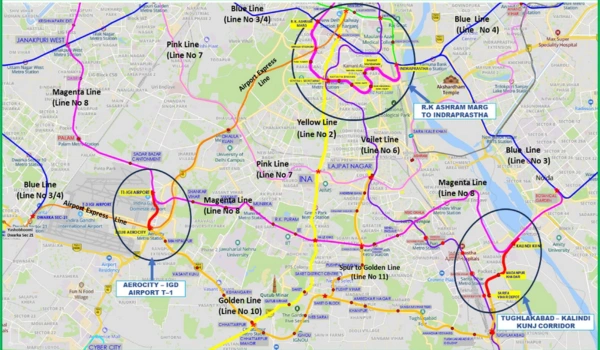
Approved Corridors of Delhi Metro Phase 5
Line 1: R.K Ashram Marg to Indraprastha
- Length: 9.913 km
- Stations:
- R.K Ashram Marg
- Shivaji Stadium
- Central Secretariat
- Kartavya Bhawan
- India Gate
- War Memorial – High Court
- Baroda House
- Bharat Mandapam
- Indraprastha
Key Highlights:
This line will connect west, north, and old Delhi to central Delhi, providing easier access to the Central Vista redevelopment area. The corridor will enhance commuter convenience for office-goers and visitors in the city center.
Line 2: Aerocity to IGD Airport T-1
- Length: 2.263 km
- Stations: Aerocity, IGD T-1
Key Highlights:
This short yet vital corridor ensures seamless connectivity to Terminal 1 of the Indira Gandhi International Airport. Commuters traveling from south Delhi neighborhoods such as Saket and Chattarpur will now have a direct metro link to the domestic airport.
Line 3: Tughlakabad to Kalindi Kunj
- Length: 3.9 km
- Stations: Sarita Vihar Depot, Madanpur Khadar, Kalindi Kunj
Key Highlights:
The corridor will improve access to south Delhi, connecting residential and commercial areas efficiently. Tughlakabad-Kalindi Kunj corridor is expected to ease commutes for thousands of daily passengers.
Delhi Metro Phase 5: Expected Completion Timeline
Phase 5A corridors are expected to be operational in stages over the next few years, integrating with Delhi Metro Phase 4 lines. The extension to Indraprastha and the airport terminals will particularly benefit commuters and reduce travel times by up to 30 minutes. Future Phase 5B expansions will cover additional corridors connecting other NCR regions.
Real Estate Impact of Delhi Metro Phase 5
The expansion of the Delhi Metro network under Phase 5 is likely to boost property demand along the new corridors. Areas around R.K Ashram Marg, Aerocity, and Tughlakabad are expected to see higher residential and commercial property appreciation.
Key Effects:
|
Locality |
Expected Price Appreciation |
Benefits |
|
Central Delhi |
5–10% |
Easier access to offices and government buildings |
|
South Delhi |
7–12% |
Faster commute to airport and business hubs |
|
Tughlakabad |
4–8% |
Enhanced connectivity for residential areas |
Investors looking for high ROI properties may find metro-adjacent developments particularly attractive.
Also Read: Premium Under-Construction Home Prices Surge in Noida, Mumbai, Gurugram & Bengaluru 2025
How Delhi Metro Phase 5 Will Ease Commuter Travel
The new corridors will reduce congestion on city roads, improve commute times, and offer multiple interchange points with existing lines. Multi-modal integration with buses and feeder services will further enhance the ease of travel for daily commuters. The Central Vista corridor, connecting key government offices, is expected to benefit around 60,000 office-goers and 200,000 visitors daily.
Conclusion
Delhi Metro Phase 5 represents a significant step in the city’s transportation infrastructure, promising faster travel, reduced congestion, and enhanced connectivity to the airport and central Delhi. With improved accessibility, the upcoming corridors will positively influence real estate, especially for residential and commercial developments. As Delhi Metro Phase 5 comes online, commuting in the NCR will become more efficient, convenient, and cost-effective.





Ans 1. Delhi Metro Phase 5 is a new metro expansion project in Delhi, aimed at improving city connectivity with three new approved corridors under Phase 5A.
Ans 2. R.K Ashram Marg to Indraprastha Aerocity to IGD Airport T-1 Tughlakabad to Kalindi Kunj
Ans 3. Phase 5A is expected to be operational in stages, starting from the next 2–3 years.
Ans 4. Yes, Phase 5 corridors will integrate with Phase 4 and existing metro lines, providing multiple interchange points.
Ans 5. Yes, the Aerocity to IGD Airport T-1 corridor will connect south Delhi to Terminal 1.
Ans 6. Yes, commuters can expect reductions of 20–30 minutes on key routes due to direct connectivity.