
✦ AI Summary
Table of Content
▲
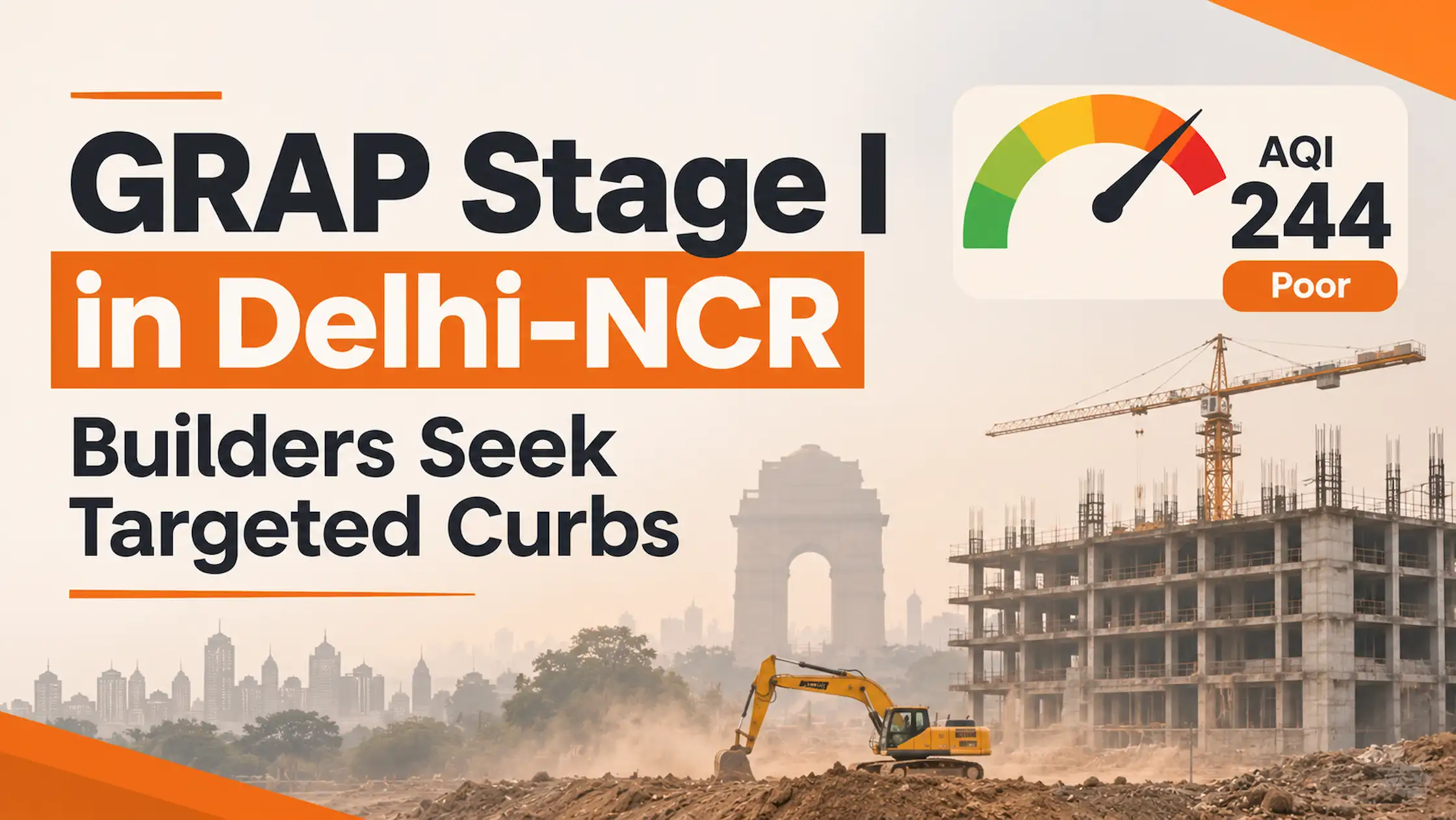
Delhi’s air slipped into the ‘poor’ category on Wednesday, prompting the Commission for Air Quality Management (CAQM) to invoke Stage I of the Graded Response Action Plan across the National Capital Region (NCR). For builders, the move means tighter enforcement of dust-control rules, not an automatic stop-work order.
Delhi’s Air Quality Index (AQI) stood at 179 on October 20, a ‘moderate’ reading. By 2 pm on October 21, it had climbed to 244. CAQM’s GRAP sub-committee met the same day and brought Stage I into effect immediately, citing forecasts from the India Meteorological Department (IMD) and the Indian Institute of Tropical Meteorology (IITM) that indicated poor air quality could persist.
On Thursday morning, pollution levels remained high. The government’s dashboard recorded an AQI of 299, close to the threshold for Stage II, while IQAir reported 242. Readings can vary by source and time, but both indicated continued air-quality concerns.
Real estate bodies have called for pollution controls that focus on dust at its source rather than imposing broad restrictions without considering individual sites. With housing, commercial and infrastructure projects spread across Delhi, Noida, Greater Noida, Ghaziabad, Gurugram and Faridabad, the implementation of these measures matters to the wider construction sector.
What changes on construction sites?
GRAP Stage I applies when the AQI falls between 201 and 300. It covers Delhi and the designated NCR districts in Haryana, Uttar Pradesh and Rajasthan. The emphasis is on stricter enforcement of existing pollution-control measures.
Reported measures include restrictions on the use of coal and firewood in tandoors, controls on diesel generator use, road sweeping and vehicle checks. Construction activity is one part of a broader set of pollution-control measures.
At construction and demolition sites, dust management remains a key requirement. Developers are expected to sprinkle water where required, cover stored construction materials and waste, and transport debris in covered vehicles. Pollution control boards and local authorities are responsible for inspections. Sites that fail to meet applicable requirements may face action under the relevant rules.
Delhi projects also face dust-portal registration requirements linked to building-plan approvals. The DPCC dust portal registration requirement for building plan approvals in Delhi sets out the compliance requirements relevant to construction activity.
Why builders want targeted restrictions
NAREDCO president Parveen Jain has called for construction sites to follow prescribed pollution-control measures, including water sprinkling, covering materials and proper debris management. He has also argued that restrictions should focus on activities that contribute significantly to pollution rather than apply blanket curbs without distinguishing between sites.
Developers say the way restrictions are enforced can affect project schedules and construction costs. Housing and infrastructure projects employ daily-wage workers, while homebuyers often plan their finances around expected possession dates. Restrictions that slow work for an extended period can affect all three groups.
The industry has also raised concerns about coordination across Delhi-NCR. Dust and emissions do not stop at state borders, and construction is not the only source of pollution. Builders argue that enforcement needs to be consistent across the region if restrictions are to deliver meaningful results.
Similar concerns arose during earlier, more severe pollution episodes. During GRAP Stage III restrictions, developers sought site-specific relief to limit construction curbs and avoid project delays in Delhi-NCR. The debate highlights the challenge of balancing pollution control with the need to keep construction activity moving.
Delhi’s winter plan is separate from GRAP
The Delhi government’s winter pollution plan is separate from the CAQM’s Stage I order.
In late September, Environment Minister Manjinder Singh Sirsa announced plans to restrict dust-generating demolition and outdoor civil construction from November 1 to January 31. A complete construction and demolition ban was also reported for December 10 to January 20. Vehicle curbs, revised office hours and work-from-home arrangements were among the other measures outlined in the plan.
These dates relate to Delhi’s separate winter measures. They should not be treated as restrictions introduced by the Stage I GRAP order or assumed to apply across the entire NCR. Developers and homebuyers should check the final notified orders for the activities covered, exemptions and implementation dates.
The distinction matters because GRAP restrictions change according to pollution levels, while separate government measures may have their own timelines and conditions. Project owners need to track the applicable orders rather than rely on a single summary of pollution restrictions.
What the restrictions mean for project schedules and buyers
At sites that comply with applicable requirements, Stage I does not automatically stop construction. Its immediate effect is to reinforce pollution-control measures. The obligations for each project depend on the rules and directions in force, making current CAQM and local authority orders the most relevant reference for developers.
The greater risk to project schedules comes if air quality worsens and stricter GRAP stages are invoked. Stage II applies when the AQI is between 301 and 400, while Stages III and IV cover more severe pollution levels. Depending on the stage and the applicable directions, construction and demolition activity may face tighter restrictions or bans.
Any delay in possession will depend on the project’s location, the type of work underway, the restrictions in force and how long they remain in place. Projects will not necessarily be affected equally. A slowdown can also affect daily-wage workers whose earnings depend on construction activity.
For homebuyers awaiting possession, the practical step is to ask the developer whether current restrictions have affected work at the site and whether the expected handover timeline has changed. A rise in the AQI alone does not establish that a particular project will be delayed.
Air pollution is also influencing conversations around residential amenities and indoor air quality. Clean-air and wellness-focused homes in Delhi-NCR reflect another aspect of how persistent pollution is shaping housing preferences.
The CAQM sub-committee said it would review the situation periodically, with further decisions guided by Delhi’s AQI and forecasts from the IMD and IITM. For the real estate sector, the immediate priority is to comply with the measures currently in force while preparing for possible changes if pollution levels rise.




Ans 1. It is the first stage of the Graded Response Action Plan, used when Delhi’s AQI is in the ‘poor’ range of 201 to 300. CAQM invoked it across the NCR on October 21, 2026, after Delhi’s AQI reached 244.
Ans 2. No. Stage I tightens enforcement of existing norms, including dust control at construction and demolition sites. In earlier winters, bans on non-essential construction came only under the later stages.
Ans 3. Sites are expected to control dust by sprinkling water, covering stored material and waste, and moving debris in covered vehicles. Check CAQM’s current GRAP schedule and your local authority’s directions for the exact list.
Ans 4. Delhi and the NCR areas of Haryana, Uttar Pradesh and Rajasthan.
Ans 5. Stage II applies when the AQI is between 301 and 400, the ‘very poor’ range.
Ans 6. Stage I alone does not stop work at sites that follow the norms, so a delay is not a direct result of it. Delays become more likely only if later stages or Delhi’s winter dates restrict work for long periods. Buyers can ask their developer how the site is handling the rules.